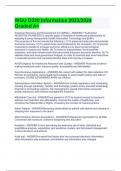
WGU D220 Informatics 2023/2024 Graded A+
American Recovery and Reinvestment Act (ARRA) - ANSWER-**Authorized INCENTIVE PAYMENTS to specific types of hospitals & healthcare professionals for adopting & using interoperable Health Information Technology and EHR's. The purposes of this act include the following: (1) To preserve/create jobs and promote economic recovery. (2) To assist those most impacted by the recession. (3) To provide investments needed to increase economic efficiency by spurring technological advances in science and health. (4) To invest in transportation, environmental protection, and other infrastructure that will provide long-term economic benefits. (5) To stabilize state and local government budgets, in order to minimize and avoid reductions in essential services and counterproductive state and local tax increases. AHQR (Agency for Healthcare Research and Quality) - ANSWER-Produced evidence making healthcare safer, improve quality, accessibility and affordability Asynchoronous Applications - ANSWER-No contact with patient for data collection. EX: Remote pt monitoring, Using health technologies to share health metrics and data w/ providers. STORE & FORWARD APPS (ex: photos) Administrative Information System - ANSWER-can include registration and scheduling; tracking through admission, transfer and discharge; patient acuity and staff scheduling; financial or accounting systems; risk management; payroll and human resources; quality assurance; and contract management functions. Affordable Care Act - ANSWER-law passed in 2010 to expand access to insurance, address cost reduction and affordability, improve the quality of healthcare, and introduce the Patient's Bill of Rights, increasing the number of insured persons. Alarm Fatique - ANSWER-Becoming desensitized to patient care alarms and missing or delaying their response to the alarm. ANA (American Nurses Association) - ANSWER-Professional organization for all RNs. Concerned with licensure, collective bargaining and education Analytics - ANSWER-A term describing the extensive use of data, statistical and quantitative analysis, explanatory and predictive models, and fact-based management to drive decisions and actions. Audit trail - ANSWER-a report that traces who has accessed electronic information, when information was accessed, and whether any information was changed Authentication - ANSWER-A method for confirming users' identities Authorization - ANSWER-The process of giving someone permission to do or have something Barcode Scanning Technology - ANSWER-Scans drug and patients wristband to verify medication order, inventory control, + pt identification, correct med admin Big Data - ANSWER-a collection of large, complex data sets, including structured and unstructured data, which cannot be analyzed without the use of information technology Bioinformatics - ANSWER-application of mathematics and computer science to store, retrieve, and analyze biological data Biometrics - ANSWER-the identification of a user based on a physical characteristic, such as a fingerprint, iris, face, voice, or handwriting Business Continuity Plan - ANSWER-A plan for how an organization will recover and restore partially or completely interrupted critical function(s) within a predetermined time after a disaster or extended disruption Business Intelligence - ANSWER-Information collected from multiple sources such as suppliers, customers, competitors, partners, and industries that analyzes patterns, trends, and relationships for strategic decision making Change Control Board (CCB) - ANSWER-A committee that evaluates the worthiness of a proposed change and either approves or rejects the proposed change. Chief Nursing Officer (CNO) - ANSWER-The senior manager (usually a registered nurse with advanced education and extensive experience) responsible for administering patient care services Clinical Care Classification (CCC) - ANSWER-"Two interrelated taxonomies, the CCC of Nursing Diagnoses and Outcomes and the CCC of Nursing Interventions and Actions, that provide a standardized framework for documenting patient care in hospitals, home health agencies, ambulatory care clinics, and other healthcare settings" CPOE (Computerized Physician Order Entry) - ANSWER-An order entry and decision support system that allows direct entry of orders and immediately shared w/ others Change Management - ANSWER-The process, tools and techniques that help people implement changes to achieve a desired outcome. (Supports the adoption of a medication Administration System) Change Control - ANSWER-Helps to prioritize limited resources and ensures system standards are upheld. Connected health - ANSWER-a model of health care delivery using technology to provide services including information and education. Technology assisted healthcare is delivered between at least 2 points involving either asynchronous or synchronous exchange. Consumer Health Informatics - ANSWER-Use of electronic info & communication to improve medical outcomes & healthcare decision making from pt perspective. Patient view and structures and process that enable consumer to manage their own care. Clinical Research Informatics - ANSWER-Discovery and management of new knowledge pertinent to health and disease from clinical trials via secondary data use. C-CDA (Consolidated Clinical Document Architecture) - ANSWER-Allows interoperability of health information exchange between to hospitals. 21st Century Cures Act - ANSWER-designed to help accelerate medical product development and bring new innovations and advances to patients who need them faster and more efficiently. Provisions that will improve workflow & exchange of electronic info. ONC (responsible for implementing) seamless & secure access, exchange and use of electronic health info. 5 rights of clinical decision support - ANSWER-Right information Right person Right intervention format Right channel Right time in workflow Clinical Informatics - ANSWER-concentration on the delivery of timely, safe, effective , EB and pt centered care. C - ANSWER- Clinical Decision Support System - ANSWER-A special subcategory of clinical information systems that is designed to help healthcare providers make knowledge-based clinical decisions Ex: Alerts for abnormal VS, labs results, med contraindications, screenings, standing orders, reminders in EHR ect... Clinical Information Systems - ANSWER-Ex: May be specific to certain departments. Lab, radiology, pharm(Both), or particular pt population. Functions may include order entry, results reporting, scheduling and documentation. Lg computerized database used to access the pt data that are needed to plan, implement and evaluate care. Clinical Nurse Specialist - ANSWER-Expert clinician in a specialized area of practice who engages in research and helps direct practice change. clinical terminology - ANSWER-standardized terms and their synonyms used to record pt data with sufficient detail to support clinical care, decision support, outcomes research, and quality improvement, flow sheets, vital signs, assessments and nursing notes. Computer Literacy - ANSWER-The ability to use computers for basic tasks, such as developing documents, sending emails and searching the internet for information. Confidentiality - ANSWER-Relationship has been established where private info shared but NOT disclosed w/out permission configurability - ANSWER-Refers to the extent that a given software product can be adapted or changed to meet a user's preference Contextual Inquiry - ANSWER-involves studying customers' use of a product at their place of work Focusing on users point of view. CCR (Continuity of Care Record) - ANSWER-Snapshot/standardized summary of the most relevant and timely health information about pt and shared to a physician who does not have access to pts EHR. Continuous Quality Improvement (CQI) - ANSWER-Continuous monitoring of performance and supports audit capability also known as QUALITY ASSURANCE SYSTEM Critical Care Information System - ANSWER-Integrates captured physiological data w/ practitioner documentation and clinical data management functions, as well as access and communication w/ remote experts. Data - ANSWER-Facts, figures, and other evidence gathered through observations. Database - ANSWER-A collection of data organized in a manner that allows access, retrieval, and use of that data Data cleansing/scrubbing - ANSWER-A process that weeds out and fixes or discards inconsistent, incorrect, or incomplete information Data Governance - ANSWER-refers to the overall management of the availability, usability, integrity, and security of company data Data Integrity - ANSWER-The correctness of data after processing, storage or transmission. Ability to store, retrieve, correct and complete data are available to authorized users Data Mining - ANSWER-the application of statistical techniques to find patterns and relationships among data for classification and prediction using software. Data Analysis - ANSWER-processing of data that identifies trends and patterns of relationships Data Warehousing - ANSWER-Powerful method of managing and analyzing data DICOM (Digital Imaging and Communications in Medicine) - ANSWER-Transmits digital imaging (DICOM & HL7 support standardization in health care data DIKW theory - ANSWER-Data, Information, Knowledge, Wisdom (data is most discrete) Data=pt monitoring, labs, diagnostic systems (CT scans) Information=Clinical Info systems, & DSS (alerts/reminders) Knowledge=Lg databases (med articles) & Artificial Intelligence Data Modeling - ANSWER-the process of determining the users' information needs and identifying relationships among the data to support processes for an info system (key step in design of EHR) DSS (decision support system) - ANSWER-an interactive, flexible, computerized information system that enables managers to obtain and manipulate information as they are making decisions r/t patient care device integration - ANSWER-Capturing data from patient monitors and anesthesia machines, and filing them directly to a patient's chart in EHR. Ex: entering VS, cardiac monitor download data into EHR Disease Registries - ANSWER-collections of secondary data related to patients with a specific diagnosis, condition, or procedure. disruptive innovation - ANSWER-a process by which a product or service takes root initially in simple applications at the bottom of a market and then relentlessly moves up market, eventually displacing established competitors Dissemination - ANSWER-the act of spreading widely or scattering data including research knowledge. Doctorate of nursing practice (DNP) - ANSWER-degree w/ emphasis on EBP, quality improvement and system leadership EHR system - ANSWER-3 elements: Data, Info, Knowledge. Decrease med errors, increase provider documentation. Function ex: Bar Code Admin. EMR (electronic medical record) - ANSWER-a record of one episode of care, source data for EHR, Brings together diagnositc & Tx info in a specific healthcare setting. Ergonomics - ANSWER-The study of workplace equipment design or how to arrange and design devices, machines, or workspace so that people and things interact safely and most efficiently. EHR - ANSWER-Pt data stored in electronic form(collection of pt healthcare data) **Successful if pt needs met PHR (personal health record) - ANSWER-Lifelong tool for managing health info, controlled by pt - data can be provided by MD or pharmacy. (conditions, allergies, meds, surgeries) Barriers: Poor or no internet, poorly designed apps, limited clinical integration Predictors: Awareness of PHR's, ease of access, personal motivation, increased levels of education and health literacy. emerging trends - ANSWER-• Secondary data • Technology-based data management • Digital information acquisition and retrieval • International client base • Information management (patient safety & error reduction) EBP (evidence based practice) - ANSWER-Using current best evidence for pt care decision in order to improve pt outcomes (found in standing orders) Ex: sepsis protocols & CDS Expert Systems - ANSWER-Type of CDS/DDS but does NOT need human intervention (artificial intelligence) Ex: Personal Insulin Pump EMRAM (Electronic Medical Record Analytical Model) - ANSWER-Measures clinical outcomes, pt engagement & clinical use of EMR technology to strengthen organizational performance & health outcomes across pt populations "Basically, evaluates Health Information System" feature creep - ANSWER-occurs when developers add extra features that were not part of the initial requirements Finacial system - ANSWER-uses pt demographic data and insurance info to charge for services & reimbursment Functional Testing - ANSWER-Final process in Project Management Phase 2 (planning) that ensures the innovation works as designed. Fish boning - ANSWER-Cause/effect diagram, can help in brainstorming to identify possible causes of a prob. Firewalls - ANSWER-hardware, software, or both designed to prevent unauthorized persons from accessing electronic information, while allowing authorized communication. Gantt Chart - ANSWER-A time and activity bar chart that is used for planning, managing, and controlling major programs that have a distinct beginning and end.(used for a glance at management) Gap Analysis - ANSWER-a type of analysis that compares the differences between the consumer's expectations about and experiences with a service based on dimensions of service quality (Planning) Go Live - ANSWER-the official time and date that the facility begins using the new system (Implementation Phase) HIE (Health Information Exchange) - ANSWER-Electronic sharing of pt info (demographic data, allergies, diagnostic tests, and other revelant data between providers, specialists, hospitals, and insurance companies. HIS Health Information System - ANSWER-Broad term used to describe administrative and clinical systems to streamline work flow processes efficiency. Hardware/software dedicated to the collection, storage, processing, retrieval and communication of patient care info. healthcare terminology standards - ANSWER-designed to enable and support widespread interoperability among healthcare software applications for the purpose of sharing information HIPAA (Health Insurance Portability and Accountability Act) - ANSWER-Kennedy Kassebaum Bill, Federal legislation to protect client records & mandate that all electronic transactions included only HIPAA compliant codes. Sets nation standards of PHI, legal protection of PHI. (signing in devices requires encryption) HIT - Health Information Technology - ANSWER-Technology that is used to record, store, and manage patient healthcare information. Ex: CDS, CPOE, EMR, EHR, PHR, Telehealth, E-scribe National & Global implications Health literacy definition - ANSWER-a person's capacity to learn about and understand basic health information and services, and to use these resources to promote one's health and wellness HIS (Hospital Information System) - ANSWER-What is the name of the computer system that tracks admission and discharge information, diagnostic and treatment services, pharmaceutical and equipment information, and billing information? Advantages: Better communication, decreased errors & better access to info. HITECH (Health Information Technology for Economic and Clinical Health Act) - ANSWER-2009 ARRA includes HITECH - promote adoption and meaningful use to HIT. Goal: Improve quality care, Pt safety, Decrease costs by using meaningful use *Improves Population Health Outcome* HL7 (Health Level 7) - ANSWER-Acronym used to refer a standard of interoperability and exchange of clinical data (HL7 & DICOM-Standardization) HIMSS Healthcare Information & Management Systems Society - ANSWER-formal group of healthcare organizations that seek to improve delivery of healthcare by advancing technology & data management. *work almost exclusively w/ data *They protect & handle pt data of all kinds (diagnosis, symptoms, test results, med hx, procedures) *They ensure info is accurate, accessible, secure and of high quality *Cause-based, Nonprofit, Global organization focused on better health through info & tech. Health Informatics Management - ANSWER-focus on info technology needed to store and retrieve pt data accurately, securely and management of the people & processes. HIE forms - ANSWER-Direct - send/recieve secure info electronically between providers ex: immunization data, quality measures sent to Medicaide/Medicare Query - find & request info, often used for unplanned care (ER, pregnancy) Consumer mediated - pts to aggregate and control the use of health info among providers (correcting info, tracking their health, providing providers w/ info) Informatics - ANSWER-the science and art of turning data into information *Interdisciplinary field Data to info, Info to knowledge, Knowledge to wisdom Implementation Science - ANSWER-study how interventions, which have been shown to be effective in one setting, can be applied to sustain improvements to population health Information Epidemiology - ANSWER-science of distribution of information in an electronic format w/ te ultimate aim to inform public health and public policy Informatics Competencies - ANSWER-the ability to perform the tasks associated w/ informatics information - ANSWER-A continuum of progressively developing and clustered data. Collection of data that has been interpreted & examined for patterns and structures information literacy - ANSWER-the ability to figure out the type of information you need, find that information, evaluate it, and properly use it * Ability to read and understand works/numbers and ability to recognize when info is needed. Information System - ANSWER-a set of hardware, software, data, people, and procedures that work together to produce information "Data Collection" Information Technology (IT) - ANSWER-Transmit Data Ex: EHR, CDST (clinical decision support tool) information science - ANSWER-Primarily focused on input processing output and feedback through technology intergration 5 rights of Informatics - ANSWER-Right - Information Person Intervention Channel Time in workflow Informatics Innovator - ANSWER-Conducts information and RESEARCH & generate THEORY & have advanced understanding in info management & computer technology ICD-10 - ANSWER-Used to classify mortality and morbidity data from inpatient/outpatient records, used for reimbursement Integration - ANSWER-Process of two systems exchanging data in a way that is seamless to end user. Interoperability - ANSWER-Ability of 2 entities, human/machine to exchange & predictably use data/info while retaining original meaning of data Ex: Dr-Dr, Hosp-Hosp(C-CDA), escript-pharm Interface - ANSWER-Bridge/connector to send info from 2 different systems interoperable systems - ANSWER-Expected outcomes=error reduction, improved revenue, increased communication. Systems share limited processes and data Information Security - ANSWER-Security Rule - Nation set of security standards health info in electronic form GOAL: Protect privacy while adopting new technologies to improve quality & efficiency of pt care "Need to KNow basis" The Joint Comission Standards - ANSWER-Standard The hospital respects the patient's right to receive information in a manner he or she understands. Elements of Performance The hospital provides language interpreting and translation services Note: Language interpreting options may include hospital employed language interpreters, contract interpreting services, or trained bilingual staff, and may be provided in person or via telephone or video. The hospital determines which translated documents and languages are needed based on its patient population. --do not have family or children translate! -don't have to have one there the whole time - but having one there for discharge would be very important Joint Commision - ANSWER-ACCREDIATATION key standard of information management: Protect & aggregate data, uniform language, teach info management (training), disaster and preparedness knowledge - ANSWER-Skills, experience, and expertise coupled with information and intelligence that creates a person's intellectual resources Knowledge Database - ANSWER-A database that not only manages raw data but also integrates them with information from various reference works knowledge translation - ANSWER-applying research to practice Knowledge Management (KM) - ANSWER-structed process for the generation, storage, distribution and application of both tacit(personal) knowledge and explicit (evidence) knowledge knowledge workers - ANSWER-Generate knowledge as product
Written for
- Institution
- WGU D220
- Course
- WGU D220
Document information
- Uploaded on
- May 20, 2023
- Number of pages
- 29
- Written in
- 2022/2023
- Type
- Exam (elaborations)
- Contains
- Questions & answers
Subjects
- wgu d220
- wgu d220 informatics
- admini
-
wgu d220 informatics 20232024 graded a
-
american recovery and reinvestment act arra
-
ahqr agency for healthcare research and quality
-
asynchoronous applications

Document also available in package deal