Astronomy 101 Exam 1 Questions with All Correct Answers
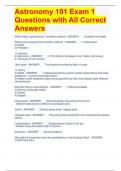
Astronomy 101 Exam 1 Questions with All Correct Answers What makes a good theory? (scientific method) - ANSWER Testable and Simple What is the process of the scientific method? - ANSWER 1) Observation 2) Model 3) Prediction 1) Universe 2) Astronomy - ANSWER 1) The totality of all space, time, matter, and energy 2) The study of the universe Light years - ANSWER The distance travelled by light in a year 1) Theory 2) Model - ANSWER 1) Ideas/assumptions used to explain observations and make predictions - must be continually tested 2) Makes further predictions about the properties/how they may change under different circumstances Scientific theory characteristics - ANSWER 1) Must be testable 2) Must be continually tested 3) Simple 4) Elegant Circumpolar - ANSWER Stars that always stay above the horizon - Different latitudes have different circumpolar stars Zenith - ANSWER Directly above head - highest point Celestial poles - ANSWER The points where the Earth's axis intersects the celestial sphere Constellations - ANSWER Configurations of stars in the sky - Zodiacs along the ecliptic path of the Sun Asterisms - ANSWER Obvious patterns Why didn't the ancients name the constellations in the Southern Sky? - ANSWER Couldn't see them Celestial equator - ANSWER Represents the intersection of Earth's equatorial plane with the celestial sphere Ecliptic - ANSWER The path of the sun through the sky - along the zodiac constellations Sidereal day - ANSWER Day measured by the stars Solar day - ANSWER Day measured on Earth - 24 hours - Rotates a little extra each day so that it faces the Sun as it orbits it --> 3.9 minutes longer than the sidereal day 1) Summer Solstice 2) Winter Solstice - ANSWER 1) When the Sun is at its Northern-most point above the equator 2) When the Sun is at its Southernmost point below the equator 1) Equinox 2) Autumnal Equinox 3) Vernal Equinox - ANSWER 1) Where the Earth's rotation axis is perpendicular to the Earth-Sun line 2) Sun crosses the Southern hemisphere from the Northern Hemisphere 3) Sun crosses the celestial equator moving North What are the seasons caused by? - ANSWER - Changes in the angle at which the sunlight strikes the ground which cause changes in the temperature - Summer: Sun is high in sky and focused on a small area - more intense - Winter: Sun is lower in sky and covers 3x the space Precession - ANSWER The changing of the Earth's axis gradually over time due to torque on the Earth by the Sun and the moon What causes the time difference between the sidereal and solar year? - ANSWER Precession Julius Caesar - ANSWER Reformed the calendar and abolished an extra month - Added the extra day to Feb. every 4 years Moon's phases - ANSWER 1) New Moon - invisible in sky, rises with the Sun 2) Waxing crescent 3) First quarter - half of moon, rises at noon 4) Waxing gibbous 5) Full moon - rises at sundown, opposite of Sun 6) Waning gibbous 7) Third quarter - rises at midnight 8) Waning Crescent
Written for
- Institution
- Astronomy 101
- Course
- Astronomy 101
Document information
- Uploaded on
- May 19, 2023
- Number of pages
- 19
- Written in
- 2022/2023
- Type
- Exam (elaborations)
- Contains
- Questions & answers
Subjects
- astronomy 101
- astronomy 101 exam 1
-
astronomy 101 exam 1 questions with all correct answers
-
what makes a good theory
-
what is the process of the scientific method

Also available in package deal