Chapter 2: Forms of Business Organization
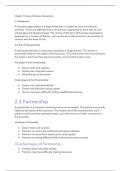
2.1 Introduction
A business organization is a legal entity that is created to carry on business
activities. There are different forms of business organizations, each with its own
advantages and disadvantages. The choice of the form of business organization
depends on a number of factors, such as the size of the business, the number of
owners, and the level of risk.
2.2 Sole Proprietorship
A sole proprietorship is a business owned by a single person. The owner is
personally liable for the debts of the business. This means that if the business fails,
the owner could lose their personal assets, such as their home or car.
Advantages of Sole Proprietorship
• Easy to start and operate
• Owner has complete control
• All profits go to the owner
Disadvantages of Sole Proprietorship
• Owner has unlimited liability
• Owner has difficulty raising capital
• Owner may have difficulty finding qualified employees
2.3 Partnership
A partnership is a business owned by two or more people. The partners are jointly
liable for the debts of the business. This means that if the business fails, each
partner could lose their personal assets, up to the amount of their investment in
the business.
Advantages of Partnership
• Easy to start and operate
• Partners can share the workload and responsibilities
• Partners can pool their resources to raise capital
• Partners can bring different skills and talents to the business
Disadvantages of Partnership
• Partners have unlimited liability
• Partners may have difficulty making decisions
2.1 Introduction
A business organization is a legal entity that is created to carry on business
activities. There are different forms of business organizations, each with its own
advantages and disadvantages. The choice of the form of business organization
depends on a number of factors, such as the size of the business, the number of
owners, and the level of risk.
2.2 Sole Proprietorship
A sole proprietorship is a business owned by a single person. The owner is
personally liable for the debts of the business. This means that if the business fails,
the owner could lose their personal assets, such as their home or car.
Advantages of Sole Proprietorship
• Easy to start and operate
• Owner has complete control
• All profits go to the owner
Disadvantages of Sole Proprietorship
• Owner has unlimited liability
• Owner has difficulty raising capital
• Owner may have difficulty finding qualified employees
2.3 Partnership
A partnership is a business owned by two or more people. The partners are jointly
liable for the debts of the business. This means that if the business fails, each
partner could lose their personal assets, up to the amount of their investment in
the business.
Advantages of Partnership
• Easy to start and operate
• Partners can share the workload and responsibilities
• Partners can pool their resources to raise capital
• Partners can bring different skills and talents to the business
Disadvantages of Partnership
• Partners have unlimited liability
• Partners may have difficulty making decisions