

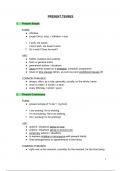
PRESENT TENSES
1. Present Simple
FORM:
● infinitive
● except 3rd p. sing. = infinitive + (e)s
+ I work. He works.
- I don’t work. He doesn’t work.
? Do I work? Does he work?
USE:
● habits, routines and customs
● facts or general truths
● permanent actions / situations
● future events based on a timetable, schedule, programme
● future in time clauses (when, as soon as) and conditional clauses (if)
COMMON PHRASES:
● always, often, as a rule, generally, usually, on the whole, never
● once (a week / a month / a year)
● every (Monday / winter / year)
2. Present Continuous
FORM:
● present simple of “to be” + ing form
+ I am working. He is working.
- I’m not working. He’s not working.
? Am I working? Is he working?
USE:
● actions / situations going on now
● actions / situations going on around now
● temporary actions / situations
● to express irritation or annoyance with present habits
● fixed arrangements or appointments in the future
COMMON PHRASES:
● right now, at the moment, currently, for the moment, for the time being
1
, 3. Stative Verbs
● Verbs of thinking: to think, to know, to agree, to remember
● Verbs of appearance: to look, to seem
● Verbs of feeling: to love, to hate, to prefer, to want, to envy
● Verbs of possession: to own, to possess, to belong
● Verbs of the senses: to hear, to see, to taste, to sound, to smell
USE:
● normally used in the present simple
● She seems upset.
● This hamburger tastes delicious!
4. Present Perfect
FORM:
● present simple of “to have” + past participle (irregulars laatste kolom)
+ I have worked. He has worked.
- I haven’t worked. He hasn’t worked.
? Have I worked? Has he worked?
USE:
● actions which happened in a time period up to now
(unfinished time period)
● actions which started in the past and have continued up to now
● past actions whose result is important now
(when no time period mentioned: finished, stress the result)
● recent past actions
COMMON PHRASES:
● ever, once, several times, before, so far, already, yet
⤷ unspecific past time expressions
● cannot use with specific past time expressions
⤷ yesterday, one week ago, last week, when I was a child
2
1. Present Simple
FORM:
● infinitive
● except 3rd p. sing. = infinitive + (e)s
+ I work. He works.
- I don’t work. He doesn’t work.
? Do I work? Does he work?
USE:
● habits, routines and customs
● facts or general truths
● permanent actions / situations
● future events based on a timetable, schedule, programme
● future in time clauses (when, as soon as) and conditional clauses (if)
COMMON PHRASES:
● always, often, as a rule, generally, usually, on the whole, never
● once (a week / a month / a year)
● every (Monday / winter / year)
2. Present Continuous
FORM:
● present simple of “to be” + ing form
+ I am working. He is working.
- I’m not working. He’s not working.
? Am I working? Is he working?
USE:
● actions / situations going on now
● actions / situations going on around now
● temporary actions / situations
● to express irritation or annoyance with present habits
● fixed arrangements or appointments in the future
COMMON PHRASES:
● right now, at the moment, currently, for the moment, for the time being
1
, 3. Stative Verbs
● Verbs of thinking: to think, to know, to agree, to remember
● Verbs of appearance: to look, to seem
● Verbs of feeling: to love, to hate, to prefer, to want, to envy
● Verbs of possession: to own, to possess, to belong
● Verbs of the senses: to hear, to see, to taste, to sound, to smell
USE:
● normally used in the present simple
● She seems upset.
● This hamburger tastes delicious!
4. Present Perfect
FORM:
● present simple of “to have” + past participle (irregulars laatste kolom)
+ I have worked. He has worked.
- I haven’t worked. He hasn’t worked.
? Have I worked? Has he worked?
USE:
● actions which happened in a time period up to now
(unfinished time period)
● actions which started in the past and have continued up to now
● past actions whose result is important now
(when no time period mentioned: finished, stress the result)
● recent past actions
COMMON PHRASES:
● ever, once, several times, before, so far, already, yet
⤷ unspecific past time expressions
● cannot use with specific past time expressions
⤷ yesterday, one week ago, last week, when I was a child
2


