

Bonds (Ionic)
Ions:
Is an atom or group of atoms with a positive or negative charge.
Atoms sometimes lose or gain electrons (e.g. when a metal reacts with anon-metal). When they
do this they become a charge atom or an ion.
If an atom loses 1 or more electrons, it gains a positive charge because it has less electrons than
protons.
E.g. if sodium atom loses 1 electron, it forms a Na+ ion.
It has 11 protons, 12 neutrons and 10 electrons.
If an atom gains 1 or more electrons, it gains a negative charge beause it has more electrons
than protons.
2-
E.g. if an oxygen atom gains 2 electrons, it forms a 0 ion.
It has 8 protons, 8 neutrons and 10 electrons.
Ionic Bonding:
Ionic bonds form between metal and non-metals.
Ionic bonding consists of electrons moving from 1 atom to
another. This then produces cations (+) and anions(-)
An ion is an atom or group of atoms with a positive or negative charge.
Metals lose electrons to become positively charged ions
Non-metals gain electrons to become negatively charged ions.
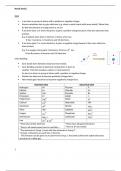
POSITIVE IONS NEGATIVE IONS
Hydrogen H+ Fluorine F-
Lithium Li+ Chloride Cl-
Sodium Na+ Bromide Br-
Potassium K+ Iodide I-
Magnesium 2+ Oxide -
Mg O2
Calcium 2+ Hydroxide OH-
Ca
Aluminum 3+ Nitrate
Al NO3 -
Silver Ag+ Sulphate 2-
SO4
Copper 2+ Phosphate 3-
Cu PO4
Ammonium Carbonate 2-
NH4 + CO3
Iron 2+ 3+
Fe & Fe
*They have all lost electrons *These have all gained electrons
*They’re all metals apart from H+ and NH 4 + *They’re all non-metals
*The elements in Group 1 react with the elements in Group 7.
*Groups 1 elements can each lose 1 electron.
This electron can be given to an atom from Group 7, they both achieve the stable electronic
structure of a noble gas.
1
, Bonds (Ionic)
Dot and Cross Diagrams:
The electrostatic attraction between the oppositely charged Na+ ions and Cl- ions is
called ionic bonding. The electron transfer during the formation of an ionic compound
can be showed through dot and cross diagram:
The charge on the ions produced by metals in group 1 and 2 and by non-metas in group 6 and 7
relates to the group number of the element in the periodic table.
For example; Group 1 form 1+ ions, Group 3 form 3+ ions, Group 6 form 2- ions and Group 7
form 1- ions.
Examples;
Magnesium Oxide:
Sometimes the atoms reacting need to gain or lose 2 electrons to gain a stable noble gas
structure. Each magnesium loses 2 electrons and each oxygen gains 2 electrons.
2+
Magnesium ions have the formula Mg , while oxide ions have the formula O2- .
This means that 1 magnesium atom reacts with 1 oxygen atom, giving the formula MgO
2
Ions:
Is an atom or group of atoms with a positive or negative charge.
Atoms sometimes lose or gain electrons (e.g. when a metal reacts with anon-metal). When they
do this they become a charge atom or an ion.
If an atom loses 1 or more electrons, it gains a positive charge because it has less electrons than
protons.
E.g. if sodium atom loses 1 electron, it forms a Na+ ion.
It has 11 protons, 12 neutrons and 10 electrons.
If an atom gains 1 or more electrons, it gains a negative charge beause it has more electrons
than protons.
2-
E.g. if an oxygen atom gains 2 electrons, it forms a 0 ion.
It has 8 protons, 8 neutrons and 10 electrons.
Ionic Bonding:
Ionic bonds form between metal and non-metals.
Ionic bonding consists of electrons moving from 1 atom to
another. This then produces cations (+) and anions(-)
An ion is an atom or group of atoms with a positive or negative charge.
Metals lose electrons to become positively charged ions
Non-metals gain electrons to become negatively charged ions.
POSITIVE IONS NEGATIVE IONS
Hydrogen H+ Fluorine F-
Lithium Li+ Chloride Cl-
Sodium Na+ Bromide Br-
Potassium K+ Iodide I-
Magnesium 2+ Oxide -
Mg O2
Calcium 2+ Hydroxide OH-
Ca
Aluminum 3+ Nitrate
Al NO3 -
Silver Ag+ Sulphate 2-
SO4
Copper 2+ Phosphate 3-
Cu PO4
Ammonium Carbonate 2-
NH4 + CO3
Iron 2+ 3+
Fe & Fe
*They have all lost electrons *These have all gained electrons
*They’re all metals apart from H+ and NH 4 + *They’re all non-metals
*The elements in Group 1 react with the elements in Group 7.
*Groups 1 elements can each lose 1 electron.
This electron can be given to an atom from Group 7, they both achieve the stable electronic
structure of a noble gas.
1
, Bonds (Ionic)
Dot and Cross Diagrams:
The electrostatic attraction between the oppositely charged Na+ ions and Cl- ions is
called ionic bonding. The electron transfer during the formation of an ionic compound
can be showed through dot and cross diagram:
The charge on the ions produced by metals in group 1 and 2 and by non-metas in group 6 and 7
relates to the group number of the element in the periodic table.
For example; Group 1 form 1+ ions, Group 3 form 3+ ions, Group 6 form 2- ions and Group 7
form 1- ions.
Examples;
Magnesium Oxide:
Sometimes the atoms reacting need to gain or lose 2 electrons to gain a stable noble gas
structure. Each magnesium loses 2 electrons and each oxygen gains 2 electrons.
2+
Magnesium ions have the formula Mg , while oxide ions have the formula O2- .
This means that 1 magnesium atom reacts with 1 oxygen atom, giving the formula MgO
2


