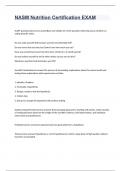
NASM Nutrition Certification EXAM 2023 WITH 100% CORRECT ANSWERS
SCOFF questionnaire Basic yet reliable set of five questions that help assess whether an eating disorder exists. Do you make yourself Sick because you feel uncomfortably full? Do you worry that you have lost Control over how much you eat? Have you recently lost more than One stone (14 lbs) in a 3-month period? Do you believe yourself to be Fat when others say you are too thin? Would you say that Food dominates your life? Scientific Method The process of formulating explanations about the natural world and testing those explanations with experiments and data. 1. Identify a Problem 2. Formulate a hypothesis 3. Design a study to test the hypothesis 4. Collect data 5. Discard or change the hypothesis OR continue testing Evidence-Based Practice A three-pronged approach to working with clients, which consists of making decisions based on the weight of the scientific evidence, field observations, and individual client needs and preferences. Prediction An expected outcome generated from a hypothesis Theory A hypothesis or set of hypotheses for which a large body of high-quality evidence has been accumulated. Hierarchy of Evidence 1. Systematic Reviews 2. Randomized Controlled Trials 3. Observational Research 4. Peer Reviews 5. Non-Peer-Reviewed Media, including anecdotes Anecdote an account of a person's experience or event Uncontrolled Variable A variable in an experiment that a scientist makes no effort to manipulate or account for. Primary Research Original research where scientists perform experiments and collect data - this is in contrast to secondary research where scientists analyze data that has already been collected or published elsewhere. Observational Research Research in which a researcher observes ongoing behaviors to determine correlation. Correlation A relationship between two or more variables. Randomized Control Trial (RCT) A type of scientific study/trial where participants are randomly assigned into different groups - one or more will be the intervention to be tested and one will be the control group. Groups are randomized and a control is used in an attempt to reduce potential bias in the trial. Independent Variable The variable scientists manipulate in an experiment. External Validity The ability to generalize the results of a study. Systematic Review A review where scientists systematically gather all research on a topic and evaluate it based on predefined criteria and rules. Meta-Analysis A statistical analysis of a group of studies to assess the overall weight of the evidence. Empirical Based on observation or experience. Test-Retest Reliability The ability to get similar results when something is measured under the same conditions. Reliability The consistency of a measure. Validity The assessment of whether a tool is measuring what it is supposed to measure. Selection Bias A sample of people under study is not representative of the larger population that scientists are looking to make inferences about. Retrospective Describes a study that looks backward in time. Recall Bias The inability to accurately remember past behaviors. Health A state of complete physical, mental, and social well-being, not merely the absence of disease or infirmity. Homeostasis The tendency toward a relatively stable equilibrium between interdependent elements, especially as maintained by physiological processes. Disease A disorder of structure or function in a human, animal, or plant, especially one that produces specific signs or symptoms, affects a specific location, and is not simply a direct result of physical injury. Noncommunicable Disease A noncommunicable disease (NCD) is a medical condition or disease that is not caused by infectious agents; it can refer to chronic diseases which last for long periods of time and progress slowly. Communicable Disease Infectious diseases caused by microorganisms such as bacteria, viruses, parasites, and fungi that can be spread (directly or indirectly) from one person to another. Wellness The fluid process of improving the emotional, occupational, physical, social, intellectual, and spiritual components of life, dynamically leading to a better state of health and well-being. Obese A high degree of excess body fat - a BMI greater than 30. Biometrics The technical term for measurements and calculations related to human physical characteristics.
Written for
- Institution
- NASM Nutrition
- Course
- NASM Nutrition
Document information
- Uploaded on
- May 13, 2023
- Number of pages
- 51
- Written in
- 2022/2023
- Type
- Exam (elaborations)
- Contains
- Questions & answers
Subjects
-
nasm nutrition certification exam 2023 with 100 correct answers

Also available in package deal