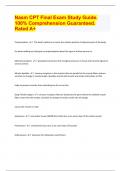
Nasm CPT Final Exam Study Guide. 100% Comprehension Guaranteed. Rated A+
Nasm CPT Final Exam Study Guide. 100% Comprehension Guaranteed. Rated A+ Document Content and Description Below Proprioception - The body's ability to to sense the relative position of adjacent parts of the body Ex: when walking our feet give us proprioception about the type of surface we are on. M echanoreceptors - specialized structures that recognize pressure in tissue and transmit signals to sensory nerves. Muscle Spindles - sensory receptors in the muscles that are parallel to the muscle fibers and are sensitive to change in muscle length. Spindles stretch with muscle and sends information to CNS. helps to prevent muscles from stretching too far or too fast Golgi Tendon Organs - sensory receptors that are located at the point where the skeletal muscle fibers insert into the tendon. Sensitive to change in tension at the rate of change causes the muscle to relax Epimysium - connective tissue UNDER fascia that acts as an outer layer of the whole muscle Perimysium - connective tissue acts as an outer layer of fascicles Endomysium - between the individual muscle fibers Type 1 Muscle Fiber - "slow-twitch", smaller in size, lessforce produced, long-term contractions (stabilization) Type 2 Muscle Fiber - fast twitch, larger, quick to fatigue, force and power exercises Agonist - PRIME MOVER, main muscles ex: chest press- pectoralis major Synergist - ASSIST PRIME MOVER, ex: chest press - ant deltoid, triceps Stabilizer - stabilizes while prime mover and assist work. chest press - rotator cuff Antagonist - Oppose Prime mover, chest press - posterior delt Right Atrium - gather DEOXGENATED blood returning to the heart from ENTIRE BODY Left Atrium - gathers OXYGENATED blood coming from the LUNGS Right Ventricle - thin walls pumps under low pressure. Pumps to lungs Left Ventricle - thick walls, pumps under high pressure to rest of body Metabolism - all of the chemical reactions that happen in our body to maintain itself. Nutrients are acquired, transported and used by the body. Exercise Metabolism - bioenergetics as it relates to the unique physiologic changes and demands on body during exercise Substrates - where enzymes act Carbohydrates - Sugars, starches, and fiber. Provide the body with a source of fuel and energy required for all daily activities Glucose - a simple sugar that comes from the digestion of carbs that is transported through the blood and is used or stored as energy Glycogen - the stored form of carbs, when needed it converts to glucose and used Fat - a secondary source of energy Trigylcerides - come from fats, when calories are consumed but not used they are converted and stored in fat cells Protein - Amino acids that build and repair body tissues and structures. A third energy source, usually not until starvation. Recommended 0.8 g per day Adults, 1.2-1.7 per day strength athletes, 1.2-1.4 endurance athletes 1 g = 4 calories Gluconeogenesis - glucose form from non carb sources like amino acids Adenosine Triphosphate (ATP) - Energy storage and transfer unit in the cells. When chemical bonds that hold it together are broken, energy is released Adenosine Diphosphate (ADP) - molecule produced by ATP ATP-PC system - simpliest and fastest, occurs without oxygen (anaerobic), provides energy for high intensity, short-duration ex: power and strentgh Glycosis System - produces lots of energy for 30-50 sec. Typical bc it falls in the time frame of 8-12 reps Oxidative System - most complex B- oxidation - breakdowns triclgycerides into free fatyy acids to produce more ATP Myth of Fat Burning Zone - higher intensity workouts require greater contribution from fat despite the increase in need of fuel source from carbs Biomechanics - internal and external forces acting on the human body and the effect produced Superior - above a reference point inferior - below a reference point Proximal - reference closest to the center of the body or reference Distal - refernence furthest away Anterior - Reference in front of t
Geschreven voor
- Instelling
- Nasm CPT
- Vak
- Nasm CPT
Documentinformatie
- Geüpload op
- 9 mei 2023
- Aantal pagina's
- 14
- Geschreven in
- 2022/2023
- Type
- Tentamen (uitwerkingen)
- Bevat
- Vragen en antwoorden
Onderwerpen
-
nasm cpt final exam study guide 100 comprehension guaranteed rated a document content and description below proprioception the bodys ability to to sense the relative position of adjacent par

Ook beschikbaar in voordeelbundel