BIOL 1108 Exam 3 Questions & Answers. (A+ Guide)
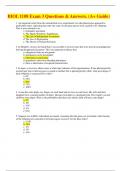
BIOL 1108 Exam 3 Questions & Answers. (A+ Guide)-1.An important result from the monohybrid cross experiments was that phenotypes appeared in predictable ratios, indicating that only one copy of each gene passes from a parent to its offspring. This is now referred to as: a. Sympatric speciation b. The Hardy-Weinberg Equilibrium c. The Law of Independent Assortment d. The Law of Segregation e. The Theory of Natural Selection 2. In Mendel's crosses, he found that it was possible to recover traits that were present in grandparents but had disappeared in parents. This was important evidence that: a. categorical traits are not genetic b. dominance can be incomplete c. inheritance is particulate d. quantitative traits have blending inheritance e. there is inheritance of acquired characteristics 3. In tigers, a recessive allele causes a white tiger (absence of fur pigmentation). If one phenotypically normal tiger that is heterozygous is mated to another that is phenotypically white, what percentage of their offspring is expected to be white? a. 0% b. 25% c. 50% d. 75% e. 100% 4. A man has extra digits (six fingers on each hand and six toes on each foot). His wife and their daughter have a normal number of digits. Having extra digits is a dominant trait. The couple's second child has extra digits. What is the probability that their next (third) child will have extra digits? a. 1/2 b. 1/8 c. 1/16 d. 3/4 e. 9/16 5. Suppose two AaBbCc individuals are mated. Assuming that the genes are not linked, what fraction of the offspring are expected to be homozygous recessive for the three traits? a. 1/256 b. 1/64 c. 1/4 d. 1/8 e. 1/16 6. In the F2 generation of the monohybrid cross, it is possible to get 3 phenotypes. What is this evidence for and what is the ratio of the phenotypes? a. Complete dominance, 1:1:1 ratio b. Genetic drift, 1:1:1 ratio c. Incomplete dominance, 1:2:1 ratio d. Blending inheritance, 1:2:1 ratio e. Gene flow, 1:2:1 ratio
Connected book
Written for
- Institution
- BIOL 1108
- Course
- BIOL 1108
Document information
- Uploaded on
- May 9, 2023
- Number of pages
- 8
- Written in
- 2023/2024
- Type
- Exam (elaborations)
- Contains
- Questions & answers

Also available in package deal