

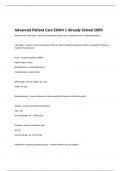
Advanced Patient Care EXAM 1 Already Solved 100%
What are the Vital Signs - Answer Temperature. pulse rate, respiratory rate, and blood pressure Vital signs - Answer Primary mechanism that are able to adapt to response within or outside the body to maintain homeostasis Pulse - Answer Number of BPM Radial Artery- Wrist Brachial Artery- Antecubital fossa Caratid Artery- Lateral Neck BPM range - Answer Adult= 60- 100 Child= 70-120 Blood pressure - Answer Measure of force exerted by blood on the artery walls Systole - Answer Ventricles Contraction 100- 120 Normal Range= 95- 119mm/Hg Diastole - Answer Ventricles relax 60- 80 Normal range= 60- 79 mm/Hg Method of measuring blood pressure - Answer Indirect by auscultation Stethoscope Sphygomomameter (Hg) and aneroid Complete Blood count (CBC) - Answer Determination of the number of red and white blood cells per cubic millimeter of blood RBC Normal range - Answer Males= 4.7-6.1 millimeter/mm3 Females= 4.2- 5.4 millimeter/mm3 WBC Normal range - Answer 5000 to 10000/cm3 Hemoglobin (Hb) - Answer Complex protien iron compound that carries oxygen to the cells from the lungs and CO2 away from the cells to the lungs Decrease in Hb ---- anemia Normal range of Hb - Answer 12.16 g/dL women; 13.5-18g/dL Men Hematocrit - Answer measure of the volume of erythrocytes in a given volume of total blood Normal range 37- 47% women 40-54% Men Abnormal blood counts - Answer Low RBC, High and or HCT ---- Anemia, blood lose High RBC ---- Polycythernia, dehydration Low WBC ---- Infection, exposure, chemo High WBC ----- Infection, Inflammation (Leukemia- 500,000- 1 million)
Document information
- Uploaded on
- May 8, 2023
- Number of pages
- 7
- Written in
- 2022/2023
- Type
- Exam (elaborations)
- Contains
- Questions & answers


