Co-ownership
Monday, 25 October 2021 12:19
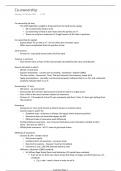
Co-ownership (at law)
- The 1925 legislation sought to bring clarity to the land law by saying
○ All co-ownership needs a trust
○ Co-ownership of land at law means that the parties are JT
○ There can only be a maximum of 4 legal owners of the land in question
Co-ownership (in equity)
- Equity allows TIC as well as JT - fair to reflect the monetary input
- Often more complicated than the position at law
Joint tenancy
- All own all - each joint tenant owns all of the land
Tenancy in common
- Each tenant owns a share of the land (usually calculated by the value contributed)
How to tell which is which
- Words of severance
- Express declaration - usually seen as binding - Goodman v Gallant [1985]
- The four unities - Possession, Time, Title and Interest (Joint tenancy needs all 4)
- Apply presumptions - normally a commercial property indicates that it is a TIC, and a domestic
property indicates that it is a JT
Survivorship - JT only
- Old name - ius accrescendi
- Favoured by the common law because it tends to lead to a single owner
- Fear of this is the most common reason for severance
- All own all - if 3 people (A, B and C) own a property and then C dies, C's heirs get nothing from
the property
Severance
- Giving one or more joint tenants a distinct tenant in common share
- Several traps to watch for
○ Goodman trap - severance is always into equal shares (natural position)
○ Severance does not normally happen by Will
○ Different kinds of severance work differently
- Partial/unilateral severance - one JT severs themselves and is therefore entitled to their
share - the rest are still JT's
- Whole/total severance - all JT's sever to get equal shares
Methods of severance
- Section 36 LPA - written notice
○ Only severs equity
○ Unilateral form of severance - just your share
○ Need not be express - however must be immediate
○ Common to use s.196 LPA deemed delivery rules
- Williams v Hensman (1861) methods
○ Sir William Page Wood (later Lord Hatherley LC) stated these methods
▪ Such an act on their own share shows that they no longer see themselves as a JT -
unilateral
□ E.g. a sale - need a share in order to sell it
□ Mortgage of the share
Land Law Page 1
Monday, 25 October 2021 12:19
Co-ownership (at law)
- The 1925 legislation sought to bring clarity to the land law by saying
○ All co-ownership needs a trust
○ Co-ownership of land at law means that the parties are JT
○ There can only be a maximum of 4 legal owners of the land in question
Co-ownership (in equity)
- Equity allows TIC as well as JT - fair to reflect the monetary input
- Often more complicated than the position at law
Joint tenancy
- All own all - each joint tenant owns all of the land
Tenancy in common
- Each tenant owns a share of the land (usually calculated by the value contributed)
How to tell which is which
- Words of severance
- Express declaration - usually seen as binding - Goodman v Gallant [1985]
- The four unities - Possession, Time, Title and Interest (Joint tenancy needs all 4)
- Apply presumptions - normally a commercial property indicates that it is a TIC, and a domestic
property indicates that it is a JT
Survivorship - JT only
- Old name - ius accrescendi
- Favoured by the common law because it tends to lead to a single owner
- Fear of this is the most common reason for severance
- All own all - if 3 people (A, B and C) own a property and then C dies, C's heirs get nothing from
the property
Severance
- Giving one or more joint tenants a distinct tenant in common share
- Several traps to watch for
○ Goodman trap - severance is always into equal shares (natural position)
○ Severance does not normally happen by Will
○ Different kinds of severance work differently
- Partial/unilateral severance - one JT severs themselves and is therefore entitled to their
share - the rest are still JT's
- Whole/total severance - all JT's sever to get equal shares
Methods of severance
- Section 36 LPA - written notice
○ Only severs equity
○ Unilateral form of severance - just your share
○ Need not be express - however must be immediate
○ Common to use s.196 LPA deemed delivery rules
- Williams v Hensman (1861) methods
○ Sir William Page Wood (later Lord Hatherley LC) stated these methods
▪ Such an act on their own share shows that they no longer see themselves as a JT -
unilateral
□ E.g. a sale - need a share in order to sell it
□ Mortgage of the share
Land Law Page 1