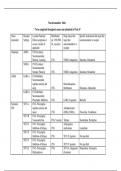
Paramedic 1 Final Exam Review
Paramedic 1 Final Exam Review • Define fibrin, collagen, and plasmin - When activated, fibrinogen is converted to: o A) fibrin. o B) plasmin. o C) thrombin. o D) thromboplastin. - is the protein that bonds to form the fibrous component of a blood clot. o A) Kinin o B) Plasmin o C) Fibrin o D) Collagen • Review Osmosis - If too much water enters a cell during osmosis, it will burst. This process is called: o A) diffusion. o B) crenation. o C) lysis. o D) viscosity. - Osmosis is the movement of a: o A) solvent from an area of low solute concentration to one of high concentration. o B) solvent from an area of high solute concentration to one of low concentration. o C) solute from an area of high solvent concentration to one of low concentration. o D) solute from an area of low solvent concentration to one of high concentration. - The net effect of osmosis is to: o A) equalize the amount of water on both sides of the cell membrane. o B) shift extracellular fluid to the intracellular and intravascular fluids. o C) passively transport a solution to an area of lower solute concentration. o D) equalize the concentrations of a solute on both sides of the cell membrane. - Osmosis occurs when: o A) water moves from an area of higher solute concentration to an area of lower solute concentration. o B) solutes move from an area of lower water concentration to an area of higher water concentration. o C) water moves from an area of lower solute concentration to an area of higher solute concentration. o D) solutes move from an area of higher water concentration to an area of lower water concentration. - The net effect of osmosis is to: o A) balance the concentration of water on both sides of the cell wall. o B) equalize solute concentrations on both sides of the cell membrane. o C) utilize ATP to actively move solutes across the cell membrane. o D) maintain a higher concentration of solutes outside of the cell. • Review CO2 levels, what does it mean to retain CO2? - Decreases in the PaCO2 result in pH levels in the respiratory center and a(n) in ventilation. o A) decreased, decrease o B) increased, increase o C) decreased, increase o D) increased, decrease - The hypoxic drive, a backup system to control breathing, is stimulated when: o A) arterial PaO2 levels decrease. o B) arterial PaCO2 levels increase. o C) arterial PaO2 levels increase. o D) arterial PaCO2 levels decrease. - What happens when the PaCO2 of the arterial blood increases? o A) pH increases and respirations increase o B) pH decreases and respirations decrease o C) pH increases and respirations decrease o D) pH decreases and respirations increase • What does it mean when a cell membrane is selectively permeable? - The cell membrane is selectively permeable, which means that it: o A) allows only certain substances to pass through it. o B) will allow any substance to readily pass through it. o C) only allows potassium and calcium to pass through it. o D) only allows sodium and chloride to pass through it. - The separation of the intracellular and extracellular areas by a selectively permeable membrane helps to maintain: o A) endocytosis. o B) homeostasis. o C) hemostasis. o D) exocytosis. • Review total cholesterol / LDL / HDL – with risks to CAD
Written for
- Institution
- Paramedic 1
- Module
- Paramedic 1
Document information
- Uploaded on
- May 3, 2023
- Number of pages
- 23
- Written in
- 2022/2023
- Type
- Exam (elaborations)
- Contains
- Questions & answers
Subjects
- paramedic 1
-
paramedic 1 final exam review
-
paramedic 1 final exam questions and 1o0 verified answers
-
paramedic 1 final exam review questions with marking scheme
-
paramedic 1 exam and answers