

REPRODUCTIVE SYSTEMS
FEMALE REPRODUCTIVE SYSTEM
Ovum = mature egg, produced by female. An immature ovum is an oocyte.
Functions:
— Producing oocytes or egg cells
— Provide an environment for fertilization to occur
º fallopian tube, particularly the ampulla section
— Provide environment for cell division to take place should fertilization be successful
— Implantation
— Fetal development
— Gestation period
— Follicles of ovaries produce hormones such as estrogen
— Uterus can produce PGF2α
— Corpus Luteum produces progesterone which is responsible for maintaining pregnancy
— Birthing process
— Production of milk
Components
— Ovaries
— Duct system
º Oviducts
º Uterus
º Cervix
º Vagina
º Vulva
— Support structure, nerves, and blood supply.For example, the ovaries are stabilized via the Broad
Ligament. The blood supply to the uterus is extensive when the placenta forms
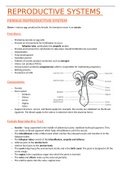
Female Reproductive Tract
— Ovaries - Hang suspended in the middle of abdominal cavity, stabilized by Broad Ligament. They
can rotate on Broad Ligament which helps infundibulum catch the oocyte.
— The infundibulum is like a little funnel which catches the released oocyte and transfers it to the
fallopian tubes.
— The fallopian tubes consist of the infundibulum, ampulla and isthmus
— Isthmus joins to the uterine horn
— Uterine horn joins to the uterine body
— The cervix helps keep the environment sterile and is the birth canal. The penis is designed to fit the
cervix snugly.
— The vagina is the copulatory organ into which the penis is inserted.
— The vulva and clitoris make up the external genitalia.
— The urethra opens into the vulva, vaginal area.
, Ovaries:
— Produce oocytes and 3 hormones
º Estrogen
º Progesterone
º Inhibin
— Ovaries of different species can look very different
— They can be monotocous or polytocous, depending on how many oocytes they release at a time.
Cows are monotocous and only have one calf while sows are polytocous and have a little of piglets.
— Oocytes develop in follicles
Follicle = fluid filled sac containing a developing egg
Parenchyma = functional tissue
Follicle development in parenchyma of ovaries:
— Oogonium is recruited and begins development in a Primary follicle
— The primary follicle becomes a Secondary, Tertiary, and finally a Graafian follicle
— The Graafian follicle ruptures to release oocyte, thus becoming the corpus haemorrhagicum
— The corpus haemorrhagicum becomes the corpus luteum
— The corpus luteum produces progesterone until the body confirms if fertilization and implantation
occurred.
— If implantation did not occur, the uterus produces PGF2α which stimulates the destruction of the
corpus luteum.
— The corpus luteum then becomes the corpus albicans which is a little lump of scar tissue.
— If the corpus luteum stays intact too long, the female will have an irregular cycle.
Oviducts:
— Fallopian tubes which are 20-30cm long, consisting of infundibulum, ampulla, and isthmus
— They transport ova and sperm via peristalsis
— Estrogen stimulates peristalsis as it drives the processes leading towards implantation
— Progesterone inhibits peristalsis as it maintains static state of reproductive tract during pregnancy.
NB! Bi-directional transport
FEMALE REPRODUCTIVE SYSTEM
Ovum = mature egg, produced by female. An immature ovum is an oocyte.
Functions:
— Producing oocytes or egg cells
— Provide an environment for fertilization to occur
º fallopian tube, particularly the ampulla section
— Provide environment for cell division to take place should fertilization be successful
— Implantation
— Fetal development
— Gestation period
— Follicles of ovaries produce hormones such as estrogen
— Uterus can produce PGF2α
— Corpus Luteum produces progesterone which is responsible for maintaining pregnancy
— Birthing process
— Production of milk
Components
— Ovaries
— Duct system
º Oviducts
º Uterus
º Cervix
º Vagina
º Vulva
— Support structure, nerves, and blood supply.For example, the ovaries are stabilized via the Broad
Ligament. The blood supply to the uterus is extensive when the placenta forms
Female Reproductive Tract
— Ovaries - Hang suspended in the middle of abdominal cavity, stabilized by Broad Ligament. They
can rotate on Broad Ligament which helps infundibulum catch the oocyte.
— The infundibulum is like a little funnel which catches the released oocyte and transfers it to the
fallopian tubes.
— The fallopian tubes consist of the infundibulum, ampulla and isthmus
— Isthmus joins to the uterine horn
— Uterine horn joins to the uterine body
— The cervix helps keep the environment sterile and is the birth canal. The penis is designed to fit the
cervix snugly.
— The vagina is the copulatory organ into which the penis is inserted.
— The vulva and clitoris make up the external genitalia.
— The urethra opens into the vulva, vaginal area.
, Ovaries:
— Produce oocytes and 3 hormones
º Estrogen
º Progesterone
º Inhibin
— Ovaries of different species can look very different
— They can be monotocous or polytocous, depending on how many oocytes they release at a time.
Cows are monotocous and only have one calf while sows are polytocous and have a little of piglets.
— Oocytes develop in follicles
Follicle = fluid filled sac containing a developing egg
Parenchyma = functional tissue
Follicle development in parenchyma of ovaries:
— Oogonium is recruited and begins development in a Primary follicle
— The primary follicle becomes a Secondary, Tertiary, and finally a Graafian follicle
— The Graafian follicle ruptures to release oocyte, thus becoming the corpus haemorrhagicum
— The corpus haemorrhagicum becomes the corpus luteum
— The corpus luteum produces progesterone until the body confirms if fertilization and implantation
occurred.
— If implantation did not occur, the uterus produces PGF2α which stimulates the destruction of the
corpus luteum.
— The corpus luteum then becomes the corpus albicans which is a little lump of scar tissue.
— If the corpus luteum stays intact too long, the female will have an irregular cycle.
Oviducts:
— Fallopian tubes which are 20-30cm long, consisting of infundibulum, ampulla, and isthmus
— They transport ova and sperm via peristalsis
— Estrogen stimulates peristalsis as it drives the processes leading towards implantation
— Progesterone inhibits peristalsis as it maintains static state of reproductive tract during pregnancy.
NB! Bi-directional transport


