

HOMEOSTASIS AND
INTEGRATION
GIT = gastrointestinal tract
Processes crucial for life
Growth processes that take place throughout their lifespan.
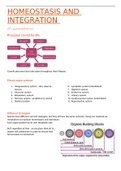
Eleven organ systems
1. Integumentary system - skin, claws & 6. Lymphatic system (interlinked)
hooves 7. Digestive system
2. Muscular system 8. Endocrine system
3. Respiratory system 9. Urinary system
4. Nervous system - peripheral & central 10. Cardiovascular system (interlinked)
5. Skeletal system 11. Reproductive system
Different strategies
Species have different survival strategies, but they all have the same outcome: Using raw material via
metabolism to maintain homeostasis and reproduce.
Each organ system has its own metabolic rate
BUT regardless of that - at any given time all 11
organs will collaborate in order to ensure that
homeostasis is maintained.
, Organization of an animal
Cells
Tissues (muscles, nerves, epithelia, connective)
Organs (two or more tissue types organized to perform a function Cells: Most cells
in the body
have a nucleus
Systems (collection of organs that perform the same function)
(contains DNA
information/
genetic code).
Tissue: A collection/ grouping of cells. More than one tissue types in an organ.
Organs: A collection of cells & tissues
System: Organs & associated structures
Within an organ system: what do cells need to do?
- Obtain nutrients and oxygen from environment
- Conduct respiration to produce energy
- Eliminate waste
- Synthesize new cellular parts
- Control exchange and transport of materials
- Sense and respond to environmental changes
- Reproduce
o Some nerve and muscle cells lose ability to reproduce early on in the animal’s lifespan, thus
growth is genetically controlled and the number of muscle/nerve cells are limited.
INTEGRATION
GIT = gastrointestinal tract
Processes crucial for life
Growth processes that take place throughout their lifespan.
Eleven organ systems
1. Integumentary system - skin, claws & 6. Lymphatic system (interlinked)
hooves 7. Digestive system
2. Muscular system 8. Endocrine system
3. Respiratory system 9. Urinary system
4. Nervous system - peripheral & central 10. Cardiovascular system (interlinked)
5. Skeletal system 11. Reproductive system
Different strategies
Species have different survival strategies, but they all have the same outcome: Using raw material via
metabolism to maintain homeostasis and reproduce.
Each organ system has its own metabolic rate
BUT regardless of that - at any given time all 11
organs will collaborate in order to ensure that
homeostasis is maintained.
, Organization of an animal
Cells
Tissues (muscles, nerves, epithelia, connective)
Organs (two or more tissue types organized to perform a function Cells: Most cells
in the body
have a nucleus
Systems (collection of organs that perform the same function)
(contains DNA
information/
genetic code).
Tissue: A collection/ grouping of cells. More than one tissue types in an organ.
Organs: A collection of cells & tissues
System: Organs & associated structures
Within an organ system: what do cells need to do?
- Obtain nutrients and oxygen from environment
- Conduct respiration to produce energy
- Eliminate waste
- Synthesize new cellular parts
- Control exchange and transport of materials
- Sense and respond to environmental changes
- Reproduce
o Some nerve and muscle cells lose ability to reproduce early on in the animal’s lifespan, thus
growth is genetically controlled and the number of muscle/nerve cells are limited.


