Page 1 of 14
NS & its Cells:
Learning Outcomes:
• be able to explain what type of tissue makes up the NS
• be able to describe the di erent roles of tissues in perceiving & behaving
Key Words:
(a) Bilaterally symmetrical - anterior & posterior ends and a right & left
side - description of the brain
(b) Cephalisation - nervous tissue becomes highly concentrated on one
end of an organism
(c) Brain - complex integrating centre are up of clusters of ganglia
(d) Ganglia - grouping of neurone cell bodies in PNS
(e) Nuclei/Centre - grouping of neurone cell bodies in the brain (CNS)
(f) Tracts - grouping of axons in the brain (CNS)
(g) Nerves - axons of a erent & e erent neurones
(h) Soma - neurone cell body
Explain what type of tissue makes up the NS
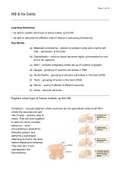
Cnidarians - unusual organism where neurones are not specialised unlike most NS's
where the neurones are split
into 3 types - sensory, relay &
motor. They still work together
to allow for some complex
behaviour - when
encountering a seashell its
tentacles grasp it and
performs a somersault
attaching its foot to the shell
before releasing its tentacles.
They also don't have
cephalisation like
Echinoderms.
ff ff ff
, Page 2 of 14
Vertebrate CNS -
• most highly cephalised and unique in that they have hollow dorsal nerve chords.
• Portion of the NS encased within cartilage or bone is the CNS (brain/spinal chord) -
everything else is PNS
Origin of Neural Tissue -
• both come from the same type of cell - Neural Stem Cells (NSC's).
• Stem cells are multipotent & self-renewing that can develop into di erent types of cells.
NSC's vital for neurogenesis (genesis of Neural Tissue) - mostly occurs in prenatal
development.
• Adult neurogenesis does occur - in adult mammals (inc. humans) - plasticity (explored
further in future lesson) - process of NSC's development in slide
Two types of Neural tissue/cells -
1. Neurones - processing, transfer, storage of info.
2. Neuroglia / Glial cells - support, regulation, protection and repair* of Neurons -
surround the neurons for said reasons
*Glial cells act as stem cells in some areas of brain promoting regrowth where possible, in
regions where uncontrolled regrowth may be detrimental they hinder regrowth of
damaged neurones.
ff
NS & its Cells:
Learning Outcomes:
• be able to explain what type of tissue makes up the NS
• be able to describe the di erent roles of tissues in perceiving & behaving
Key Words:
(a) Bilaterally symmetrical - anterior & posterior ends and a right & left
side - description of the brain
(b) Cephalisation - nervous tissue becomes highly concentrated on one
end of an organism
(c) Brain - complex integrating centre are up of clusters of ganglia
(d) Ganglia - grouping of neurone cell bodies in PNS
(e) Nuclei/Centre - grouping of neurone cell bodies in the brain (CNS)
(f) Tracts - grouping of axons in the brain (CNS)
(g) Nerves - axons of a erent & e erent neurones
(h) Soma - neurone cell body
Explain what type of tissue makes up the NS
Cnidarians - unusual organism where neurones are not specialised unlike most NS's
where the neurones are split
into 3 types - sensory, relay &
motor. They still work together
to allow for some complex
behaviour - when
encountering a seashell its
tentacles grasp it and
performs a somersault
attaching its foot to the shell
before releasing its tentacles.
They also don't have
cephalisation like
Echinoderms.
ff ff ff
, Page 2 of 14
Vertebrate CNS -
• most highly cephalised and unique in that they have hollow dorsal nerve chords.
• Portion of the NS encased within cartilage or bone is the CNS (brain/spinal chord) -
everything else is PNS
Origin of Neural Tissue -
• both come from the same type of cell - Neural Stem Cells (NSC's).
• Stem cells are multipotent & self-renewing that can develop into di erent types of cells.
NSC's vital for neurogenesis (genesis of Neural Tissue) - mostly occurs in prenatal
development.
• Adult neurogenesis does occur - in adult mammals (inc. humans) - plasticity (explored
further in future lesson) - process of NSC's development in slide
Two types of Neural tissue/cells -
1. Neurones - processing, transfer, storage of info.
2. Neuroglia / Glial cells - support, regulation, protection and repair* of Neurons -
surround the neurons for said reasons
*Glial cells act as stem cells in some areas of brain promoting regrowth where possible, in
regions where uncontrolled regrowth may be detrimental they hinder regrowth of
damaged neurones.
ff