www.stuvia.com/user/TBKLeo
1. Introduction to Enterprise Systems for Management
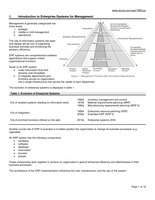
Management is generally categorized into
three levels:
1. strategic
2. middle or mid-management
3. operational
The role of information systems has been
and always will be one of supporting
business activities and enhancing the
workers, efficiency.
ERP systems are comprehensive software
applications that support critical
organizational functions.
Goals of an ERP system:
make information flow both
dynamic and immediate
to integrate departments and Figure 1: Management Pyramid with Information Requirements
functions across an organization
into a single infrastructure that serves the needs of each department
The evolution of enterprise systems is displayed in table 1.
Table 1: Evolution of Enterprise Systems
1960s Inventory management and control
Era of isolated systems (leading to information silos) 1970s Material requirements planning (MRP)
1980s Manufacturing requirements planning (MRP II)
1990s Enterprise resource planning (ERP)
Era of integration
2000s Extended ERP (ERP II)
Era of enriched functions offered on the web 2010s Enterprise systems (EIS)
Another crucial role of ERP in business is to better position the organization to change its business processes (e.g.
upgrades).
An ERP system has the following components:
hardware
software
database
information
process
people
These components work together to achieve an organization’s goal of enhanced efficiency and effectiveness in their
business processes.
The architecture of the ERP implementation influences the cost, maintenance, and the use of the system.
Page 1 of 19
, www.stuvia.com/user/TBKLeo
A system’s architecture is a blueprint of the actual ERP system. The logical architecture focuses on supporting the
requirements of the end users, whereas the physical architecture focuses on the efficiency (cost, response time, etc.) of
the system.
ERP and e-Business are complementary technologies due to the following reasons:
1. e-Business technology focus has been on linking a company with its external partners and stakeholders, whereas
ERP focus has been on integrating the functional silos of an organization into an enterprise application
2. e-Business is a disruptive technology, whereas ERP is adaptive technology
In other words, both technologies have a different focus and complement each other.
The ERP implementation process:
business process management (BPM): the understanding, visibility and control of business processes
understanding an ERP system life cycle: it requires a continuous cycle of product release and support
choosing an implementation strategy:
o “chocolate” implementation: modifications to the ERP software package
o “vanilla” implementation: no modifications to the ERP software package
software and vendor selection (evaluate its current and future needs in enterprise management systems)
operations and post-implementation, five areas of stabilization are important
1. training for end users
2. reactive support (e.g., help desk for troubleshooting)
3. auditing support to make sure data quality is not compromised by new system
4. data fix to resolve data migration and errors that are revealed by audits
5. new features and functionalities to support the evolving needs of the organization
For an ERP system to be implemented successfully, project management must provide strong leadership, a clear and
understood implementation plan, and close monitoring of the budget. Some things to consider:
role of consultants must assess the organizations’ ability to be successful
change management is essential because it prepares an organization for changes to how its business is done
business process reengineering: current business processes will need to be changed to use the functionality of
the ERP fully
global, ethical, and security management
The market of ERP vendors can be grouped into three tiers: I, II, III; for respectively: large, midsize and small companies.
Table 2: ERP Market Tiers
Tier I Tier II Tier III
SAP Epicor ABAS
Oracle Sage Activant Solutions Inc.
Oracle – e-Business Suite Infor Bowen and Groves
Oracle – JD Edwards IFS Compiere
Oracle – Peoplesoft QAD Exact
Microsoft Dynamics Lawson NetSuite
CDC Software Visibility
CGS
Hansa World
Consona
Syspro
Implications for management:
ERP systems implementation is a complex organizational activity
ERP systems implementation requires strong project management oversight
ERP systems provide improved and added functionality for an organization
ERP systems are set to proliferate globally
Page 2 of 19
1. Introduction to Enterprise Systems for Management
Management is generally categorized into
three levels:
1. strategic
2. middle or mid-management
3. operational
The role of information systems has been
and always will be one of supporting
business activities and enhancing the
workers, efficiency.
ERP systems are comprehensive software
applications that support critical
organizational functions.
Goals of an ERP system:
make information flow both
dynamic and immediate
to integrate departments and Figure 1: Management Pyramid with Information Requirements
functions across an organization
into a single infrastructure that serves the needs of each department
The evolution of enterprise systems is displayed in table 1.
Table 1: Evolution of Enterprise Systems
1960s Inventory management and control
Era of isolated systems (leading to information silos) 1970s Material requirements planning (MRP)
1980s Manufacturing requirements planning (MRP II)
1990s Enterprise resource planning (ERP)
Era of integration
2000s Extended ERP (ERP II)
Era of enriched functions offered on the web 2010s Enterprise systems (EIS)
Another crucial role of ERP in business is to better position the organization to change its business processes (e.g.
upgrades).
An ERP system has the following components:
hardware
software
database
information
process
people
These components work together to achieve an organization’s goal of enhanced efficiency and effectiveness in their
business processes.
The architecture of the ERP implementation influences the cost, maintenance, and the use of the system.
Page 1 of 19
, www.stuvia.com/user/TBKLeo
A system’s architecture is a blueprint of the actual ERP system. The logical architecture focuses on supporting the
requirements of the end users, whereas the physical architecture focuses on the efficiency (cost, response time, etc.) of
the system.
ERP and e-Business are complementary technologies due to the following reasons:
1. e-Business technology focus has been on linking a company with its external partners and stakeholders, whereas
ERP focus has been on integrating the functional silos of an organization into an enterprise application
2. e-Business is a disruptive technology, whereas ERP is adaptive technology
In other words, both technologies have a different focus and complement each other.
The ERP implementation process:
business process management (BPM): the understanding, visibility and control of business processes
understanding an ERP system life cycle: it requires a continuous cycle of product release and support
choosing an implementation strategy:
o “chocolate” implementation: modifications to the ERP software package
o “vanilla” implementation: no modifications to the ERP software package
software and vendor selection (evaluate its current and future needs in enterprise management systems)
operations and post-implementation, five areas of stabilization are important
1. training for end users
2. reactive support (e.g., help desk for troubleshooting)
3. auditing support to make sure data quality is not compromised by new system
4. data fix to resolve data migration and errors that are revealed by audits
5. new features and functionalities to support the evolving needs of the organization
For an ERP system to be implemented successfully, project management must provide strong leadership, a clear and
understood implementation plan, and close monitoring of the budget. Some things to consider:
role of consultants must assess the organizations’ ability to be successful
change management is essential because it prepares an organization for changes to how its business is done
business process reengineering: current business processes will need to be changed to use the functionality of
the ERP fully
global, ethical, and security management
The market of ERP vendors can be grouped into three tiers: I, II, III; for respectively: large, midsize and small companies.
Table 2: ERP Market Tiers
Tier I Tier II Tier III
SAP Epicor ABAS
Oracle Sage Activant Solutions Inc.
Oracle – e-Business Suite Infor Bowen and Groves
Oracle – JD Edwards IFS Compiere
Oracle – Peoplesoft QAD Exact
Microsoft Dynamics Lawson NetSuite
CDC Software Visibility
CGS
Hansa World
Consona
Syspro
Implications for management:
ERP systems implementation is a complex organizational activity
ERP systems implementation requires strong project management oversight
ERP systems provide improved and added functionality for an organization
ERP systems are set to proliferate globally
Page 2 of 19