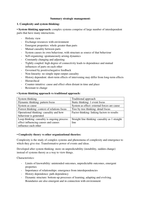
Summary strategic management:
1. Complexity and system thinking:
• System thinking approach: complex systems comprise of large number of interdependent
parts that have many interactions.
- Holistic view
- Exchange resources with environment
- Emergent properties: whole greater than parts
- Mutual causality between parts
- System causes its own behaviour, with structure as source of that behaviour
- Self-organizing: spontaneously arising dynamics
- Constantly changing and adjusting
- Tightly coupled: high degree of connectivity leads to dependence and mutual
influences of parts on each other
- Governed by positive/negative feedback
- Non-linearity: no simple input-output causality
- History dependent: short-term effects of intervening may differ from long-term effects
- Hierarchical
- Counter-intuitive: cause and effect often distant in time and place
- Resistant to change
• System thinking approach vs traditional approach:
System thinking Traditional approach
Dynamic thinking: pattern focus Static thinking: 1 event focus
System as cause System as effect: external forces are cause
Forrest thinking: context of relations focus Tree by tree thinking: detail focus
Operational thinking: causality and how Factor thinking: linking factors to results
behaviour is generated
Loop thinking: causality is ongoing process: Straight line thinking: causality as 1 straight
effect influencing causes and causes line
influence each other
• Complexity theory vs other organizational theories:
Complexity is the study of complex systems and phenomena of complexity and emergence to
which they give rise. Transformative power of events and ideas.
Developed after system thinking: more on unpredictability (instability, sudden change)
instead of systems theory as a way to view things.
Characteristics:
- Limits of knowability: unintended outcomes, unpredictable outcomes, emergent
properties
- Importance of relationships: emergence from interdependencies
- History dependence: path dependency
- Dynamic structure: bottom-up processes of learning, adapting and evolving.
Boundaries are also emergent and in connection with environment
, - Inevitability of change
- Power lies with the one who has the info
Other theories: scientific management: reductionism and division of labour
• Complex adaptive systems – characteristics:
Branch of complexity theory: only adaptive part is new.
Collection of individuals, semi-autonomous agents that not always act predictable and seek to
maximize their goodness over time. Characteristics:
- Agents: info processors. Adjust behaviour according to info they receive
- Interconnections: nonlinear relations between agents
- Emergence: as result of pattern of relations
- Self-organizing: order is result of properties within system, not from control from
outside
- Co-evolution: CAS changes the world around them as well. Co-evolve with
environment. They influence each other
Adaptive systems: complex environment, so: need flexible strategy and few control to
handle medical uncertainties
• Loosely coupled vs tightly coupled systems: HC systems are tightly coupled. The more
interactions and interdependence, the tightier coupled it is. It is also more structured,
inflexible, so less option for change
• Non-linearity/Chaos/unpredictability/randomness: ?
• Chaos statuses: unpredictability = complexity.
- Static stage: only incremental change or no change. No adaptation to environment:
death.
- Edge of chaos (holon): best for complex organizations. Standardization can be
adaptive and spontaneous, alive. Evolving systems.
- Chaos: unstable, too rapid change: self-destruct. Out of control, too many positive
feedback loops. Poor adaptation. Effective leadership is needed to go back:
standardization, set common goals, improve feedback loops, let everyone share
knowledge
• System dynamic modelling: result of interplay between feedback loops.
2 stages: ID and mapping causal loop and quantifying and testing loops in computer model.
It shows complexity and connection within system. It overcomes the actual delay in time
between cause-effect. It consists of hundreds of equations. Finally, it shows causes and
relations of health issues to be addressed and where possible solutions lie and effects of these
interventions.
• Applications of system thinking to understand:
– Healthcare organizations (strategy, leadership, change):
,– Healthcare systems: input or change or interventions doesn’t always lead to desired
outcome. Due to change in system, all properties change. Complexity and interconnections of
relationships!
WHO health systems framework:
- Service delivery
- Health workforce
- Information
- Medical products, vaccines and technology
- Financing
- Leadership/governance.
All interconnected through people
Lead with access, coverage, quality and safety towards:
- Improved health
- Responsiveness
- Social and financial risk protection
- Improved efficiency
2. Strategic management:
• Strategy: the development of a broad formula prescribing a way in which business
competes, collaborates, sets goals and establishes policies to carry out those goals in order to
achieve the organizational mission. 9 characteristics
- Organization + environmental focus
- Complex
- Affects welfare of the organization
- Involves issues of context and process
- Not purely deliberate
- Exists on different levels
- Involves various though processes
- Involves allocation of resources
- Mission based
It is all about making the right decisions. 2 functions: to improve decisions of resource
allocation to yield long-term benefits and developing strategies should challenge existing
assumptions and be open to new possibilities in order to be aware of new realities and manage
change effectively.
• Competitive advantage:
Long-term market positions and uniqueness of the organization that’s not easily duplicable by
rivals. By external management done; anticipating on possible changes in the environment
and enabling organizations to change and maintain competitive advantage. In HC, mostly
non-profit, but care is expensive, so competition reduces revenues and decreases QOC or
leads to redundancy and duplication (isomorphism as well). This leads to inefficiency and
overcapacity.
, • Organizational Values/Mission/Vision:
Values: 5-7. Expression of the ethics that guide employees. They constrain how mission and
vision should be accomplished. Develop them together with employees.
Mission: foundation of strategic direction. Direct outgrowth of values. Reason of existence.
Components:
- Definition of product/service
- Standards employed
- Population or segment served
Must call employees to action. The essence of the difference with other organizations.
Vision: statement of what it wants to become in the future. Motivate and give direction to
employees. Together with mission the foundation of strategic plans and activities
• Positioning school vs resource-based view:
5 forces vs. resources of organization as basis for strategy. Physical capital, human capital and
organizational structure capital as resources.
Positioning school of thought: focuses on the interface between strategy & external
environment, competitive advantage is a function of industry attractiveness & positioning:
Ø Attractiveness relates to industry profitability
Ø Positioning relates to the issue of which generic strategy to follow
Does industry matter?
• Internal vs external value chain:
Internal: added values of every step.
Points in time: pre-service point of service post-service
Support activities:
- Infrastructure: organizational planning and control
- Culture: shared assumptions, values and behavioural norms
- Resources: financial, human, information
- Technology: development and application
Resource based: competitive advantage becomes a function of firm-specific resources, of the
extent to which they are: valuable, rare, difficult to imitate, difficult-to-substitute.
Tangible: Organizational, Physical, Financial, Technological.
Intangible: Organizational Capabilities, Reputation, Innovation & Creativity, Human
resources.
External: marketing, PR, service and investments.
• Business model components: all interconnected:
Customer value: product differentiation, cost, access
1. Complexity and system thinking:
• System thinking approach: complex systems comprise of large number of interdependent
parts that have many interactions.
- Holistic view
- Exchange resources with environment
- Emergent properties: whole greater than parts
- Mutual causality between parts
- System causes its own behaviour, with structure as source of that behaviour
- Self-organizing: spontaneously arising dynamics
- Constantly changing and adjusting
- Tightly coupled: high degree of connectivity leads to dependence and mutual
influences of parts on each other
- Governed by positive/negative feedback
- Non-linearity: no simple input-output causality
- History dependent: short-term effects of intervening may differ from long-term effects
- Hierarchical
- Counter-intuitive: cause and effect often distant in time and place
- Resistant to change
• System thinking approach vs traditional approach:
System thinking Traditional approach
Dynamic thinking: pattern focus Static thinking: 1 event focus
System as cause System as effect: external forces are cause
Forrest thinking: context of relations focus Tree by tree thinking: detail focus
Operational thinking: causality and how Factor thinking: linking factors to results
behaviour is generated
Loop thinking: causality is ongoing process: Straight line thinking: causality as 1 straight
effect influencing causes and causes line
influence each other
• Complexity theory vs other organizational theories:
Complexity is the study of complex systems and phenomena of complexity and emergence to
which they give rise. Transformative power of events and ideas.
Developed after system thinking: more on unpredictability (instability, sudden change)
instead of systems theory as a way to view things.
Characteristics:
- Limits of knowability: unintended outcomes, unpredictable outcomes, emergent
properties
- Importance of relationships: emergence from interdependencies
- History dependence: path dependency
- Dynamic structure: bottom-up processes of learning, adapting and evolving.
Boundaries are also emergent and in connection with environment
, - Inevitability of change
- Power lies with the one who has the info
Other theories: scientific management: reductionism and division of labour
• Complex adaptive systems – characteristics:
Branch of complexity theory: only adaptive part is new.
Collection of individuals, semi-autonomous agents that not always act predictable and seek to
maximize their goodness over time. Characteristics:
- Agents: info processors. Adjust behaviour according to info they receive
- Interconnections: nonlinear relations between agents
- Emergence: as result of pattern of relations
- Self-organizing: order is result of properties within system, not from control from
outside
- Co-evolution: CAS changes the world around them as well. Co-evolve with
environment. They influence each other
Adaptive systems: complex environment, so: need flexible strategy and few control to
handle medical uncertainties
• Loosely coupled vs tightly coupled systems: HC systems are tightly coupled. The more
interactions and interdependence, the tightier coupled it is. It is also more structured,
inflexible, so less option for change
• Non-linearity/Chaos/unpredictability/randomness: ?
• Chaos statuses: unpredictability = complexity.
- Static stage: only incremental change or no change. No adaptation to environment:
death.
- Edge of chaos (holon): best for complex organizations. Standardization can be
adaptive and spontaneous, alive. Evolving systems.
- Chaos: unstable, too rapid change: self-destruct. Out of control, too many positive
feedback loops. Poor adaptation. Effective leadership is needed to go back:
standardization, set common goals, improve feedback loops, let everyone share
knowledge
• System dynamic modelling: result of interplay between feedback loops.
2 stages: ID and mapping causal loop and quantifying and testing loops in computer model.
It shows complexity and connection within system. It overcomes the actual delay in time
between cause-effect. It consists of hundreds of equations. Finally, it shows causes and
relations of health issues to be addressed and where possible solutions lie and effects of these
interventions.
• Applications of system thinking to understand:
– Healthcare organizations (strategy, leadership, change):
,– Healthcare systems: input or change or interventions doesn’t always lead to desired
outcome. Due to change in system, all properties change. Complexity and interconnections of
relationships!
WHO health systems framework:
- Service delivery
- Health workforce
- Information
- Medical products, vaccines and technology
- Financing
- Leadership/governance.
All interconnected through people
Lead with access, coverage, quality and safety towards:
- Improved health
- Responsiveness
- Social and financial risk protection
- Improved efficiency
2. Strategic management:
• Strategy: the development of a broad formula prescribing a way in which business
competes, collaborates, sets goals and establishes policies to carry out those goals in order to
achieve the organizational mission. 9 characteristics
- Organization + environmental focus
- Complex
- Affects welfare of the organization
- Involves issues of context and process
- Not purely deliberate
- Exists on different levels
- Involves various though processes
- Involves allocation of resources
- Mission based
It is all about making the right decisions. 2 functions: to improve decisions of resource
allocation to yield long-term benefits and developing strategies should challenge existing
assumptions and be open to new possibilities in order to be aware of new realities and manage
change effectively.
• Competitive advantage:
Long-term market positions and uniqueness of the organization that’s not easily duplicable by
rivals. By external management done; anticipating on possible changes in the environment
and enabling organizations to change and maintain competitive advantage. In HC, mostly
non-profit, but care is expensive, so competition reduces revenues and decreases QOC or
leads to redundancy and duplication (isomorphism as well). This leads to inefficiency and
overcapacity.
, • Organizational Values/Mission/Vision:
Values: 5-7. Expression of the ethics that guide employees. They constrain how mission and
vision should be accomplished. Develop them together with employees.
Mission: foundation of strategic direction. Direct outgrowth of values. Reason of existence.
Components:
- Definition of product/service
- Standards employed
- Population or segment served
Must call employees to action. The essence of the difference with other organizations.
Vision: statement of what it wants to become in the future. Motivate and give direction to
employees. Together with mission the foundation of strategic plans and activities
• Positioning school vs resource-based view:
5 forces vs. resources of organization as basis for strategy. Physical capital, human capital and
organizational structure capital as resources.
Positioning school of thought: focuses on the interface between strategy & external
environment, competitive advantage is a function of industry attractiveness & positioning:
Ø Attractiveness relates to industry profitability
Ø Positioning relates to the issue of which generic strategy to follow
Does industry matter?
• Internal vs external value chain:
Internal: added values of every step.
Points in time: pre-service point of service post-service
Support activities:
- Infrastructure: organizational planning and control
- Culture: shared assumptions, values and behavioural norms
- Resources: financial, human, information
- Technology: development and application
Resource based: competitive advantage becomes a function of firm-specific resources, of the
extent to which they are: valuable, rare, difficult to imitate, difficult-to-substitute.
Tangible: Organizational, Physical, Financial, Technological.
Intangible: Organizational Capabilities, Reputation, Innovation & Creativity, Human
resources.
External: marketing, PR, service and investments.
• Business model components: all interconnected:
Customer value: product differentiation, cost, access