AP Biology Chapter 24 Exam 2023
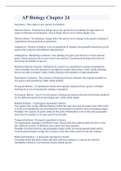
AP Biology Chapter 24 Speciation - The origin of new species in evolution. Macroevolution - Evolutionary change above the species level, including the appearance of major evolutionary developments, such as flight, that we use to define higher taxa. Microevolution - Evolutionary change below the species level; change in the genetic makeup of a population from generation to generation. Anagenesis - Phyletic evolution, is the accumulation of changes that gradually transform a given species into a species with different characteristics. Cladogenesis - Branching evolution, is the splitting of a gene pool into two or more separate pools, which each give rise to one or more new species. Can promote biological diversity by increasing the number of species. Biological Species Concept - Definition of a species as a population or group of populations whose members have the potential to interbreed in nature and produce viable, fertile offspring, but are not able to produce viable, fertile offspring with members of other populations. Reproductive Isolation - The existence of biological factors (barriers) that impede members of two species from producing viable, fertile hybrids. Prezygotic Barrier - A reproductive barrier that impedes mating between species or hinders fertilization of ova if interspecific mating is attempted. Postzygotic Barrier - Any of several species-isolating mechanisms that prevent hybrids produced by two different species from developing into viable, fertile adults. Habitat Isolation - A prezygotic reproductive barrier. Two species that occupy different habitats within the same area may encounter each other rarely, if at all, even though they are not isolated by obvious physical barriers such as mountain ranges. Example: Two species of garter snakes in the genus Thamnophis occur in the same geographic areas, but live mainly (a) in water and (b) terrestrially Temporal Isolation - Prezygotic reproductive barrier. Two populations reproduce at different times. Species that breed during different times of the day, different seasons, or different years cannot mix their gametes. Example: In North America, the geographic ranges of the (a) eastern spotted skunk and (b) western spotted skunk overlap, but (a) mates in the late winter and (b) in the late summer Behavioral Isolation - A prezygotic reproductive barrier. Courtship rituals that attract mates and other behaviors unique to a species are effective reproductive barriers, even between closely related species.
Geschreven voor
- Instelling
- AP Biology
- Vak
- AP Biology
Documentinformatie
- Geüpload op
- 23 april 2023
- Aantal pagina's
- 3
- Geschreven in
- 2022/2023
- Type
- Tentamen (uitwerkingen)
- Bevat
- Vragen en antwoorden
Onderwerpen
-
ap biology chapter 24 exam 2023

Ook beschikbaar in voordeelbundel