

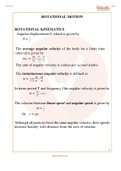
1 ROTATIONAL MOTION ROTATIONAL KINEMATICS Angular displacement , which is given by =
rs
The average angular velocity of the body for a finite time interval is given by av =
i fi f
t t t
The unit of angular velocity is radian per second (rad/s). The instantaneous angular velocity is defined as =
dtd
tLim
t
0
In terms period T and frequency f the angular velocity is given by =
fT 22
The relation between linear speed and angular speed is given by =
rv
Or v = r Although all particles have the same angular velocity, their speeds increase linearly with distance from the axis of rotation. 2 Equations of rotation kinematics to 2
21t to o o o 22 2 The ab ove equations are called the equations of rotation kinematics for constant angular acceleration. MOMENT OF INERTIA For a discrete system of particles the moment of inertia is defined as I = miri2 Where mi is the mass of the ith particle and ri is the perpendicular distance of the ith particle from the axis of rotation. r1 A discrete system of particles Axis of rotation m1 m3 r3 m2 r2 m4 r4 The Parallel Axis Theorem It states that the moment of inertia of a body about an axis is equal to its moment of inertia about a parallel axis through its centre of mass plus the product of the mass of the body and the square of perpendicular distance between the two axes. I = Icm + md 2
rs
The average angular velocity of the body for a finite time interval is given by av =
i fi f
t t t
The unit of angular velocity is radian per second (rad/s). The instantaneous angular velocity is defined as =
dtd
tLim
t
0
In terms period T and frequency f the angular velocity is given by =
fT 22
The relation between linear speed and angular speed is given by =
rv
Or v = r Although all particles have the same angular velocity, their speeds increase linearly with distance from the axis of rotation. 2 Equations of rotation kinematics to 2
21t to o o o 22 2 The ab ove equations are called the equations of rotation kinematics for constant angular acceleration. MOMENT OF INERTIA For a discrete system of particles the moment of inertia is defined as I = miri2 Where mi is the mass of the ith particle and ri is the perpendicular distance of the ith particle from the axis of rotation. r1 A discrete system of particles Axis of rotation m1 m3 r3 m2 r2 m4 r4 The Parallel Axis Theorem It states that the moment of inertia of a body about an axis is equal to its moment of inertia about a parallel axis through its centre of mass plus the product of the mass of the body and the square of perpendicular distance between the two axes. I = Icm + md 2


