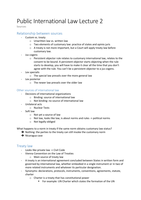
Public International Law Lecture 2
Sources
Relationship between sources
- Custom vs. treaty
o Unwritten law vs. written law
o Two elements of customary law: practice of states and opinio juris
o A treaty is not more important, but a Court will apply treaty law before
customary law.
- Jus cogens
o Persistent objector rule relates to customary international law, relates to the
consent to be bound. A persistent objector starts objecting when the rule
starts to develop, you will have to make it clear all the time that you don’t
agree with the rule. You can’t be a persistent objector to a jus cogens.
- Lex specialis
o The special law prevails over the more general law
- Lex posterior
o The newer law prevails over the older law
Other sources of international law
- Decisions of international organizations
o Binding: source of international law
o Not binding: no source of international law
- Unilateral acts
o Nuclear Tests
- Soft law
o Not yet a source of law
o Not law, looks like law, is about norms and rules -> political norms
o Not legally obliged
What happens to a norm in treaty if the same norm obtains customary law status?
Nothing: the parties to the treaty can still invoke the customary norm
Nicaragua case
Treaty law
- Looks like private law -> Civil Code
- Vienna Convention on the Law of Treaties
o Main source of treaty law
- A treaty is an international agreement concluded between States in written form and
governed by international law, whether embodied in a single instrument or in two of
more related instruments and whatever its particular designation.
- Synonyms: declarations, protocols, instruments, conventions, agreements, statute,
charter
o Charter is a treaty that has constitutional power
For example: UN Charter which states the formation of the UN
Sources
Relationship between sources
- Custom vs. treaty
o Unwritten law vs. written law
o Two elements of customary law: practice of states and opinio juris
o A treaty is not more important, but a Court will apply treaty law before
customary law.
- Jus cogens
o Persistent objector rule relates to customary international law, relates to the
consent to be bound. A persistent objector starts objecting when the rule
starts to develop, you will have to make it clear all the time that you don’t
agree with the rule. You can’t be a persistent objector to a jus cogens.
- Lex specialis
o The special law prevails over the more general law
- Lex posterior
o The newer law prevails over the older law
Other sources of international law
- Decisions of international organizations
o Binding: source of international law
o Not binding: no source of international law
- Unilateral acts
o Nuclear Tests
- Soft law
o Not yet a source of law
o Not law, looks like law, is about norms and rules -> political norms
o Not legally obliged
What happens to a norm in treaty if the same norm obtains customary law status?
Nothing: the parties to the treaty can still invoke the customary norm
Nicaragua case
Treaty law
- Looks like private law -> Civil Code
- Vienna Convention on the Law of Treaties
o Main source of treaty law
- A treaty is an international agreement concluded between States in written form and
governed by international law, whether embodied in a single instrument or in two of
more related instruments and whatever its particular designation.
- Synonyms: declarations, protocols, instruments, conventions, agreements, statute,
charter
o Charter is a treaty that has constitutional power
For example: UN Charter which states the formation of the UN