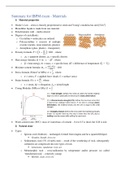
Summary for IBPM exam - Materials
1) Material properties
• Hooke’s Law – stress is linearly proportional to strain and Young’s modulus has unit [N/m2]
• Monolithic façade is made from one material
• Polychromatic wall – multi-colored
• Degrees of crystallinity:
o Crystalline = molecules are ordered
o Polycrystalline = consists of multiple
crystals (metals, stone materials, plastics)
o Amorphous (glass, plastics - transparent)
𝜌
• Porosity formula: 𝑃 = (1 − 𝜌𝑉 ) ∙ 100 , where:
𝑆
o 𝜌𝑉 = apparent density, 𝜌𝑆 = specific density
• Heat energy formula: 𝑄 = 𝑚 ∙ 𝑐 ∙ ∆𝑇 , where:
o 𝑄 = heat energy, 𝑚 = mass, 𝑐 = specific heat, ∆𝑇 = difference of temperature (𝑇𝑓 − 𝑇𝑖 )
𝑤𝑒𝑡−𝑑𝑟𝑦
• Moisture content formula: 𝑚𝑐 = ∙ 100
𝑑𝑟𝑦
𝐹
• Stress formula (N/mm2 or MPa): 𝜎 = , where:
𝑆
o 𝜎 = stress, 𝐹 = applied force (load), 𝑆 = surface (area)
∆𝐿
• Strain formula (%): 𝜀 = , where:
𝐿0
o 𝜀 = strain, ∆𝐿 = elongation, 𝐿0 = initial length
𝜎
• Young Modulus (MPa or GPa): 𝐸 = 𝜀
• Water-cement ratio (W/C): mass of water/mass of cement – 0.4 to 0.5 is ideal, but 0.28 is min
2) Natural stone
• Types:
o Igneous rock (bedrock) – unchanged, formed from magma and lava (quartz/feldspar)
▪ Granite, basalt, iron ore
o Sedimentary rock (5% of earth crust) – result of the weathering of rock, subsequently
sediments are compressed into new types of rock
▪ Limestone, sandstone, iron ore
o Metamorphic rock – recrystallization by temperature and/or pressure (so called
‘transformed rock’ – relatively young)
▪ Marble, slate, iron ore
, • How to can natural stone be obtained?
o From mountain/quarry – sawing, cutting, polishing (dimensions stone) / blasting,
grinding, milling, sieving (rock granules)
o From dredging, excavation - after weathering (erosion), transported by wind or water
and deposition (alluvial aggregates – gravel and sand(mostly quartz), clay)
• Products from natural stone:
o Dimension stone (shaped) – granites, sandstones; application: tile, block, column, short
beam (it’s dangerous to make too long beams)
o Aggregates (from weathering or quarrying)
o Fiber (melting and extrusion/spinning)
Figure 1: Facade made of natural stone cladding
• Granules:
o Aggregates (sand, gravel)
▪ Gabion = a net in which aggregates are packed in a cage
▪ Mortar and concrete – mixed with binder cement, lime etc.
▪ Asphalt – mixed with binder bitumen
▪ Heated and cooled – glass, fibers
o Fines (loam, clay)
▪ Clay bricks, loam plaster – compacted and dried
▪ Clay fired bricks, roof tiles – compacted, dried and fired
▪ Cement – heated in a kiln
▪ Glass – heated and quenched
3) Lime, gypsum, cement and concrete
• Ordinary Portland cement is made from C3A, C3S, C2S and gypsum (calcium sulphate)
• White Portland cement has no aluminate clinker phase (C4AF – which gives grey color to
Ordinary Portland cement)
• For concrete: water/cement/sand/gravel ratio = 0. /
• For mortar: cement or lime(binder) / sand = .5 to (has no gypsum)
• Concrete contains gravel, while AAC does not
• Both concrete and AAC contains sand and cement
• Application of quicklime (CaO):
o Sand-lime bricks(calcium silicate) – is made from cement, lime and sand
o AAC (autoclaved aerated concrete) – is made from cement, gypsum, lime, sand (not
mortar as binder)
o Slacked lime – Ca(OH)2 – used as plaster, binder (in masonry mortar)
1) Material properties
• Hooke’s Law – stress is linearly proportional to strain and Young’s modulus has unit [N/m2]
• Monolithic façade is made from one material
• Polychromatic wall – multi-colored
• Degrees of crystallinity:
o Crystalline = molecules are ordered
o Polycrystalline = consists of multiple
crystals (metals, stone materials, plastics)
o Amorphous (glass, plastics - transparent)
𝜌
• Porosity formula: 𝑃 = (1 − 𝜌𝑉 ) ∙ 100 , where:
𝑆
o 𝜌𝑉 = apparent density, 𝜌𝑆 = specific density
• Heat energy formula: 𝑄 = 𝑚 ∙ 𝑐 ∙ ∆𝑇 , where:
o 𝑄 = heat energy, 𝑚 = mass, 𝑐 = specific heat, ∆𝑇 = difference of temperature (𝑇𝑓 − 𝑇𝑖 )
𝑤𝑒𝑡−𝑑𝑟𝑦
• Moisture content formula: 𝑚𝑐 = ∙ 100
𝑑𝑟𝑦
𝐹
• Stress formula (N/mm2 or MPa): 𝜎 = , where:
𝑆
o 𝜎 = stress, 𝐹 = applied force (load), 𝑆 = surface (area)
∆𝐿
• Strain formula (%): 𝜀 = , where:
𝐿0
o 𝜀 = strain, ∆𝐿 = elongation, 𝐿0 = initial length
𝜎
• Young Modulus (MPa or GPa): 𝐸 = 𝜀
• Water-cement ratio (W/C): mass of water/mass of cement – 0.4 to 0.5 is ideal, but 0.28 is min
2) Natural stone
• Types:
o Igneous rock (bedrock) – unchanged, formed from magma and lava (quartz/feldspar)
▪ Granite, basalt, iron ore
o Sedimentary rock (5% of earth crust) – result of the weathering of rock, subsequently
sediments are compressed into new types of rock
▪ Limestone, sandstone, iron ore
o Metamorphic rock – recrystallization by temperature and/or pressure (so called
‘transformed rock’ – relatively young)
▪ Marble, slate, iron ore
, • How to can natural stone be obtained?
o From mountain/quarry – sawing, cutting, polishing (dimensions stone) / blasting,
grinding, milling, sieving (rock granules)
o From dredging, excavation - after weathering (erosion), transported by wind or water
and deposition (alluvial aggregates – gravel and sand(mostly quartz), clay)
• Products from natural stone:
o Dimension stone (shaped) – granites, sandstones; application: tile, block, column, short
beam (it’s dangerous to make too long beams)
o Aggregates (from weathering or quarrying)
o Fiber (melting and extrusion/spinning)
Figure 1: Facade made of natural stone cladding
• Granules:
o Aggregates (sand, gravel)
▪ Gabion = a net in which aggregates are packed in a cage
▪ Mortar and concrete – mixed with binder cement, lime etc.
▪ Asphalt – mixed with binder bitumen
▪ Heated and cooled – glass, fibers
o Fines (loam, clay)
▪ Clay bricks, loam plaster – compacted and dried
▪ Clay fired bricks, roof tiles – compacted, dried and fired
▪ Cement – heated in a kiln
▪ Glass – heated and quenched
3) Lime, gypsum, cement and concrete
• Ordinary Portland cement is made from C3A, C3S, C2S and gypsum (calcium sulphate)
• White Portland cement has no aluminate clinker phase (C4AF – which gives grey color to
Ordinary Portland cement)
• For concrete: water/cement/sand/gravel ratio = 0. /
• For mortar: cement or lime(binder) / sand = .5 to (has no gypsum)
• Concrete contains gravel, while AAC does not
• Both concrete and AAC contains sand and cement
• Application of quicklime (CaO):
o Sand-lime bricks(calcium silicate) – is made from cement, lime and sand
o AAC (autoclaved aerated concrete) – is made from cement, gypsum, lime, sand (not
mortar as binder)
o Slacked lime – Ca(OH)2 – used as plaster, binder (in masonry mortar)