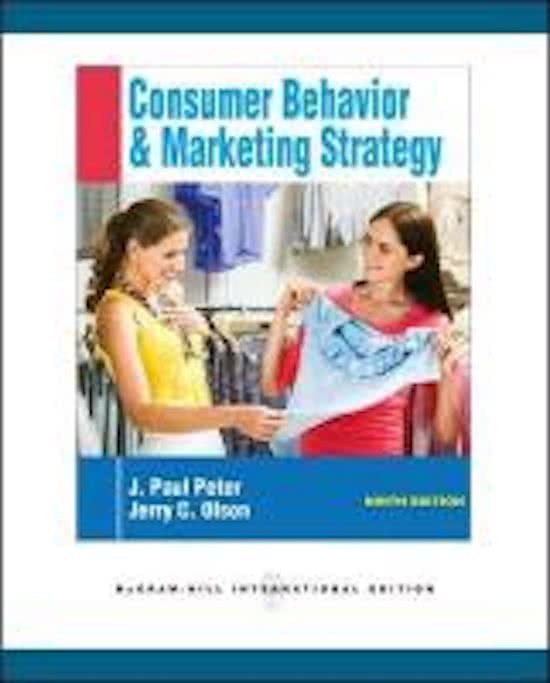
Summary Consumer Behaviour
Peter & Olson, 9th edition
Radboud University Nijmegen
Master Business Administration – Marketing
2016-2017
1
,Index
Chapter 1 Introduction to consumer behaviour and marketing strategy 3
Chapter 2 A framework for consumer analysis 4
Chapter 3 Introduction to affect and cognition 4
Chapter 4 Consumers’ product knowledge and involvement 6
Chapter 5 Attention and comprehension 8
Chapter 6 Attitudes and intentions 10
Chapter 7 Consumer decision making 12
Chapter 8 Introduction to behaviour 14
Chapter 9 Conditioning and learning processes 15
Chapter 10 Influencing consumer behaviours 17
Chapter 15 Market segmentation and product positioning 19
Chapter 16 Consumer behaviour and product strategy 21
Chapter 17 Consumer behaviour and promotion strategy 24
Chapter 18 Consumer behaviour and pricing strategy 28
Chapter 19 Consumer behaviour, electronic commerce and channel strategy 31
2
,Chapter 1 Introduction to consumer behaviour and marketing strategy
Marketing concept = suggests an organisation should satisfy consumer needs and wants to make
profits. To implement this concept, organisations must understand their customers and stay close to
them to provide products and services that consumers will purchase and use appropriately. Many of
the most successful companies have become so by designing the entire organisation based on
creating customer value, it is not only a marketing strategy, but the overall strategy for the
organisation.
Why are companies making changes to serve consumers better? Three reasons: 1. The success of
Japanese companies as Toyota and Sony, that focus on providing consumers with value-laden
products have forced other companies to follow. 2.Companies are now better able to actually
implement the marketing concept, because the quality of consumer and marketing research is
better. 3.Internet can be used as an effective marketing tool.
Consumer behaviour = “the dynamic interaction of affect and cognition, behaviour, and the
environment by which human beings conduct the exchange aspects of their lives”.
Dynamic because the thinking, feelings and actions of people and their environment are
constantly changing.
Interactions because consumer behaviour involves interactions among people’s thinking,
feelings and actions, and the environment.
Exchanges because it involves exchanges between human beings. People give up something
of value to others and receive something in return.
Thus, consumer behaviour involves the thoughts and feelings people experience and the actions they
perform in consumption processes. It also includes all the things in the environment that influence
these thoughts, feelings, and actions.
Three approaches to the study of consumer behaviour:
Approaches Core disciplines Primary objectives Primary methods
Interpretive Cultural anthropology Understand consumption and its Long interviews
meanings Focus groups
Traditional Psychology Explain consumer decision Experiments
Sociology making and behaviour Surveys
Marketing Economics Predict consumer choice and Math-modeling
science Statistics behaviour Simulation
Consumer behaviour research is used by three groups: marketing organisations, government and
political organisations and consumers.
Marketing strategy = the design, implementation, and control of a plan to influence exchanges to
achieve organisational objectives. They involve developing and presenting marketing stimuli directed
at selected target markets to influence what they think, how they feel, and what they do.
3
, Chapter 2 A framework for consumer analysis
Wheel of consumer analysis / Three elements for consumer analysis and their relationships:
Consumer affect and cognition
Two types of mental responses consumers exhibit
toward events in their environment. Affect = feelings
about stimuli and events, such as whether they like or
dislike a product. Emotions, moods, attitudes.
Cognition = refers to their thinking, such as their beliefs
about a product. Knowledge, meanings and beliefs that
customers have developed from their experiences.
Consumer behaviour
Behaviour = the physical actions of consumers that
can be directly observed and measured by others.
Consumer environment
Environment = everything external to consumers that
influences what they think, feel, and do. It includes social
stimuli, such as actions of others in cultures, subcultures,
social classes, reference groups and family.
Consumer processes can be viewed as a reciprocal system = any of the elements can be either a
cause or effect of a change at any particular time.
Marketing strategy from a consumer behaviour point of view = set of stimuli placed in consumers’
environments designed to influence their affect, cognition, and behaviour. Marketing strategies
should be developed, implemented, and changed based on consumer research and analysis. They
also should be designed to both influence consumers and be influenced by them.
Chapter 3 Introduction to affect and cognition
This chapter is about the consumer affect and cognition part in the Wheel of Consumer Analysis. All
factors in the wheel of consumer analysis influence one another continuous, so no factor can be fully
understood in isolation. Customers can have both affective and cognitive responses to any element
in the Wheel of Consumer Analysis.
Affect = refers to feeling responses. It is about something that people are or feel.
Types of affective responses (can be positive or negative):
Emotions
Specific feelings
Moods
Evaluations
Affective responses are produced by the affective system, that is largely reactive (automatic), where
people have little direct control over, feel physically in their body, and can respond to virtually any
type of stimulus. Most affective responses are learned through classical conditioning processes or
experiences as young children. Because this responses are learned, they may vary across cultures.
4
Peter & Olson, 9th edition
Radboud University Nijmegen
Master Business Administration – Marketing
2016-2017
1
,Index
Chapter 1 Introduction to consumer behaviour and marketing strategy 3
Chapter 2 A framework for consumer analysis 4
Chapter 3 Introduction to affect and cognition 4
Chapter 4 Consumers’ product knowledge and involvement 6
Chapter 5 Attention and comprehension 8
Chapter 6 Attitudes and intentions 10
Chapter 7 Consumer decision making 12
Chapter 8 Introduction to behaviour 14
Chapter 9 Conditioning and learning processes 15
Chapter 10 Influencing consumer behaviours 17
Chapter 15 Market segmentation and product positioning 19
Chapter 16 Consumer behaviour and product strategy 21
Chapter 17 Consumer behaviour and promotion strategy 24
Chapter 18 Consumer behaviour and pricing strategy 28
Chapter 19 Consumer behaviour, electronic commerce and channel strategy 31
2
,Chapter 1 Introduction to consumer behaviour and marketing strategy
Marketing concept = suggests an organisation should satisfy consumer needs and wants to make
profits. To implement this concept, organisations must understand their customers and stay close to
them to provide products and services that consumers will purchase and use appropriately. Many of
the most successful companies have become so by designing the entire organisation based on
creating customer value, it is not only a marketing strategy, but the overall strategy for the
organisation.
Why are companies making changes to serve consumers better? Three reasons: 1. The success of
Japanese companies as Toyota and Sony, that focus on providing consumers with value-laden
products have forced other companies to follow. 2.Companies are now better able to actually
implement the marketing concept, because the quality of consumer and marketing research is
better. 3.Internet can be used as an effective marketing tool.
Consumer behaviour = “the dynamic interaction of affect and cognition, behaviour, and the
environment by which human beings conduct the exchange aspects of their lives”.
Dynamic because the thinking, feelings and actions of people and their environment are
constantly changing.
Interactions because consumer behaviour involves interactions among people’s thinking,
feelings and actions, and the environment.
Exchanges because it involves exchanges between human beings. People give up something
of value to others and receive something in return.
Thus, consumer behaviour involves the thoughts and feelings people experience and the actions they
perform in consumption processes. It also includes all the things in the environment that influence
these thoughts, feelings, and actions.
Three approaches to the study of consumer behaviour:
Approaches Core disciplines Primary objectives Primary methods
Interpretive Cultural anthropology Understand consumption and its Long interviews
meanings Focus groups
Traditional Psychology Explain consumer decision Experiments
Sociology making and behaviour Surveys
Marketing Economics Predict consumer choice and Math-modeling
science Statistics behaviour Simulation
Consumer behaviour research is used by three groups: marketing organisations, government and
political organisations and consumers.
Marketing strategy = the design, implementation, and control of a plan to influence exchanges to
achieve organisational objectives. They involve developing and presenting marketing stimuli directed
at selected target markets to influence what they think, how they feel, and what they do.
3
, Chapter 2 A framework for consumer analysis
Wheel of consumer analysis / Three elements for consumer analysis and their relationships:
Consumer affect and cognition
Two types of mental responses consumers exhibit
toward events in their environment. Affect = feelings
about stimuli and events, such as whether they like or
dislike a product. Emotions, moods, attitudes.
Cognition = refers to their thinking, such as their beliefs
about a product. Knowledge, meanings and beliefs that
customers have developed from their experiences.
Consumer behaviour
Behaviour = the physical actions of consumers that
can be directly observed and measured by others.
Consumer environment
Environment = everything external to consumers that
influences what they think, feel, and do. It includes social
stimuli, such as actions of others in cultures, subcultures,
social classes, reference groups and family.
Consumer processes can be viewed as a reciprocal system = any of the elements can be either a
cause or effect of a change at any particular time.
Marketing strategy from a consumer behaviour point of view = set of stimuli placed in consumers’
environments designed to influence their affect, cognition, and behaviour. Marketing strategies
should be developed, implemented, and changed based on consumer research and analysis. They
also should be designed to both influence consumers and be influenced by them.
Chapter 3 Introduction to affect and cognition
This chapter is about the consumer affect and cognition part in the Wheel of Consumer Analysis. All
factors in the wheel of consumer analysis influence one another continuous, so no factor can be fully
understood in isolation. Customers can have both affective and cognitive responses to any element
in the Wheel of Consumer Analysis.
Affect = refers to feeling responses. It is about something that people are or feel.
Types of affective responses (can be positive or negative):
Emotions
Specific feelings
Moods
Evaluations
Affective responses are produced by the affective system, that is largely reactive (automatic), where
people have little direct control over, feel physically in their body, and can respond to virtually any
type of stimulus. Most affective responses are learned through classical conditioning processes or
experiences as young children. Because this responses are learned, they may vary across cultures.
4