Introduction to Social Science Research Summary
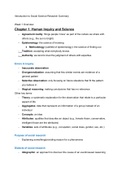
Week 1 Overview
Chapter 1: Human Inquiry and Science
- Agreement reality: things people ‘know’ as part of the culture we share with
others (e.g., the sun is bright)
- Epistemology: the science of knowing
● Methodology (subfield of epistemology): the science of finding out
- Tradition: accepting what everybody knows
- Authority: we tend to trust the judgment of others with expertise
Errors in inquiry
- Inaccurate observation
- Overgeneralization: assuming that few similar events are evidence of a
general pattern
- Selective observation: only focusing on future situations that fit the pattern
you believe in
- Illogical reasoning: making conclusions that has no relevance
Other key terms
- Theory: a systematic explanation for the observation that relate to a particular
aspect of life
- Aggregates: data that represent an information of a group instead of an
individual
- Concepts: an idea
- Attributes: qualities that describe an object (e.g., female Asian, conservative,
intelligent those are the attributes)
- Variables: sets of attributes (e.g., occupation, social class, gender, sex, etc.)
Purpose of social research
- Explaining something/providing reason for a phenomena
Dialects of social research
- Idiographic: an approach to discover the cause of an event/causal reasoning
, - Nomothetic: an approach to identify the several causes that impact an event
● “What does it mean when social researchers say one variable
(nomothetical) causes another?” = causal relationship
● Criteria for causality in research: variables must be correlated, cause
takes place before the effect, variables are non-spurious (cannot be
made up)
- Induction: general principles are developed from observations first
- Deduction: hypothesis is developed from seeing the general principles first
- Determinism: belief that all events (behavior, moral, etc.) are determined by
pre-existing causes
- Agency: human action/individual’s ability to make own free choice
- Qualitative: seeking in-depth explanation using interviews, observation, etc.
that appear in a narrative form
- Quantitative: quantifying a problem, usually works deductively
Chapter 2: Paradigms, Theory, and Research (p. 45-58)
Two Logical Systems Revisited
Traditional model of science
1. Theory
- Scientists begin with a theory and then hypothesis that they can test.
● Hypothesis: an expectation on how a phenomenon goes, usually
derives from a theory, and intends to test if it is correct.
2. Operationalization
- Specifying the meaning of all the variables involves and ‘operationalize’
it/measure the variables
- Operational definition: concrete and specific definition of something in
terms of operations
3. Observation
4. Conceptualization
- Defines concept and transforms it into something measurable
Deduction (top-down): hypothesis > observation > match hypothesis with
observation
, Induction (bottom-up): observation > finding pattern > conclusion
Grounded theory: to generate a theory by working from the ground up/observing
the aspect first, then seeking patterns, finally drawing a conclusion or theory
Tutorial
Empirical cycle
- Empirical observation requires you to go out to the world (field research)
- Inductive > general principles > deductive > specific instances > back to
inductive
Week 1 Overview
Chapter 1: Human Inquiry and Science
- Agreement reality: things people ‘know’ as part of the culture we share with
others (e.g., the sun is bright)
- Epistemology: the science of knowing
● Methodology (subfield of epistemology): the science of finding out
- Tradition: accepting what everybody knows
- Authority: we tend to trust the judgment of others with expertise
Errors in inquiry
- Inaccurate observation
- Overgeneralization: assuming that few similar events are evidence of a
general pattern
- Selective observation: only focusing on future situations that fit the pattern
you believe in
- Illogical reasoning: making conclusions that has no relevance
Other key terms
- Theory: a systematic explanation for the observation that relate to a particular
aspect of life
- Aggregates: data that represent an information of a group instead of an
individual
- Concepts: an idea
- Attributes: qualities that describe an object (e.g., female Asian, conservative,
intelligent those are the attributes)
- Variables: sets of attributes (e.g., occupation, social class, gender, sex, etc.)
Purpose of social research
- Explaining something/providing reason for a phenomena
Dialects of social research
- Idiographic: an approach to discover the cause of an event/causal reasoning
, - Nomothetic: an approach to identify the several causes that impact an event
● “What does it mean when social researchers say one variable
(nomothetical) causes another?” = causal relationship
● Criteria for causality in research: variables must be correlated, cause
takes place before the effect, variables are non-spurious (cannot be
made up)
- Induction: general principles are developed from observations first
- Deduction: hypothesis is developed from seeing the general principles first
- Determinism: belief that all events (behavior, moral, etc.) are determined by
pre-existing causes
- Agency: human action/individual’s ability to make own free choice
- Qualitative: seeking in-depth explanation using interviews, observation, etc.
that appear in a narrative form
- Quantitative: quantifying a problem, usually works deductively
Chapter 2: Paradigms, Theory, and Research (p. 45-58)
Two Logical Systems Revisited
Traditional model of science
1. Theory
- Scientists begin with a theory and then hypothesis that they can test.
● Hypothesis: an expectation on how a phenomenon goes, usually
derives from a theory, and intends to test if it is correct.
2. Operationalization
- Specifying the meaning of all the variables involves and ‘operationalize’
it/measure the variables
- Operational definition: concrete and specific definition of something in
terms of operations
3. Observation
4. Conceptualization
- Defines concept and transforms it into something measurable
Deduction (top-down): hypothesis > observation > match hypothesis with
observation
, Induction (bottom-up): observation > finding pattern > conclusion
Grounded theory: to generate a theory by working from the ground up/observing
the aspect first, then seeking patterns, finally drawing a conclusion or theory
Tutorial
Empirical cycle
- Empirical observation requires you to go out to the world (field research)
- Inductive > general principles > deductive > specific instances > back to
inductive