What is Thread? Explain Life Cycle of thread
What is Thread in java
A thread is a lightweight subprocess, the smallest unit of processing. It is a separate
path of execution.
Threads are independent. If there occurs exception in one thread, it doesn't affect other
threads. It uses a shared memory area.
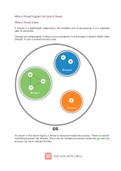
As shown in the above figure, a thread is executed inside the process. There is context-
switching between the threads. There can be multiple processes inside the OS, and one
process can have multiple threads.
, Life cycle of a Thread (Thread States)
In Java, a thread always exists in any one of the following states. These states are:
1. New
2. Active
3. Blocked / Waiting
4. Timed Waiting
5. Terminated
Explanation of Different Thread States
New: Whenever a new thread is created, it is always in the new state. For a thread in the
new state, the code has not been run yet and thus has not begun its execution.
Active: When a thread invokes the start() method, it moves from the new state to the
active state. The active state contains two states within it: one is runnable, and the
other is running.
o Runnable: A thread, that is ready to run is then moved to the runnable state. In
the runnable state, the thread may be running or may be ready to run at any given
instant of time. It is the duty of the thread scheduler to provide the thread time to
run, i.e., moving the thread the running state.
o Running: When the thread gets the CPU, it moves from the runnable to the
running state. Generally, the most common change in the state of a thread is
from runnable to running and again back to runnable.
Blocked or Waiting: Whenever a thread is inactive for a span of time (not permanently)
then, either the thread is in the blocked state or is in the waiting state.
If there are a lot of threads in the waiting or blocked state, then it is the duty of the
thread scheduler to determine which thread to choose and which one to reject, and the
chosen thread is then given the opportunity to run.
Timed Waiting: Sometimes, waiting for leads to starvation. For example, a thread (its
name is A) has entered the critical section of a code and is not willing to leave that
critical section. In such a scenario, another thread (its name is B) has to wait forever,
which leads to starvation. To avoid such scenario, a timed waiting state is given to
What is Thread in java
A thread is a lightweight subprocess, the smallest unit of processing. It is a separate
path of execution.
Threads are independent. If there occurs exception in one thread, it doesn't affect other
threads. It uses a shared memory area.
As shown in the above figure, a thread is executed inside the process. There is context-
switching between the threads. There can be multiple processes inside the OS, and one
process can have multiple threads.
, Life cycle of a Thread (Thread States)
In Java, a thread always exists in any one of the following states. These states are:
1. New
2. Active
3. Blocked / Waiting
4. Timed Waiting
5. Terminated
Explanation of Different Thread States
New: Whenever a new thread is created, it is always in the new state. For a thread in the
new state, the code has not been run yet and thus has not begun its execution.
Active: When a thread invokes the start() method, it moves from the new state to the
active state. The active state contains two states within it: one is runnable, and the
other is running.
o Runnable: A thread, that is ready to run is then moved to the runnable state. In
the runnable state, the thread may be running or may be ready to run at any given
instant of time. It is the duty of the thread scheduler to provide the thread time to
run, i.e., moving the thread the running state.
o Running: When the thread gets the CPU, it moves from the runnable to the
running state. Generally, the most common change in the state of a thread is
from runnable to running and again back to runnable.
Blocked or Waiting: Whenever a thread is inactive for a span of time (not permanently)
then, either the thread is in the blocked state or is in the waiting state.
If there are a lot of threads in the waiting or blocked state, then it is the duty of the
thread scheduler to determine which thread to choose and which one to reject, and the
chosen thread is then given the opportunity to run.
Timed Waiting: Sometimes, waiting for leads to starvation. For example, a thread (its
name is A) has entered the critical section of a code and is not willing to leave that
critical section. In such a scenario, another thread (its name is B) has to wait forever,
which leads to starvation. To avoid such scenario, a timed waiting state is given to