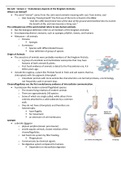
Bio 224 – lecture 1 – Evolutionary Aspects of the Kingdom Animalia
What is an Animal?
• The word “animal” comes from the Latin word animalis meaning with soul, from ánima, soul
o Also meaning “having breath” the first use of the term is found in the Bible:
“And the LORD God formed man of the dust of the ground and breathed into his nostrils
the breath of life; and man became a living soul.”
The colloquial use of the word animal refers to non-human animals.
• But the biological definition refers to all members of the kingdom Animalia.
• Encompassing diverse creatures, such as sponges, jellyfish, insects, and humans
• Metazoan – all animals:
o Parazoa
§ Sponges
o Eumetazoa
§ Species with differentiated tissues
§ Clear definition of group of species
Origin of Animals
• The ancestors of animals were probably members of the Kingdom Protista.
o A group of unicellular and multicellular eukaryotes that may have
features of both animals & plants.
o First fossil evidence of animals is dated to the Precambrian era, 4.6
billion years ago.
• Include the euglena, a plant-like Protista found in fresh and salt waters that has
chloroplasts with the pigment chlorophyll.
o Unicellular protists with more animal-like characteristics are termed protozoa, a terminology
not frequently used in present days.
Choanoflagellates are the first evolutionary evidence of intercellular communication.
• A protozoan-like modern colonial flagellated species
o The closest living relatives of modern animals
o There are approximately 140 species.
o Some of which are single celled, while others form
colonies attached to a solid substrate by a common
stalk.
o they do not have chloroplasts and therefore are
heterotrophs.
§ have flagella.
§ for movement
§ an extension of cell membranes
sponges
• suborder Parazoa
o phylum porifera (Greek: pore bearer)
o sessile aquatic animals, closest relatives of the
choanoflagellates.
o Get food into system by filter feeding.
§ Phagocytosis
o Communicate by chemical signals.
o No digestive system compared to humans.
§ Dependent on intracellular digestion
, Tissue stability is achieved through cell junctions and the extracellular matrix.
• A crucial step in the transition to multicellularity are
the connections through cell junctions.
o Unique to animals.
• Tight junctions:
o Rows of transmembrane proteins that bind to
the corresponding membrane proteins of the
adjacent cell.
§ Separates the two sides of a sheet of
cells.
§ From impermeable barriers
• Gap junctions:
o Intracellular channels that directly
communicate the cytoplasm of two cells,
allowing passage of ions and small molecules.
• Anchoring junctions:
o Link the cytoskeleton with the extracellular
matrix.
§ Adheres junctions.
§ Hemidesmosomes
§ Desmosomes: protein that allows
recognition of other cells
• Joins cells through cadherins of the same tissue by homophilic binding attached
to intermediate filaments of the cytoskeleton.
• A common proteome of identical proteins allows cells to recognize and bind
each other.
The hallmarks of Multicellularity
• The first hallmark – the formation a space between cells known as
the interstitial space (IS)
o filled with the interstitial fluid (IF) that bathes and
surrounds the cell.
• the second hallmark – controlling of the internal media.
o maintaining a complex animal body requires the ability to
control the variables of the internal media,
§ including nutrients, pH, temp & concentration of
electrolytes
What is an Animal?
• The word “animal” comes from the Latin word animalis meaning with soul, from ánima, soul
o Also meaning “having breath” the first use of the term is found in the Bible:
“And the LORD God formed man of the dust of the ground and breathed into his nostrils
the breath of life; and man became a living soul.”
The colloquial use of the word animal refers to non-human animals.
• But the biological definition refers to all members of the kingdom Animalia.
• Encompassing diverse creatures, such as sponges, jellyfish, insects, and humans
• Metazoan – all animals:
o Parazoa
§ Sponges
o Eumetazoa
§ Species with differentiated tissues
§ Clear definition of group of species
Origin of Animals
• The ancestors of animals were probably members of the Kingdom Protista.
o A group of unicellular and multicellular eukaryotes that may have
features of both animals & plants.
o First fossil evidence of animals is dated to the Precambrian era, 4.6
billion years ago.
• Include the euglena, a plant-like Protista found in fresh and salt waters that has
chloroplasts with the pigment chlorophyll.
o Unicellular protists with more animal-like characteristics are termed protozoa, a terminology
not frequently used in present days.
Choanoflagellates are the first evolutionary evidence of intercellular communication.
• A protozoan-like modern colonial flagellated species
o The closest living relatives of modern animals
o There are approximately 140 species.
o Some of which are single celled, while others form
colonies attached to a solid substrate by a common
stalk.
o they do not have chloroplasts and therefore are
heterotrophs.
§ have flagella.
§ for movement
§ an extension of cell membranes
sponges
• suborder Parazoa
o phylum porifera (Greek: pore bearer)
o sessile aquatic animals, closest relatives of the
choanoflagellates.
o Get food into system by filter feeding.
§ Phagocytosis
o Communicate by chemical signals.
o No digestive system compared to humans.
§ Dependent on intracellular digestion
, Tissue stability is achieved through cell junctions and the extracellular matrix.
• A crucial step in the transition to multicellularity are
the connections through cell junctions.
o Unique to animals.
• Tight junctions:
o Rows of transmembrane proteins that bind to
the corresponding membrane proteins of the
adjacent cell.
§ Separates the two sides of a sheet of
cells.
§ From impermeable barriers
• Gap junctions:
o Intracellular channels that directly
communicate the cytoplasm of two cells,
allowing passage of ions and small molecules.
• Anchoring junctions:
o Link the cytoskeleton with the extracellular
matrix.
§ Adheres junctions.
§ Hemidesmosomes
§ Desmosomes: protein that allows
recognition of other cells
• Joins cells through cadherins of the same tissue by homophilic binding attached
to intermediate filaments of the cytoskeleton.
• A common proteome of identical proteins allows cells to recognize and bind
each other.
The hallmarks of Multicellularity
• The first hallmark – the formation a space between cells known as
the interstitial space (IS)
o filled with the interstitial fluid (IF) that bathes and
surrounds the cell.
• the second hallmark – controlling of the internal media.
o maintaining a complex animal body requires the ability to
control the variables of the internal media,
§ including nutrients, pH, temp & concentration of
electrolytes