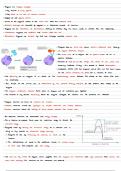
, Probability :
How
likely something is to happen .
Thing you
want to happen is an event .
Each toss of a coin is called a trial .
Result of a trial is an outcome .
Outcomes:
Some outcomes
always happen They're .
certain .
Some outcomes never
happen .
They're impossible .
Some not certain ,
but not impossible .
Probability greater than 0 less than 1 .
Compare probabilities:
The less smaller
likely an event is to happen ,
the the % .
The more
likely an event is to
happen ,
the
bigger the % .
Listing outcomes:
Favourable outcomes : Outcomes that
give the '
event
'
you
are invested in .
"
"
Getting an even number when
you
throw a dice
Throw
Activity : a dice
Possible outcomes : 1 , 2,3 , 4,5 ,
6
Event in c- rested in :
Getting an even number .
Favourable outcome :
2. 4,6
Event : See hich consists of one or more of the elements of the sample space .
,Sample space:
The sample space associated with a statistical experiment is the set of all possible outcomes of the experiment .
The number of possible outcomes in the sample space nls)=8
Four cards of diff rent suits .
Probability line:
Oi .
50% 100%
Draw a card . You've performed a trial .
certain
impossible even chance
Card draw is an outcome
you
.
Represent set notation ,
s = { A ;k ; Q ; J }
Union and intersections:
S={ 1 ; 2 ;3 ; 4 ; 5 ; 6 ; 7 ; 8 ; 9:10 }
factor of { }
Drawing a 6 : x =
1 ; 2 ; } ;b
factor of ; } ; 9}
Drawing a 9 :
y={ 1
Union:
x or { I ;3 ; a }
y x u
y
2 ;b ;
= =
Intersection:
x and
any { I ;3 }
y
= =
Disjointed : No mutual elements n B = { }
Calculating probabilities i
Outcomes
Equally likely outcomes : _ : which have an
equal chance of
happening .
P (E) =
number of favourable outcomes = n E)
total number of nls )
possible outcomes
, Mutually exclusive events:
The events -
and B exclude each other .
P A v13 =
PC A) + PCB) -
0
Both events cant happen at one trial .
Set of outcome for events are disjointed .
P A and B =
0
P An B =
0
P A or B =P An B
=P (A) + P (B)
Complementary events:
Two R and Q
complementary events .
(B) +
n ( Q) =
nls )
PIR ) + PIQ) = 1¥ =
1
P (a) =
1- PIR )
3. If ✗ and Y aren't
mutually exclusive
:
P ✗ or Y =
P ✗ v4
Two inclusive events the > -
r B
following rules are true:
Mutually exclusive events A and B
these rules are true:
Events A and B are exhaustive if
P(A or B) =1:
Two complementary events:
How
likely something is to happen .
Thing you
want to happen is an event .
Each toss of a coin is called a trial .
Result of a trial is an outcome .
Outcomes:
Some outcomes
always happen They're .
certain .
Some outcomes never
happen .
They're impossible .
Some not certain ,
but not impossible .
Probability greater than 0 less than 1 .
Compare probabilities:
The less smaller
likely an event is to happen ,
the the % .
The more
likely an event is to
happen ,
the
bigger the % .
Listing outcomes:
Favourable outcomes : Outcomes that
give the '
event
'
you
are invested in .
"
"
Getting an even number when
you
throw a dice
Throw
Activity : a dice
Possible outcomes : 1 , 2,3 , 4,5 ,
6
Event in c- rested in :
Getting an even number .
Favourable outcome :
2. 4,6
Event : See hich consists of one or more of the elements of the sample space .
,Sample space:
The sample space associated with a statistical experiment is the set of all possible outcomes of the experiment .
The number of possible outcomes in the sample space nls)=8
Four cards of diff rent suits .
Probability line:
Oi .
50% 100%
Draw a card . You've performed a trial .
certain
impossible even chance
Card draw is an outcome
you
.
Represent set notation ,
s = { A ;k ; Q ; J }
Union and intersections:
S={ 1 ; 2 ;3 ; 4 ; 5 ; 6 ; 7 ; 8 ; 9:10 }
factor of { }
Drawing a 6 : x =
1 ; 2 ; } ;b
factor of ; } ; 9}
Drawing a 9 :
y={ 1
Union:
x or { I ;3 ; a }
y x u
y
2 ;b ;
= =
Intersection:
x and
any { I ;3 }
y
= =
Disjointed : No mutual elements n B = { }
Calculating probabilities i
Outcomes
Equally likely outcomes : _ : which have an
equal chance of
happening .
P (E) =
number of favourable outcomes = n E)
total number of nls )
possible outcomes
, Mutually exclusive events:
The events -
and B exclude each other .
P A v13 =
PC A) + PCB) -
0
Both events cant happen at one trial .
Set of outcome for events are disjointed .
P A and B =
0
P An B =
0
P A or B =P An B
=P (A) + P (B)
Complementary events:
Two R and Q
complementary events .
(B) +
n ( Q) =
nls )
PIR ) + PIQ) = 1¥ =
1
P (a) =
1- PIR )
3. If ✗ and Y aren't
mutually exclusive
:
P ✗ or Y =
P ✗ v4
Two inclusive events the > -
r B
following rules are true:
Mutually exclusive events A and B
these rules are true:
Events A and B are exhaustive if
P(A or B) =1:
Two complementary events: