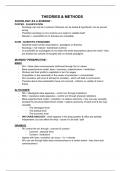
M1 – Neurobiology of Memory
Efficient Study:
• Divide your time over the next few weeks (spacing effect)
• Make sure you can reproduce the information (generation effect, retrieval practice
effect*, levels of processing effect**)
• No alcohol during learning (state-dependent learning)
* The retrieval practice effect is one of the strongest effects in memory: rather than learning by
repetition, test yourself as soon as you can. The best moment to do so is when you still remember
a little bit. By retrieving what you almost forgot, you have the strongest possible learning effect
of memory (without doing too much of an effort).
** The levels of processing effect entails that higher levels of processing (e.g., critical appraisal,
connecting two distant topics) have a better learning effect. So, the deeper the processing, the
better the learning.
History of Memory Research
Aristotle
Interest in association between stimuli (associationism), thought to be at the basis of knowledge.
His ideas have a long-ranging effect, so that millennia later they were adopted and formalized by
British philosophers (e.g., Locke, Mill).
Cicero
In his book “Herennium”, he introduces the method of loci, which is useful to learn lists of
things in logical order (e.g., Bible passages) and more.
Darwin
His idea that everything evolves to be fit to survive and create offspring applies to memory as
well. In fact, the specific characteristics of our memory have evolved for us to function optimally
in our environment, which is strongly social. Likewise, honeybees have different types of
memory, which are geared toward their optimal survival: depending on what the bee does,
different types of memory have evolved across time.
There may be an active process in our brain that erases what we do not longer need.
Ebbinghaus
Founder of modern memory psychology; did experiments on himself. Mainly famous for the
Ebbinghaus’ forgetting curve.
Jost
Jost’s Law: if two memory traces have equal retrieval probability but different ages, the older
one will be forgotten more slowly and benefit more from additional learning (than the younger
one). This law holds although we don’t know why.
1
,Bartlett
Interested in the structure of memory and focus on the influence of existing knowledge. He sees
memory as a construction, where the missing pieces are complemented by known information.
Our known information (in the form of general knowledge) is organized in schemata
(knowledge structures). Thus, our memories are typically not very detailed, and we (our brains)
fill in the blanks with existing knowledge of the world.
James
Distinguished between primary and secondary memory (similar to STM and LTM) and is well-
known for his TOT (tip-of-tongue) phenomenon.
Freud
Contributed mostly to implicit memory through his emphasis on unconscious processes. His
ideas on repression as a mechanism for forgetting are still relevant (influence of emotion). Also
well known for the SOT phenomenon (slip-of-tongue). Nowadays, both repression and SOT are
accepted as real but rare things.
Lashley
Lashley wants to find where memory sits in the mouse brain: he trained the mouse to find cheese
at the end of a maze. Then, he progressively cut portions of the cortex and repeated testing in a
hope to eventually find the cortical area responsible for memory. He found that no matter where
he cut, the mouse would not do a lot of worse unless there was a lot of cortex missing.
In other words, there was no specific cortical area where the memory trace was stored. From this,
he concluded that memories are stores all over the cortex: localization doesn’t apply to memory.
Nowadays, this is debated, and research shows that while some areas are localized (to some
degree), other areas are not (information is stored extensively).
Ribot
Ribot is known for his book on memory loss and the Ribot gradient: severe memory loss
impacts recent memories first. Last in, first out.
Important for neuropsychology of memory.
Hebb
Hebbian learning (neural networks), “cells that fire together, wire together” (he never said that,
but still)
Behaviorism
Pavlov
Classical conditioning
Watson
Fear conditioning (little Albert).
2
, Skinner
Operant conditioning.
Tolman
Purposive behaviorism.
Cognitive Psychology
In the 50s, computers influence our ideas about memory, which is now viewed as a carrier of
information that is manipulated during cognition. Here, Miller comes up with Miller’s law: we
can keep about 7 things in mind at any given time, with an error margin of 2 (i.e., 7 ± 2).
The computer idea is also used by Broadbent, who devised Broadbent’s model of memory
(focused on filtering).
The Atkinson and Shiffrin’s Model is very mathematical.
The Baddeley and Hitch Model resembles and extends the previous model by including control
mechanisms (central executive) and different memory modules.
Tulving introduces the distinction between episodic (instances in subjective time), semantic
(general knowledge, not bound to specific contexts) and procedural memories (knowing how,
S-R associations, for which we don’t need conscious processing).
3
Efficient Study:
• Divide your time over the next few weeks (spacing effect)
• Make sure you can reproduce the information (generation effect, retrieval practice
effect*, levels of processing effect**)
• No alcohol during learning (state-dependent learning)
* The retrieval practice effect is one of the strongest effects in memory: rather than learning by
repetition, test yourself as soon as you can. The best moment to do so is when you still remember
a little bit. By retrieving what you almost forgot, you have the strongest possible learning effect
of memory (without doing too much of an effort).
** The levels of processing effect entails that higher levels of processing (e.g., critical appraisal,
connecting two distant topics) have a better learning effect. So, the deeper the processing, the
better the learning.
History of Memory Research
Aristotle
Interest in association between stimuli (associationism), thought to be at the basis of knowledge.
His ideas have a long-ranging effect, so that millennia later they were adopted and formalized by
British philosophers (e.g., Locke, Mill).
Cicero
In his book “Herennium”, he introduces the method of loci, which is useful to learn lists of
things in logical order (e.g., Bible passages) and more.
Darwin
His idea that everything evolves to be fit to survive and create offspring applies to memory as
well. In fact, the specific characteristics of our memory have evolved for us to function optimally
in our environment, which is strongly social. Likewise, honeybees have different types of
memory, which are geared toward their optimal survival: depending on what the bee does,
different types of memory have evolved across time.
There may be an active process in our brain that erases what we do not longer need.
Ebbinghaus
Founder of modern memory psychology; did experiments on himself. Mainly famous for the
Ebbinghaus’ forgetting curve.
Jost
Jost’s Law: if two memory traces have equal retrieval probability but different ages, the older
one will be forgotten more slowly and benefit more from additional learning (than the younger
one). This law holds although we don’t know why.
1
,Bartlett
Interested in the structure of memory and focus on the influence of existing knowledge. He sees
memory as a construction, where the missing pieces are complemented by known information.
Our known information (in the form of general knowledge) is organized in schemata
(knowledge structures). Thus, our memories are typically not very detailed, and we (our brains)
fill in the blanks with existing knowledge of the world.
James
Distinguished between primary and secondary memory (similar to STM and LTM) and is well-
known for his TOT (tip-of-tongue) phenomenon.
Freud
Contributed mostly to implicit memory through his emphasis on unconscious processes. His
ideas on repression as a mechanism for forgetting are still relevant (influence of emotion). Also
well known for the SOT phenomenon (slip-of-tongue). Nowadays, both repression and SOT are
accepted as real but rare things.
Lashley
Lashley wants to find where memory sits in the mouse brain: he trained the mouse to find cheese
at the end of a maze. Then, he progressively cut portions of the cortex and repeated testing in a
hope to eventually find the cortical area responsible for memory. He found that no matter where
he cut, the mouse would not do a lot of worse unless there was a lot of cortex missing.
In other words, there was no specific cortical area where the memory trace was stored. From this,
he concluded that memories are stores all over the cortex: localization doesn’t apply to memory.
Nowadays, this is debated, and research shows that while some areas are localized (to some
degree), other areas are not (information is stored extensively).
Ribot
Ribot is known for his book on memory loss and the Ribot gradient: severe memory loss
impacts recent memories first. Last in, first out.
Important for neuropsychology of memory.
Hebb
Hebbian learning (neural networks), “cells that fire together, wire together” (he never said that,
but still)
Behaviorism
Pavlov
Classical conditioning
Watson
Fear conditioning (little Albert).
2
, Skinner
Operant conditioning.
Tolman
Purposive behaviorism.
Cognitive Psychology
In the 50s, computers influence our ideas about memory, which is now viewed as a carrier of
information that is manipulated during cognition. Here, Miller comes up with Miller’s law: we
can keep about 7 things in mind at any given time, with an error margin of 2 (i.e., 7 ± 2).
The computer idea is also used by Broadbent, who devised Broadbent’s model of memory
(focused on filtering).
The Atkinson and Shiffrin’s Model is very mathematical.
The Baddeley and Hitch Model resembles and extends the previous model by including control
mechanisms (central executive) and different memory modules.
Tulving introduces the distinction between episodic (instances in subjective time), semantic
(general knowledge, not bound to specific contexts) and procedural memories (knowing how,
S-R associations, for which we don’t need conscious processing).
3