

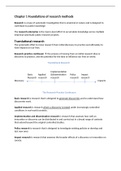
Chapter 1 Foundations of research methods
Research is a type of systematic investigation that is empirical in nature and is designed to
contribute to public knowledge
The research enterprise is the macro-level effort to accumulate knowledge across multiple
empirical systematic public research projects.
Translational research
The systematic effort to move research from initial discovery to practice and ultimately to
have impacts on our lives.
Research-practice continuum the process of moving from an initial research idea or
discovery to practice, and the potential for the idea to influence our lives or world.
Translational Research
Implementation
Basic Applied &dissemination Policy Impact
Research research research research research
Discovery Impacts
The Research-Practice Continuum
Basic research is research that is designed to generate discoveries and to understand how
discoveries work.
Applied research is research where a discovery is tested under increasingly controlled
conditions in real-world contexts.
Implementation and dissemination research is research that assesses how well an
innovation or discovery can be distributed in and carried out in a broad range of contexts
that extend beyond the original controlled studies.
Policy research is research that is designed to investigate existing policies or develop and
test new ones
Impact research is research that assesses the broader effects of a discovery or innovation on
society.
,Research synthesis is a systematic study of multiple prior research projects that address the
same research question or topic and that summarizes the results in a manner that can be
used by practitioners.
Meta-analysis is a type of research synthesis that uses statistical methods to combine the
results of similar studies quantitatively in order to allow general conclusions to be made.
Relationships:
Positive relationship Negative relationship No relationship
Hypothesis:
A hypothesis is a specific statement of prediction
Alternative hypothesis is a specific statement of prediction that usually states what you
expect will happen in your study
Null hypothesis is the hypothesis that describes the possible outcomes other than the
alternative hypothesis. Usually, the null hypothesis predicts there will be no effect of a
program or treatment you are studying.
One-tailed hypothesis the hypothesis that specifies a direction; for example, when your
hypothesis predicts that your program will increase the outcome.
Two-tailed hypothesis is a hypothesis that does not specify a direction. For example, if your
hypothesis is that your program or intervention will have an effect on an outcome, but you
are unwilling to specify whether that effect will be positive or negative, you are using a two-
tailed hypothesis.
, Variables:
Independent variable is the variable that you manipulate. E.G., a program or treatment.
Dependent variable is the variable effected by the independent variable. E.G., the outcome.
Deduction and induction:
Deductive reasoning from the more general into the more specific:
Theory hypothesis observation confirmation
Inductive reasoning moving form specific observations to broader generalizations and
theories. In inductive reasoning, you begin with specific observations and measures, detect
initial patterns and regularities, formulate some tentative hypotheses that you can explore,
and finally end up developing some general conclusions or theories.
Observation pattern tentative hypothesis theory
Validity:
Validity is the best available approximation of the truth of a given proposition, inference, or
conclusion.
There are four validity types:
Validity
External validity Can we generalize to
other persons, places, times?
Construct validity Can we generalize to the constructs?
Internal validity Is the relationship causal?
Conclusion validity Is there a relationship between the cause and effect?
(The validity questions are cumulative)
Research is a type of systematic investigation that is empirical in nature and is designed to
contribute to public knowledge
The research enterprise is the macro-level effort to accumulate knowledge across multiple
empirical systematic public research projects.
Translational research
The systematic effort to move research from initial discovery to practice and ultimately to
have impacts on our lives.
Research-practice continuum the process of moving from an initial research idea or
discovery to practice, and the potential for the idea to influence our lives or world.
Translational Research
Implementation
Basic Applied &dissemination Policy Impact
Research research research research research
Discovery Impacts
The Research-Practice Continuum
Basic research is research that is designed to generate discoveries and to understand how
discoveries work.
Applied research is research where a discovery is tested under increasingly controlled
conditions in real-world contexts.
Implementation and dissemination research is research that assesses how well an
innovation or discovery can be distributed in and carried out in a broad range of contexts
that extend beyond the original controlled studies.
Policy research is research that is designed to investigate existing policies or develop and
test new ones
Impact research is research that assesses the broader effects of a discovery or innovation on
society.
,Research synthesis is a systematic study of multiple prior research projects that address the
same research question or topic and that summarizes the results in a manner that can be
used by practitioners.
Meta-analysis is a type of research synthesis that uses statistical methods to combine the
results of similar studies quantitatively in order to allow general conclusions to be made.
Relationships:
Positive relationship Negative relationship No relationship
Hypothesis:
A hypothesis is a specific statement of prediction
Alternative hypothesis is a specific statement of prediction that usually states what you
expect will happen in your study
Null hypothesis is the hypothesis that describes the possible outcomes other than the
alternative hypothesis. Usually, the null hypothesis predicts there will be no effect of a
program or treatment you are studying.
One-tailed hypothesis the hypothesis that specifies a direction; for example, when your
hypothesis predicts that your program will increase the outcome.
Two-tailed hypothesis is a hypothesis that does not specify a direction. For example, if your
hypothesis is that your program or intervention will have an effect on an outcome, but you
are unwilling to specify whether that effect will be positive or negative, you are using a two-
tailed hypothesis.
, Variables:
Independent variable is the variable that you manipulate. E.G., a program or treatment.
Dependent variable is the variable effected by the independent variable. E.G., the outcome.
Deduction and induction:
Deductive reasoning from the more general into the more specific:
Theory hypothesis observation confirmation
Inductive reasoning moving form specific observations to broader generalizations and
theories. In inductive reasoning, you begin with specific observations and measures, detect
initial patterns and regularities, formulate some tentative hypotheses that you can explore,
and finally end up developing some general conclusions or theories.
Observation pattern tentative hypothesis theory
Validity:
Validity is the best available approximation of the truth of a given proposition, inference, or
conclusion.
There are four validity types:
Validity
External validity Can we generalize to
other persons, places, times?
Construct validity Can we generalize to the constructs?
Internal validity Is the relationship causal?
Conclusion validity Is there a relationship between the cause and effect?
(The validity questions are cumulative)


