

Written by students who passed Immediately available after payment Read online or as PDF Wrong document? Swap it for free 4.6 TrustPilot
logo-home
Document preview thumbnail
Preview 4 out of 303 pages
Exam (elaborations)

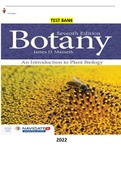
Title: Test Bank for Botany; An Introduction to Plant Biology 7th Edition by James Mauseth

Document preview thumbnail
Preview 4 out of 303 pages

COMPLETE - Elaborated Test Bank for Botany - An Introduction to Plant Biology Ed.7 by James D. Mauseth Part 1 Introduction Chapter 1 Introduction to Plants and Botany Chapter 2 Overview of Plant Life Chapter 3 Ethnobotany Part 2 Plant Structure Chapter 4 Cell Structure Chapter 5 Growth and Division of the Cell Chapter 6 Tissues and the Primary Growth of Stems Chapter 7 Leaves Chapter 8 Roots Chapter 9 Structure of Woody Plants Chapter 10 Flowers and Reproduction Part 3 Plant Physiology and Development Chapter 11 Energy Metabolism: Photosynthesis Chapter 12 Energy Metabolism: Respiration Chapter 13 Transport Processes Chapter 14 Soils and Mineral Nutrition Chapter 15 Development and Morphogenesis Part 4 Genetics and Evolution Chapter 16 Genes and the Genetic Basis of Metabolism and Development Chapter 17 Genetics Chapter 18 Population Genetics and Evolution Chapter 19 Classification and Systematics Chapter 20 Algae and the Origin of Eukaryotic Cells Chapter 21 Nonvascular Plants: Mosses, Liverworts, and Hornworts Chapter 22 Vascular Plants Without Seeds Chapter 23 Seed Plants I: Gymnosperms Chapter 24 Seed Plants II: Angiosperms Part 5 Ecology Chapter 25 Populations and Ecosystems Chapter 26 Community Ecology Chapter 27 Biomes 1. Rose plants often get black spots on their leaves. This is an: A) observation. B) hypothesis. C) theory. D) law. E) explanation. Answer: A A-head: Scientific Method Subject: Chapter 1 Complexity: Moderate Taxonomy: Application 2. Scientists can use the scientific method to study all of the following except: A) how a plant produces sugars. B) the interpretation of a painting. C) the chemical composition of paint. D) how an ecosystem functions. E) what makes chili peppers hot. Answer: B A-head: Areas Where the Scientific Method Is Inappropriate Subject: Chapter 1 Complexity: Moderate Taxonomy: Application 3. Which of the following is not part of the scientific method? A) Explaining phenomena controlled by unknowable forces B) Testing of all proposed explanations Botany: An Introduction to Plant Biology, Seventh Edition James D. Mauseth Test Bank Copyright © 2021 by Jones & Bartlett Learning, LLC, an Ascend Learning Company C) Controlled experiments D) Explaining observable phenomena E) Carefully documented observations Answer: A A-head: Scientific Method Subject: Chapter 1 Complexity: Easy Taxonomy: Recall 4. Which of the following is the probable sequence in which organisms evolved? A) Prokaryotic bacteria à eukaryotic algae à cyanobacteria à land plants B) Eukaryotic bacteria à cyanobacteria à eukaryotic algae à land plants C) Cyanobacteria à prokaryotic bacteria à eukaryotic algae à land plants D) Cyanobacteria à eukaryotic algae à prokaryotic bacteria à land plants E) Prokaryotic bacteria à cyanobacteria à eukaryotic algae à land plants Answer: E A-head: Origin and Evolution of Plants Subject: Chapter 1 Complexity: Difficult Taxonomy: Analysis 5. The first organisms to evolve have been dated at about: A) 3.5 billion years and were much like present-day bacteria. B) 2.8 billion years and were photosynthetic like present-day cyanobacteria. C) 3.5 billion years and had a nucleus. D) 1.5 billion years and were terrestrial. E) 3.5 billion years and possessed organelles which had specialized functions. Answer: A A-head: Origin and Evolution of Plants Subject: Chapter 1 Complexity: Easy Taxonomy: Recall Botany: An Introduction to Plant Biology, Seventh Edition James D. Mauseth Test Bank Copyright © 2021 by Jones & Bartlett Learning, LLC, an Ascend Learning Company 6. All of the following contribute to carbon dioxide additions to the atmosphere except: A) animals, fungi, and bacteria, which produce carbon dioxide as a by-product of respiration. B) burning wood, coal, natural gas, and other fossil fuels. C) volcanic eruptions. D) formation of calcium carbonate algal shells. E) magma eruptions at mid-ocean ridges. Answer: D A-head: Concepts Subject: Chapter 1 Complexity: Moderate Taxonomy: Application 7. Which of the following adaptations enable evergreen species to survive the physiological drought that occurs during freezing winter months? A) The aboveground shoot system dies while maintaining a viable subterranean system. B) The leaves are shed. C) The leaves have extra thick cuticles. D) The subterranean root system goes dormant. E) The bark is shed. Answer: C A-head: Diversity of Plant Adaptations Subject: Chapter 1 Complexity: Moderate Taxonomy: Application 8. The population of grass plants growing in an open field: A) share identical genetic information. B) carry out a metabolism that is uniquely biological and unrelated to the laws of physics and chemistry. C) are adapted to grow and reproduce in the conditions of the open field. D) have well protected fibrous leaves that are no longer capable of photosynthesis. E) lack a means of storing and using information. Answer: C A-head: Using Concepts to Understand Plants Botany: An Introduction to Plant Biology, Seventh Edition James D. Mauseth Test Bank Copyright © 2021 by Jones & Bartlett Learning, LLC, an Ascend Learning Company Complexity: Difficult Subject: Chapter 1 Taxonomy: Analysis 9. Which of the following is a logical question to ask concerning the biological phenomena that roots absorb water? A) Do plants have sources of energy other than sunlight? B) Do plants create carbohydrate reserves in their root systems? C) Do plants have alternative pathways by which water can be absorbed? D) Are roots fibrous and tough in order to be unpalatable to insects? E) Are some leaf modifications intended to trap insects as a source of nutrition? Answer: C A-head: Plants versus the Study of Plants Subject: Chapter 1 Complexity: Difficult Taxonomy: Analysis 10. All plants have a scientific name consisting of: A) a minimum of three descriptive adjectives. B) the family name and genus name. C) the phylum name and a specific epithet. D) the genus name and a specific epithet. E) the species name and subspecies name. Answer: D A-head: Plants Subject: Chapter 1 Complexity: Easy Taxonomy: Recall 11. Derived features that have evolved more recently from ancestral features are known as: A) plesiomorphic B) apomorphic C) eukaryotic Botany: An Introduction to Plant Biology, Seventh Edition James D. Mauseth Test Bank Copyright © 2021 by Jones & Bartlett Learning, LLC, an Ascend Learning Company D)prokaryotic Answer: B A-head: Origin and Evolution of Plants Subject: Chapter 1 Complexity: Easy Taxonomy: Recall 12. Which of the following phrases is the correct description of a scientific theory? A) A hypothesis that has been proven over and over again and becomes generally accepted as truth B) An educated statement that makes a prediction that can be tested C) logical explanations for simple observations without verification D) the principle of never being certain of a conclusion and always being willing to consider new evidence. E) assuming that processes or structures have a purpose Answer: A A-head: Scientific Method Subject: Chapter 1 Complexity: Easy Taxonomy: Recall True/False 13. The scientific method can, ultimately, explain any concept. Answer: False A-head: Areas Where the Scientific Method Is Inappropriate Subject: Chapter 1 Complexity: Moderate Taxonomy: Application 14. At one time, fungi were classified as plants. Botany: An Introduction to Plant Biology, Seventh Edition James D. Mauseth Test Bank Copyright © 2021 by Jones & Bartlett Learning, LLC, an Ascend Learning Company Answer: True A-head: Plants Subject: Chapter 1 Complexity: Easy Taxonomy: Recall 15. The idea that mitochondria and chloroplasts originated as independent, prokaryotic organisms is now a law. Answer: False A-head: Scientific Method Subject: Chapter 1 Complexity: Difficult Taxonomy: Analysis 16. Eukaryotes with mitochondria and chloroplasts evolved into algae and plants. Answer: True A-head: Origin and Evolution of Plants Subject: Chapter 1 Complexity: Easy Taxonomy: Recall 17. The principles of chemistry and physics apply only to nonliving things, not to plants. Answer: False A-head: Using Concepts to Understand Plants Subject: Chapter 1 Complexity: Moderate Taxonomy: Application Fill-in-the-Blank Botany: An Introduction to Plant Biology, Seventh Edition James D. Mauseth Test Bank Copyright © 2021 by Jones & Bartlett Learning, LLC, an Ascend Learning Company 18. When new features arise through mutation, _____________________ is the process by which the new features are eliminated from the population or passed on to future generations. Answer: natural selection A-head: Origin and Evolution of Plants Subject: Chapter 1 Complexity: Moderate Taxonomy: Analysis 19. In contrast to most observations, which are reasonably accurate and trustworthy, _____________________ are human constructs based on observations, intuition, and expectations. Answer: interpretations A-head: Plants versus the Study of Plants Subject: Chapter 1 Complexity: Moderate Taxonomy: Application 20. Assuming that plants have human characters such as decision-making capabilities is called _____________________. Answer: anthropomorphism A-head: Using Concepts to Understand Plants Subject: Chapter 1 Complexity: Easy Taxonomy: Recall 21. Numerous scientific studies have shown that all plants are composed of cells. This statement is an example of a well-supported _____________________. Answer: theory A-head: Scientific Method Subject: Chapter 1 Complexity: Easy Taxonomy: Recall Botany: An Introduction to Plant Biology, Seventh Edition James D. Mauseth Test Bank Copyright © 2021 by Jones & Bartlett Learning, LLC, an Ascend Learning Company 22. A key evolutionary step in the history of life occurred when the DNA was packaged within its own nucleus, creating a group of organisms called _____________________. Answer: eukaryotes A-head: Origin and Evolution of Plants Subject: Chapter 1 Complexity: Easy Taxonomy: Recall Matching 23. Match the following terms with their examples. A) Logical extension of an observation without verification Answer: Speculative philosophy B) Creation of species by God Answer: Religious system C) Complex reactions of photosynthesis were developed by a wise creator Answer: Intelligent design D) Investigates a testable hypothesis Answer: Scientific method E) Willingness to consider new evidence that is not in support of an established theory Answer: Skepticism [F] Mountains erode over time but the law of gravity is invariable Answer: Constancy and universality A-head: Scientific Method Subject: Chapter 1 Complexity: Difficult Taxonomy: Analysis 24. Match the following terms with their definitions or examples. A) Three groups into which all organisms are classified. Answer: Domains B) Bacteria, cyanobacteria, and archaeans Answer: Prokaryotes Botany: An Introduction to Plant Biology, Seventh Edition James D. Mauseth Test Bank Copyright © 2021 by Jones & Bartlett Learning, LLC, an Ascend Learning Company C) Cells with nuclei Answer: Eukaryotes D) Protozoans, fungi, and animals Answer: Eukaryotic cells without chloroplasts E) Protists Answer: Eukaryotic cells with chloroplasts A-head: Origin and Evolution of Plants Subject: Chapter 1 Complexity: Moderate Taxonomy: Application COMPLETE - Elaborated Test Bank for Botany - An Introduction to Plant Biology Ed.7 by James D. Mauseth. ALL Chapters 1-27 Included and updated for 2023

Content preview

Prof.Exams


TEST BANK


2022

,Prof.Exams


COMPLETE
Elaborated Test Bank
for
Botany - An Introduction
to
Plant Biology
Ed.7
by
James D. Mauseth
2022

, Prof.Exams
TABLE OF CONTENTS
Part 1 Introduction
Chapter 1 Introduction to Plants and Botany
Chapter 2 Overview of Plant Life
Chapter 3 Ethnobotany
Part 2 Plant Structure
Chapter 4 Cell Structure
Chapter 5 Growth and Division of the Cell
Chapter 6 Tissues and the Primary Growth of Stems
Chapter 7 Leaves
Chapter 8 Roots
Chapter 9 Structure of Woody Plants
Chapter 10 Flowers and Reproduction
Part 3 Plant Physiology and Development
Chapter 11 Energy Metabolism: Photosynthesis
Chapter 12 Energy Metabolism: Respiration
Chapter 13 Transport Processes
Chapter 14 Soils and Mineral Nutrition
Chapter 15 Development and Morphogenesis
Part 4 Genetics and Evolution
Chapter 16 Genes and the Genetic Basis of Metabolism and Development
Chapter 17 Genetics
Chapter 18 Population Genetics and Evolution
Chapter 19 Classification and Systematics
Chapter 20 Algae and the Origin of Eukaryotic Cells
Chapter 21 Nonvascular Plants: Mosses, Liverworts, and Hornworts
Chapter 22 Vascular Plants Without Seeds
Chapter 23 Seed Plants I: Gymnosperms
Chapter 24 Seed Plants II: Angiosperms
Part 5 Ecology
Chapter 25 Populations and Ecosystems
Chapter 26 Community Ecology
Chapter 27 Biomes

,

Connected book
 image
Publisher: 2014 ISBN: 9781284068856 Edition: Unknown

Document information

Uploaded on
April 9, 2023
Number of pages
303
Written in
2022/2023
Type
Exam (elaborations)
Contains
Questions & answers
$36.50

Wrong document? Swap it for free Within 14 days of purchase and before downloading, you can choose a different document. You can simply spend the amount again.
Written by students who passed
Immediately available after payment
Read online or as PDF

Seller avatar
Reputation scores are based on the amount of documents a seller has sold for a fee and the reviews they have received for those documents. There are three levels: Bronze, Silver and Gold. The better the reputation, the more your can rely on the quality of the sellers work.
Sturdydrone
4.0
(154)
Sold
950
Followers
639
Items
1792
Last sold
8 hours ago


Why students choose Stuvia

Created by fellow students, verified by reviews

Quality you can trust: written by students who passed their tests and reviewed by others who've used these notes.

Didn't get what you expected? Choose another document

No worries! You can instantly pick a different document that better fits what you're looking for.

Pay as you like, start learning right away

No subscription, no commitments. Pay the way you're used to via credit card and download your PDF document instantly.

Student with book image

“Bought, downloaded, and aced it. It really can be that simple.”

Alisha Student

Working on your references?

Create accurate citations in APA, MLA and Harvard with our free citation generator.

Working on your references?

Frequently asked questions

