AC1.2 Assess the usefulness of investigative techniques in criminal
investigations:20marks.
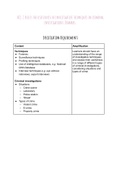
Specification Requirements
Content Amplification
Techniques Learners should have an
● Forensic understanding of the range
● Surveillance techniques of investigative techniques
● Profiling techniques and assess their usefulness
in a range of different types
● Use of intelligence databases, e.g. National
of criminal investigations,
DNA Database considering situations and
● Interview techniques e.g. eye witness types of crime.
interviews, expert interviews
Criminal investigations
● Situations
○ Crime scene
○ Laboratory
○ Police station
○ 'Street'
● Types of crime
○ Violent crime
○ E-crime
○ Property crime
, Forensics - DNA
Description of the technique:
DNA profiling is used in criminal investigations as a type of forensic technique. It can be
used to compare criminal suspects profiles to DNA found at crime scenes. Each person's
DNA profile is unique meaning comparison and analysis is effective when identifying
suspects. DNA can be found in blood, hair, saliva, semen, faeces and bones or teeth. DNA
massively improved the functioning of the criminal justice system. DNA can be found on
victims and perpetrators at crime scenes most commonly, violent and property crimes. In E
crimes DNA is not found. SOCOs are responsible for collecting DNA from crime scenes and
police are responsible for collecting DNA from suspects at the police station. After collection
DNA is sent to the lab to be analysed. DNA isn’t normally collected from public areas as it is
too prolific.
Strengths of this technique:
A strength of DNA is that it is effective. This is because it can be found in every cell inside
the human body and every person's DNA is unique (apart from identical twins) making it very
effective. Locards exchange principle states that whenever someone goes into an
environment, something is added or removed to the environment. So any contact will leave a
trace (evidence) at the crime scene. This includes physical contact, when an individual
enters a physical environment. Therefore there is a high likelihood of finding DNA evidence
at all crime scenes, meaning it is easier to identify possible suspects. This leads to quicker
criminal investigations. For example, in the case of Amanda Knox she was convicted of
killing Meridith Kercher but the actual killer Rudy Guede was found guilty due to multiple bits
of DNA evidence. His bloody hand print was found on Kerhcers pillow, his shoe prints were
found in her room and his DNA found on her bra, purse and coat as well as inside her. His
DNA was also discovered in feces left in the toilet.
Another strength of DNA is that analysis can be done a while after the crime is committed;
this is because it can be permanently stored on NDNAD. This means if DNA evidence is
handled carefully and is collected using correct procedure it can be stored for many years.
This can be useful as some criminal investigations or court trials can last a while, it also
1
investigations:20marks.
Specification Requirements
Content Amplification
Techniques Learners should have an
● Forensic understanding of the range
● Surveillance techniques of investigative techniques
● Profiling techniques and assess their usefulness
in a range of different types
● Use of intelligence databases, e.g. National
of criminal investigations,
DNA Database considering situations and
● Interview techniques e.g. eye witness types of crime.
interviews, expert interviews
Criminal investigations
● Situations
○ Crime scene
○ Laboratory
○ Police station
○ 'Street'
● Types of crime
○ Violent crime
○ E-crime
○ Property crime
, Forensics - DNA
Description of the technique:
DNA profiling is used in criminal investigations as a type of forensic technique. It can be
used to compare criminal suspects profiles to DNA found at crime scenes. Each person's
DNA profile is unique meaning comparison and analysis is effective when identifying
suspects. DNA can be found in blood, hair, saliva, semen, faeces and bones or teeth. DNA
massively improved the functioning of the criminal justice system. DNA can be found on
victims and perpetrators at crime scenes most commonly, violent and property crimes. In E
crimes DNA is not found. SOCOs are responsible for collecting DNA from crime scenes and
police are responsible for collecting DNA from suspects at the police station. After collection
DNA is sent to the lab to be analysed. DNA isn’t normally collected from public areas as it is
too prolific.
Strengths of this technique:
A strength of DNA is that it is effective. This is because it can be found in every cell inside
the human body and every person's DNA is unique (apart from identical twins) making it very
effective. Locards exchange principle states that whenever someone goes into an
environment, something is added or removed to the environment. So any contact will leave a
trace (evidence) at the crime scene. This includes physical contact, when an individual
enters a physical environment. Therefore there is a high likelihood of finding DNA evidence
at all crime scenes, meaning it is easier to identify possible suspects. This leads to quicker
criminal investigations. For example, in the case of Amanda Knox she was convicted of
killing Meridith Kercher but the actual killer Rudy Guede was found guilty due to multiple bits
of DNA evidence. His bloody hand print was found on Kerhcers pillow, his shoe prints were
found in her room and his DNA found on her bra, purse and coat as well as inside her. His
DNA was also discovered in feces left in the toilet.
Another strength of DNA is that analysis can be done a while after the crime is committed;
this is because it can be permanently stored on NDNAD. This means if DNA evidence is
handled carefully and is collected using correct procedure it can be stored for many years.
This can be useful as some criminal investigations or court trials can last a while, it also
1