Stem cells in drug research
College 1: Introduction to stem cells and cell therapy
Micha Drukker
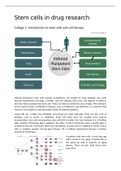
Induced pluripotent stem cells provide revolutionary cell models for drug pipelines and could
become revolutionary cell drugs. Currently, cells are collected from urine, skin biopsies or blood to
turn into induced pluripotent stem cells. These can than be turned into any cell type. This technique
can be used to study a multitude of diseases, such as Parkinson’s and Alzheimer’s, or used for drug
research, for example to make pancreatic islands for diabetes patients.
Living cells are a rather new discipline, most drugs are small molecules, there are also a lot of
biologics, such as insulin or antibodies. Some cell drugs exist, for example bone marrow
transportation, here only hematopoietic stem cells (HSCs) matter. We ‘own’ between 5 to 10 million
HSCs. Another cell therapy that is applied in the clinic, is CAR-T cell therapy. Here a specific gene is
transferred into the T-cell that is taken from the patient, to make sure it is adapted to certain cancer
cells. It combines somatic cell and gene therapy. IVF or artificial reproductive therapy is another
example of cell therapy.
A problem with stem cells, is that they age
which results in our aging. A dysfunction is
this aging can lead to progeria, an aging
disease. There are also adult tissue stem
cells, HSCs.
, Hematopoietic stem cells produce a lifetime supply of immune and blood cells. They are ultra rare,
while other specialized blood cell types are very common. Only the HSCs can give rise to all blood cell
types and to HSCs themselves. The HSCs are obtained from the bone marrow, in research this is from
mice. Research showed that only long term HSCs can safe immunodeficient mice. The cells can be
detected in the bone marrow with flow cytometry.
Stem cells can only be identified as stem cells in retrospective, they are defined by their progeny
output. However, they do have specific fundamental properties.
1. Self-renewal, stem cells can create more stem cells
2. Differentiation into specific cell types
Pluripotent stem cells are only present in the body for a few days during
development in the blastocyst, approximately from day 3 to day 9-10. After this,
we only have multipotent, adult tissue stem cells which are tissue specific. There
are mostly no stem cells in the brain, some regions do contain them. Adult tissue
stem cells are also progenitor cells, they do have some self-renewal but
eventually will all differentiate. They can also only give rise to specific cell types.
There are these kind of cells in CNS neurons, in the lungs and in the intestine.
Trans-differentiation, thus progenitor cells that are able to give rise to multiple
different cell types, has been claimed but is not possible. The adult stem cells are
almost always tissue specific! They are multipotent, not pluripotent. They are able to self-renew but
will differentiate. They are able to sustain tissues by replenishing cells throughout life.
Only pluripotent cells are really able to give rise to all cell types in the body. If they can become
ectoderm, mesoderm and endoderm, they are considered pluripotent. This is related to the three
world theory, where all tissues come from these three tissues during development. There are
embryonic stem cells, and induced pluripotent stem cells.
The embryonic stem cells (ESCs)
have 2 states, either ground/naïve,
or primed. The naïve state is
related to the blastocyst stage,
where the primed state (EpiSCs) is
related to the epiblast stage of the
development. These states can be
interchanged, and are important
to understand reprogramming.
College 1: Introduction to stem cells and cell therapy
Micha Drukker
Induced pluripotent stem cells provide revolutionary cell models for drug pipelines and could
become revolutionary cell drugs. Currently, cells are collected from urine, skin biopsies or blood to
turn into induced pluripotent stem cells. These can than be turned into any cell type. This technique
can be used to study a multitude of diseases, such as Parkinson’s and Alzheimer’s, or used for drug
research, for example to make pancreatic islands for diabetes patients.
Living cells are a rather new discipline, most drugs are small molecules, there are also a lot of
biologics, such as insulin or antibodies. Some cell drugs exist, for example bone marrow
transportation, here only hematopoietic stem cells (HSCs) matter. We ‘own’ between 5 to 10 million
HSCs. Another cell therapy that is applied in the clinic, is CAR-T cell therapy. Here a specific gene is
transferred into the T-cell that is taken from the patient, to make sure it is adapted to certain cancer
cells. It combines somatic cell and gene therapy. IVF or artificial reproductive therapy is another
example of cell therapy.
A problem with stem cells, is that they age
which results in our aging. A dysfunction is
this aging can lead to progeria, an aging
disease. There are also adult tissue stem
cells, HSCs.
, Hematopoietic stem cells produce a lifetime supply of immune and blood cells. They are ultra rare,
while other specialized blood cell types are very common. Only the HSCs can give rise to all blood cell
types and to HSCs themselves. The HSCs are obtained from the bone marrow, in research this is from
mice. Research showed that only long term HSCs can safe immunodeficient mice. The cells can be
detected in the bone marrow with flow cytometry.
Stem cells can only be identified as stem cells in retrospective, they are defined by their progeny
output. However, they do have specific fundamental properties.
1. Self-renewal, stem cells can create more stem cells
2. Differentiation into specific cell types
Pluripotent stem cells are only present in the body for a few days during
development in the blastocyst, approximately from day 3 to day 9-10. After this,
we only have multipotent, adult tissue stem cells which are tissue specific. There
are mostly no stem cells in the brain, some regions do contain them. Adult tissue
stem cells are also progenitor cells, they do have some self-renewal but
eventually will all differentiate. They can also only give rise to specific cell types.
There are these kind of cells in CNS neurons, in the lungs and in the intestine.
Trans-differentiation, thus progenitor cells that are able to give rise to multiple
different cell types, has been claimed but is not possible. The adult stem cells are
almost always tissue specific! They are multipotent, not pluripotent. They are able to self-renew but
will differentiate. They are able to sustain tissues by replenishing cells throughout life.
Only pluripotent cells are really able to give rise to all cell types in the body. If they can become
ectoderm, mesoderm and endoderm, they are considered pluripotent. This is related to the three
world theory, where all tissues come from these three tissues during development. There are
embryonic stem cells, and induced pluripotent stem cells.
The embryonic stem cells (ESCs)
have 2 states, either ground/naïve,
or primed. The naïve state is
related to the blastocyst stage,
where the primed state (EpiSCs) is
related to the epiblast stage of the
development. These states can be
interchanged, and are important
to understand reprogramming.