

BKAT Study (verified answers) graded A+ 2023
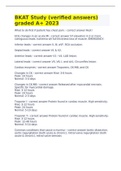
BKAT Exam (verified Answers) Graded A+ 2023. What to do first if patient has chest pain. - correct answer Rest! ECG changes in an acute MI - correct answer ST elevation in 2 or more contiguous leads. Ischemia d/t full thickness loss of muscle. EMERGENCY. Inferior leads - correct answer II, III, aVF. RCA occlusion. Septal leads - correct answer V1 & V2. Anterior leads - correct answer V1 - V4. LAD lesion. Lateral leads - correct answer V5, V6, I, and aVL. Circumflex lesion. Cardiac enzymes - correct answer Troponins, CK-MB, and CK Changes in CK - correct answer Rise: 3-6 hours Peak: 24 hours Normal: 3-4 days Changes in CK-MB - correct answer Released after myocardial necrosis. Specific for myocardial damage. Rise: 3-12 hours Peak: 24 hours Normal: 2-3 days Troponin I - correct answer Protein found in cardiac muscle. High sensitivity. Rise: 3-12 hours Peak: 24 hours Normal: 5-10 days Troponin T - correct answer Protein found in cardiac muscle. High sensitivity. Rise: 3-12 hours Peak: 12-48 hours Normal: 5-14 days Common conditions that cause a murmur - correct answer Aortic dissection, aortic regurgitation (both acute & chronic), mitral valve regurgitation (both acute & chronic), mitral valve stenosis Drugs to decrease afterload/SVR/PVR - correct answer (Arterial Dilators) Nitroprusside, nitroglycerin, amrinone, alpha (Regitine) & Ca channel blockers Drugs to increased afterload/SVR/PVR - correct answer (Vasopressors) Epinepherine, norepinepherine, dopamine, neosynephrine Drugs to decrease contractility/SVI - correct answer Beta blockers (atenolol, metoprolol, propranolol, labetolol, esmolol) and Ca channel blockers Drugs to increase contractility/SVI - correct answer Positive inotropes, dobutamine, dopamine, milrinone, and digoxin Drugs to decrease preload/CVP/PAWP - correct answer Venous Dilators - Nitroglycerin, nitroprusside, amrinone, alpha & Ca channel blockers Diuretics - Furosemide, bumex, mannitol Drugs to increase preload/CVP/PAWP - correct answer Volume - Colloid, crystalloids, blood, hetastarch Dysrhythmia control - antirhythmics, pacemaker, AICD Complications when using thrombolytics - correct answer Allergic reaction, bleeding/hemorrhage, stroke Failure to capture - correct answer Pacer delivers a stimulus at the appropriate time but no depolarization occurs. No P or QRS wave after pacer spike. Failure to fire/pace - correct answer No pacer spikes seen Failure to sense - correct answer Pacemaker does not detects heart's intrinsic activity or interprets noncardiac activity as intrinsic activity. Spikes in inappropriate times. Normal PR - correct answer 0.12 - 0.20 Normal QRS - correct answer 0.04-0.10 Normal QT - correct answer Less than 0.48. Varies by age, HR, and gender. Vasopressors - correct answer Epinepherine, norepinepherine, dopamine, phenylephrine/neosynephrine, vasopressin/pitressin, milrinone/Primacor, dobutamine/Dobutrex Indication for dopamine/Intropin - correct answer Acts on SNS to increased HR and BP. Indicated for hypotension, low CO, decreased renal blood flow. Use if patient is bradycardic. Doses of dopamine - correct answer Low: 0.5-2 mcg/kg/min (dopaminergic) Intermediate: 2-10 mcg/kg/min (beta receptors, increases CO) High: over 10 mcg/kg/min (alpha receptors, vasoconstrict).
Document information
- Uploaded on
- April 5, 2023
- Number of pages
- 13
- Written in
- 2022/2023
- Type
- Exam (elaborations)
- Contains
- Questions & answers


