Summary of the hand of project management | Remco van der Schoot
7. CHAPTER 7 – MEASURING PERFORMANCE (P.105-123)
➢ Performance measurement is the use of quantitative or qualitative data to evaluate quality and progress
towards objectives.
➢ Traditional financial such as ROI (return on investment) measures have been criticized for being
historical, short-term focused, and insensitive to external factors.
➢ Alternative measures like the balanced scorecard and triple bottom line include non-financial criteria
like customer satisfaction, internal processes, and social/environmental impact.
➢ In project management, financial and objective measures like time and cost are important, but
contextually sensitive criteria are also needed.
➢ Considerations for performance assessment include the purpose, units, and dimensions being measured
(single project, program, portfolio, completion vs. phases, success vs. performance, individual/team vs.
organizational/project capability, sustainability/CSR).
7.1. ASSESSING PERFORMANCE
7.1.1. PURPOSE OF ASSESSMENT
Assessment is any process that allows us to receive feedback on or make judgments about or in some way analyze
a set of activities. Possible purposes of assessment are:
➢ Ensuring alignment with strategy;
➢ Determining achievement of objectives or outcomes;
➢ Determining effectiveness or efficiency;
➢ Reviewing progress;
➢ Ensuring adequate competence or capability to support performance;
➢ Providing feedback for improvement.
7.1.2. UNIT AND CONTEXT OF ASSESSMENT
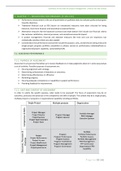
In order to satisfy the specific purpose, what needs to be assessed? The focus of assessment may be on
outcomes, processes and practices or the competence and skills of people. The context may be a single project,
multiple projects or programs or organizational capability including portfolios.
P a g i n a 10 | 61
, Summary of the hand of project management | Remco van der Schoot
7.1.3. PERFORMANCE AND SUCCES
It is now generally accepted that success is in the eye of the beholder and may be a matter of timing. Success
remains an ambiguous concept that may be judged differently from different stakeholder perspectives over time.
For practical purposes the definition provided by Baker, Murphy and Fisher (1988) will be used. They
concluded that success is a matter of perception but that a project will be most likely to be perceived as an
‘overall success’ if:
the project meets the technical performance specifications and/or mission to be performed,
and if there is a high level of satisfaction concerning the project outcome among key people
on the project team, and key users or clientele of the project effort
Further, although it is generally agreed that time and budget performance alone are inadequate as measures of
project success. Project management success can therefore be seen as a component of project success.
Patanakul, Iewwongcharoen and Milosevic (2010) proposed that dimensions for judging success could be
categorized into:
➢ internal or project related criteria:
o time, cost and performance.
➢ customer related criteria:
o satisfaction, actual utilization and benefits.
➢ organization related criteria:
o financial, market and benefits.
CRITERIA AND FACTORS
Criteria = measures or metrics that can be used as a basis for judgment
Factors = elements or causes that contribute to a result.
➢ Factors that affect a result may also be used as criteria.
7.1.4. BENCHMARKS AND STANDARDS
In order to interpret and make use of performance measures it is necessary to have standards or guidelines of
acceptable performance against which actual performance can be compared.
➢ it is necessary to have guidelines that indicate what level of variation is considered acceptable.
Benchmarks = a particular form of comparative indicator. They are measures that represent the best
performance of a particular outcome, process or practice either within or across projects or industries.
➢ Internal benchmarking -> identifying the best performance against one or more metrics
o The benchmark demonstrates that a specific level of performance is achievable and provides
a realistic target for improvement across all projects or divisions.
➢ External benchmarking -> looking outside the organization for ‘best practice’ comparators.
7.1.5. MEASURES
Performance measures = generally considered to be quantifiable expressions of the amount, cost or result of
activities that provide information on quality of capabilities, capacity, processes, practices and outcomes during
a given time period and should be as objective as possible.
➢ Direct measure -> when it measures, directly, what you want it to measure.
➢ Indirect measure -> when you measure something by measuring something else.
o Noise in the system -> occurs when there are many other factors, other than the one you are
measuring, that may contribute to phenomenon.
The more indirect the measure, the more difficult it becomes to ensure that the measures are objective and
meaningful indicators of the outcome or quality that is being measured.
P a g i n a 11 | 61
7. CHAPTER 7 – MEASURING PERFORMANCE (P.105-123)
➢ Performance measurement is the use of quantitative or qualitative data to evaluate quality and progress
towards objectives.
➢ Traditional financial such as ROI (return on investment) measures have been criticized for being
historical, short-term focused, and insensitive to external factors.
➢ Alternative measures like the balanced scorecard and triple bottom line include non-financial criteria
like customer satisfaction, internal processes, and social/environmental impact.
➢ In project management, financial and objective measures like time and cost are important, but
contextually sensitive criteria are also needed.
➢ Considerations for performance assessment include the purpose, units, and dimensions being measured
(single project, program, portfolio, completion vs. phases, success vs. performance, individual/team vs.
organizational/project capability, sustainability/CSR).
7.1. ASSESSING PERFORMANCE
7.1.1. PURPOSE OF ASSESSMENT
Assessment is any process that allows us to receive feedback on or make judgments about or in some way analyze
a set of activities. Possible purposes of assessment are:
➢ Ensuring alignment with strategy;
➢ Determining achievement of objectives or outcomes;
➢ Determining effectiveness or efficiency;
➢ Reviewing progress;
➢ Ensuring adequate competence or capability to support performance;
➢ Providing feedback for improvement.
7.1.2. UNIT AND CONTEXT OF ASSESSMENT
In order to satisfy the specific purpose, what needs to be assessed? The focus of assessment may be on
outcomes, processes and practices or the competence and skills of people. The context may be a single project,
multiple projects or programs or organizational capability including portfolios.
P a g i n a 10 | 61
, Summary of the hand of project management | Remco van der Schoot
7.1.3. PERFORMANCE AND SUCCES
It is now generally accepted that success is in the eye of the beholder and may be a matter of timing. Success
remains an ambiguous concept that may be judged differently from different stakeholder perspectives over time.
For practical purposes the definition provided by Baker, Murphy and Fisher (1988) will be used. They
concluded that success is a matter of perception but that a project will be most likely to be perceived as an
‘overall success’ if:
the project meets the technical performance specifications and/or mission to be performed,
and if there is a high level of satisfaction concerning the project outcome among key people
on the project team, and key users or clientele of the project effort
Further, although it is generally agreed that time and budget performance alone are inadequate as measures of
project success. Project management success can therefore be seen as a component of project success.
Patanakul, Iewwongcharoen and Milosevic (2010) proposed that dimensions for judging success could be
categorized into:
➢ internal or project related criteria:
o time, cost and performance.
➢ customer related criteria:
o satisfaction, actual utilization and benefits.
➢ organization related criteria:
o financial, market and benefits.
CRITERIA AND FACTORS
Criteria = measures or metrics that can be used as a basis for judgment
Factors = elements or causes that contribute to a result.
➢ Factors that affect a result may also be used as criteria.
7.1.4. BENCHMARKS AND STANDARDS
In order to interpret and make use of performance measures it is necessary to have standards or guidelines of
acceptable performance against which actual performance can be compared.
➢ it is necessary to have guidelines that indicate what level of variation is considered acceptable.
Benchmarks = a particular form of comparative indicator. They are measures that represent the best
performance of a particular outcome, process or practice either within or across projects or industries.
➢ Internal benchmarking -> identifying the best performance against one or more metrics
o The benchmark demonstrates that a specific level of performance is achievable and provides
a realistic target for improvement across all projects or divisions.
➢ External benchmarking -> looking outside the organization for ‘best practice’ comparators.
7.1.5. MEASURES
Performance measures = generally considered to be quantifiable expressions of the amount, cost or result of
activities that provide information on quality of capabilities, capacity, processes, practices and outcomes during
a given time period and should be as objective as possible.
➢ Direct measure -> when it measures, directly, what you want it to measure.
➢ Indirect measure -> when you measure something by measuring something else.
o Noise in the system -> occurs when there are many other factors, other than the one you are
measuring, that may contribute to phenomenon.
The more indirect the measure, the more difficult it becomes to ensure that the measures are objective and
meaningful indicators of the outcome or quality that is being measured.
P a g i n a 11 | 61