MASTERING
Periodic Trend
Perfect your performance with periodici
Important Trend Terms Shielding: core (nonvalence) electron
from the full attractive forces of the pr
Effective nuclear charge: the net positive charge from the nucleus that an Electron-electron repulsions: due
electron can “feel” attractions from. The core electrons are said to shield the pairs orient themselves as far away as
valence electrons from the full attractive forces of the protons in the nucleus. causing the electron cloud to expand
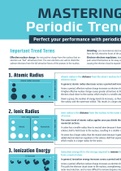
1. Atomic Radius Atomic radius is the distance from the atom’s nucleus to th
Atomic radius increases
electron cloud.
Atomic radius increases
In general, atomic radius decreases across a period and incre
Across a period, effective nuclear charge increases as electron sh
A higher effective nuclear charge causes greater attractions to th
electron cloud closer to the nucleus which results in a smaller ato
Down a group, the number of energy levels (n) increases, so there
the nucleus and the outermost orbital. This results in a larger ato
2. Ionic Radius Ionic radius is the distance from the nucleus to the outer e
Ionic radius increases
of an ion.
The same trend of atomic radius applies once you divide the
Ionic radius increases
nonmetal sections.
Metals Nonmetals A cation has a smaller radius than its neutral atom because it loses
valence shell is held closer to the nucleus, resulting in a smaller ra
An anion has a larger radius than the neutral atom because it gain
added electron/electron repulsions in the valence shell that expand
which results in a larger radius for the anion.
3. Ionization Energy Ionization energy (IE) is the energy required to remove th
IE increases
from a neutral atom.
In general, ionization energy increases across a period and d
IE increases
Across a period, effective nuclear charge increases as electron sh
This pulls the electron cloud closer to the nucleus, strengthening
outer-most electron, and is more difficult to remove (requires mo
Periodic Trend
Perfect your performance with periodici
Important Trend Terms Shielding: core (nonvalence) electron
from the full attractive forces of the pr
Effective nuclear charge: the net positive charge from the nucleus that an Electron-electron repulsions: due
electron can “feel” attractions from. The core electrons are said to shield the pairs orient themselves as far away as
valence electrons from the full attractive forces of the protons in the nucleus. causing the electron cloud to expand
1. Atomic Radius Atomic radius is the distance from the atom’s nucleus to th
Atomic radius increases
electron cloud.
Atomic radius increases
In general, atomic radius decreases across a period and incre
Across a period, effective nuclear charge increases as electron sh
A higher effective nuclear charge causes greater attractions to th
electron cloud closer to the nucleus which results in a smaller ato
Down a group, the number of energy levels (n) increases, so there
the nucleus and the outermost orbital. This results in a larger ato
2. Ionic Radius Ionic radius is the distance from the nucleus to the outer e
Ionic radius increases
of an ion.
The same trend of atomic radius applies once you divide the
Ionic radius increases
nonmetal sections.
Metals Nonmetals A cation has a smaller radius than its neutral atom because it loses
valence shell is held closer to the nucleus, resulting in a smaller ra
An anion has a larger radius than the neutral atom because it gain
added electron/electron repulsions in the valence shell that expand
which results in a larger radius for the anion.
3. Ionization Energy Ionization energy (IE) is the energy required to remove th
IE increases
from a neutral atom.
In general, ionization energy increases across a period and d
IE increases
Across a period, effective nuclear charge increases as electron sh
This pulls the electron cloud closer to the nucleus, strengthening
outer-most electron, and is more difficult to remove (requires mo