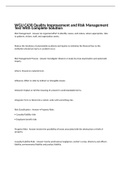
WGU C430 Quality Improvement and Risk Management Test With Complete Solution
Risk Management - Answer An organized effort to identify, assess, and reduce, where appropriate, risks to patients, visitors, staff, and organization assets. Reduce the incidence of preventable accidents and injuries to minimize the financial loss to the institution should an injury or accident occur. Risk Management Process - Answer Investigate: Observe or study by close examination and systematic inquiry. Inform: Present in material form. Influence: Affect or alter by indirect or intangible means. Interpret: Explain or tell the meaning of; present in understandable terms. Integrate: Form or blend into a whole; unite with something else. Risk Classification - Answer • Property Risks • Casualty/liability risks • Employee benefit risks Property Risks - Answer Involve the possibility of losses associated with the destruction or theft of property. Casualty/Liability Risks - Answer Involve professional negligence, worker's comp, directory and officers liability, environmental liability and product liability. Employee Benefit Risks - Answer Cost of benefit plans, disability claims, and Employee Retirement and Income Security Act (ERISA) violations. Risk Management Tools - Answer • Incident Reporting • Occurrence reporting • Occurrence screening Incident Reporting - Answer The identification and reporting of occurrences that could have led, or did lead, to an undesirable outcome. Occurrence Reporting - Answer Serves as a database for further investigation Alerts risk management to a potential claim situation. Occurrence Screening - Answer Review technique of medical records of current and discharged patients with the goal of identifying events not consistent with routine. Used to identify and correct problems and to prepare for legal defense. Managing Adverse Events - Answer Requires extensive analysis and planning to arrive at the best and fairest solution for all involved. Information must get to the upper-level administration and to the clinical chief or chiefs ASAP. It is also important for details of clinical incidents to be chared with clinicians throughout the org to prevent recurrence of adverse events. How do risk and quality management functions overlap? - Answer Quality control is doing what you want to do: meeting needs. Risk control is not doing what you do not want to do: preventing errors. Regulatory & Professional Organizations That Influence Quality & Risk Management - Answer • Joint Commission • National Committee for Quality Assurance (NCQA) • OSHA • ADA • Drug-Free Workplace Act (DFWA) • HIPAA • EMTALA • MedWatch • EPA National Committee for Quality Assurance (NCQA) Performance Measures - Answer • Effectiveness of care • Access/availability of care • Utilization • Risk adjusted utilization • Measures collected using electronic clinical data systems The Joint Commission Benefits of Accreditation - Answer • Helps organize and strengthen patient safety efforts.
Written for
- Institution
- WGU C430
- Course
- WGU C430
Document information
- Uploaded on
- April 2, 2023
- Number of pages
- 13
- Written in
- 2022/2023
- Type
- Exam (elaborations)
- Contains
- Questions & answers

Also available in package deal