
Module 4:
To predict microbial changes, we must study both microbial growth and inactivation.
Microbial growth may have both a positive and a negative impact:
o Positive impact: fermentation.
o Negative impact: growth of spoilage and pathogenic bacteria.
Whether the impact is positive or negative, the prediction of growth as a function of
relevant conditions is important. Prediction of the number of microorganisms is
usually expressed in log(V) or log(N/N0).
When it comes to microorganisms, every dilution represents a step on the logarithmic
scale.
Although the number of microorganisms is a logarithmic transformation, it can still be
seen as a direct representation of your raw data in microbial growth.
Microbial kinetics is different from chemical kinetics chemical kinetics refers to
molecular events, whereas microbial kinetics refers to the growth/inactivation of
microbial cells.
o Many chemical reactions underlie cell growth.
Note that the dependence of microbial growth on pH, water activity and temperature
is different from that of chemical reactions.
o It makes no sense to, for instance, apply the Arrhenius equation to microbial
kinetics above the inactivation temperature, there will be a decrease in
the growth rate. This is not incorporated into the Arrhenius equation.
A negative growth rate implies inactivation.
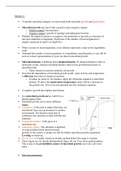
In a microbial growth curve, Ln(N/N0) is
plotted against time.
Microbial growth curves show different
stages:
1. Lag phase. Cells need to adapt when they are
transferred from one environment to another
environment. The bacteria need time to
synthesize new enzymes to deal with the new
substrate.
2. Exponential phase. Cells grow at a
maximum rate.
3. Stationary phase. The substrate is depleted,
or some produced acid limits bacterial
growth, or the system is simply too full for further microbial growth (saturation).
Leveling is observed.
4. (Death phase). Usually, foods are already spoiled before this stage is reached.
These stages are not clearly distinguished stages you’ll see more gradual phases.
This is due to the probabilistic nature of microbial growth; not every cell is the
same.
Relevant parameters:
, - : lag phase. The amount of time it takes before a cell adapts in a certain medium.
- max: maximum growth rate. Slope of the curve. At the inflection point of the curve.
- As: ln(N/Nmax). Asymptotic value: the asymptote for the maximum number of cells.
One needs to distinguish between three microbial models:
o Primary models. These models describe the growth or inactivation of
microorganisms in terms of max, As and .
o Secondary models. These models describe how kinetic parameters from
primary models depend on conditions (pH, water activity, T, etc.).
o Tertiary models. These models describe responses in decisions support
systems/expert systems. These are used in supply chain management to make
decisions based on the results of the primary and secondary models.
Primary models:
Primary models describe the growth/inactivation of microorganisms as a function of
time.
The Monod model (see formula on the right) is a primary
model that is mainly used in fermentation kinetics. It
describes how a certain amount of substrate is converted in
microbial mass (biomass).
o X: biomass concentration.
o : specific growth rate.
o max: maximum specific growth rate.
o S: substrate concentration.
o Ks: saturation constant.
Because of the logarithmic ratio that is used, the steepness of the substrate use is
increasing over time, whereas the microbes increase in a logarithmic fashion.
o If the substrate is depleted, the growth of microbes will become stationary.
Note that the Monod model does not describe a lag phase it assumes that
microbes will immediately adapt not a good model!
The logistic model (see formula on the right) does describe a lag
phase. It contains three parameters (a, b, c) and it results in a S-
shaped curve.
o These parameters can be made more meaningful
by reparameterization: the parameters a, b & c
are replaced by As, max and . As a result, the
formula on the right is created.
o You can now determine the parameters that
means something more related to the physiology of the microbes.
- Inflection point: point where you go from an increase to a decrease in the derivative.
The Gompertz model (see function on the right) produces
a similar curve as the logistic equation. However, it slightly
differs, especially in the beginning of the curve the
logarithmic model takes off earlier than the Gompertz model.
The Gompertz model contains a double exponential
function and 3 parameters, which can again be
reparametrized (see formula on the right).
To predict microbial changes, we must study both microbial growth and inactivation.
Microbial growth may have both a positive and a negative impact:
o Positive impact: fermentation.
o Negative impact: growth of spoilage and pathogenic bacteria.
Whether the impact is positive or negative, the prediction of growth as a function of
relevant conditions is important. Prediction of the number of microorganisms is
usually expressed in log(V) or log(N/N0).
When it comes to microorganisms, every dilution represents a step on the logarithmic
scale.
Although the number of microorganisms is a logarithmic transformation, it can still be
seen as a direct representation of your raw data in microbial growth.
Microbial kinetics is different from chemical kinetics chemical kinetics refers to
molecular events, whereas microbial kinetics refers to the growth/inactivation of
microbial cells.
o Many chemical reactions underlie cell growth.
Note that the dependence of microbial growth on pH, water activity and temperature
is different from that of chemical reactions.
o It makes no sense to, for instance, apply the Arrhenius equation to microbial
kinetics above the inactivation temperature, there will be a decrease in
the growth rate. This is not incorporated into the Arrhenius equation.
A negative growth rate implies inactivation.
In a microbial growth curve, Ln(N/N0) is
plotted against time.
Microbial growth curves show different
stages:
1. Lag phase. Cells need to adapt when they are
transferred from one environment to another
environment. The bacteria need time to
synthesize new enzymes to deal with the new
substrate.
2. Exponential phase. Cells grow at a
maximum rate.
3. Stationary phase. The substrate is depleted,
or some produced acid limits bacterial
growth, or the system is simply too full for further microbial growth (saturation).
Leveling is observed.
4. (Death phase). Usually, foods are already spoiled before this stage is reached.
These stages are not clearly distinguished stages you’ll see more gradual phases.
This is due to the probabilistic nature of microbial growth; not every cell is the
same.
Relevant parameters:
, - : lag phase. The amount of time it takes before a cell adapts in a certain medium.
- max: maximum growth rate. Slope of the curve. At the inflection point of the curve.
- As: ln(N/Nmax). Asymptotic value: the asymptote for the maximum number of cells.
One needs to distinguish between three microbial models:
o Primary models. These models describe the growth or inactivation of
microorganisms in terms of max, As and .
o Secondary models. These models describe how kinetic parameters from
primary models depend on conditions (pH, water activity, T, etc.).
o Tertiary models. These models describe responses in decisions support
systems/expert systems. These are used in supply chain management to make
decisions based on the results of the primary and secondary models.
Primary models:
Primary models describe the growth/inactivation of microorganisms as a function of
time.
The Monod model (see formula on the right) is a primary
model that is mainly used in fermentation kinetics. It
describes how a certain amount of substrate is converted in
microbial mass (biomass).
o X: biomass concentration.
o : specific growth rate.
o max: maximum specific growth rate.
o S: substrate concentration.
o Ks: saturation constant.
Because of the logarithmic ratio that is used, the steepness of the substrate use is
increasing over time, whereas the microbes increase in a logarithmic fashion.
o If the substrate is depleted, the growth of microbes will become stationary.
Note that the Monod model does not describe a lag phase it assumes that
microbes will immediately adapt not a good model!
The logistic model (see formula on the right) does describe a lag
phase. It contains three parameters (a, b, c) and it results in a S-
shaped curve.
o These parameters can be made more meaningful
by reparameterization: the parameters a, b & c
are replaced by As, max and . As a result, the
formula on the right is created.
o You can now determine the parameters that
means something more related to the physiology of the microbes.
- Inflection point: point where you go from an increase to a decrease in the derivative.
The Gompertz model (see function on the right) produces
a similar curve as the logistic equation. However, it slightly
differs, especially in the beginning of the curve the
logarithmic model takes off earlier than the Gompertz model.
The Gompertz model contains a double exponential
function and 3 parameters, which can again be
reparametrized (see formula on the right).


