
• Falsches Dokument? Kostenlos tauschen
  • Geschrieben von Student*innen, die bestanden haben
  • Sofort verfügbar nach Zahlung
  • Online lesen oder als PDF
Verkaufen
Wo studierst du
Deine Sprache
Document preview thumbnail
Vorschau 2 aus 5 Seiten
Prüfung

Physics

Document preview thumbnail
Vorschau 2 aus 5 Seiten

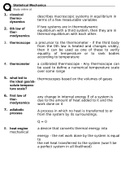
1. classical thermo- dynamics 2. 0th law of ther- modynamics describes macroscopic systems in equilibrium in terms of a few measurable variables If two systems are in thermodynamic equilibrium with a third system, then they are in thermal equilibrium with each other. 3. thermoscope a precursor to the thermometer - if the third body from the 0th law is heated and changes visibly, then it can be used as one of these to verify equality of temperature or to rank bodies according to temperature 4. thermometer a calibrated thermoscope - Any thermoscope can be used to define a numerical temperature scale over some range 5. what led to the ideal gas/ab- solute tempera- ture scale? 6. first law of ther- modynamics 7. adiabatic process thermoscopes based on the volumes of gases any change in internal energy E of a system is due to the amount of heat added to it and the work done on it A process in which no heat is transferred to or from the system by its surroundings. Q = 0 8. heat engine a device that converts thermal energy into mechanical energy - the net work done by the system is equal to the net heat transferred to the system (won't be a perfect system in all likelihood) 9. reversible process 10. quasistatic process a quasistatic process where friction can be ignored a process which proceeds very slowly such that the sys- tem is always in thermal equilibrium 11. 11. kelvin-planck statement 12. Clausius state- ment 13. fundamental thermodynamic relation It is impossible to construct an engine which, operating in a cycle, will produce no other effect than the extraction of heat from a reservoir and the performance of an equiva- lent amount of work. It is impossible to construct an refrigerator which, operat- ing in a cycle, will produce no other effect than the transfer of heat from a cooler body to a hotter one. dE = TdS - PdV 14. isentropic having equal/constant entropy 15. Gibbs free ener- gy 16. Helmholtz free energy 17. chemical poten- tial 18. How do we pre- dict properties of a macrostate for an isolated sys- tem? 19. intensive vari- ables 20. extensive vari- ables the energy of a system that is available to do work at a constant temperature and pressure G(T,P) = E - TS + PV The part of change in internal energy that we are free to use for work F(T,V) = E - TS the Gibbs free energy per molecule or mole. It is the key to to diffusive and chemical equilibrium. by averaging over the corresponding microstates are non-additive; their value is not proportional to the amount of substance are additive; their value is linearly proportional to the amount of substance. 21. what does phase coexistence (at fixed tempera- ture and pres- sure) require? Equal Gibbs free energy per molecule in the two phases. Otherwise the system would evolve to minimise its Gibbs free energy and one phase would convert into the other 22. partial pressure the contribution each gas in a mixture of gases makes to the total pressure Pi = (Ni/N)P 23. Ergodic Hypoth- esis 24. Microcanonical ensemble 25. Canonical En- semble 26. Grand Canonical Ensemble 27. postulate of equal a priori probabilities 28. pauli exclusion principle for fermions 29. pauli exclusion principle for bosons During its time evolution, a system visits all possible ac- cessible states in phase-space (specified by the positions and momenta of all particles) with equal probability. where the real system is isolated, that is at fixed energy and particle number, the copies in the ensemble are also isolated from one another If the real system is in contact with a heat bath, that is at fixed temperature, the copies are assumed to be in thermal contact, with all the rest of the copies acting as a heat bath of any individual copy If the real system can exchange both heat and particles with a reservoir, at fixed temperature and chemical poten- tial, the copies are also assumed to be in diffusive contact allows us to average over microstates - assumes that allowed microstates are equally likely the wave function should be antisymmetric under the ex- change of any pair of particles - at most one can be in anu fully-specified quantum state the wave function should be symmetric under the ex- change of any pair of particles - any number of them can be in the same quantum state

Inhaltsvorschau

Statistical Mechanics
Study online at
https://quizlet.com/_cptddw
1. classical
describes macroscopic systems in equilibrium in
thermo-
terms of a few measurable variables
dynamics
If two systems are in thermodynamic
2. 0th law of
equilibrium with a third system, then they are in
ther-
thermal equilibrium with each other.
modynamics

3. thermoscope a precursor to the thermometer - if the third body
from the 0th law is heated and changes visibly,
then it can be used as one of these to verify
equality of temperature or to rank bodies
according to temperature

4. thermometer a calibrated thermoscope - Any thermoscope can
be used to define a numerical temperature scale
over some range

5. what led to thermoscopes based on the volumes of gases
the ideal gas/ab-
solute tempera-
ture scale?

6. first law of any change in internal energy E of a system is
ther- due to the amount of heat added to it and the
modynamics work done on it
7. adiabatic A process in which no heat is transferred to or
process from the system by its surroundings.

Q=0

8. heat engine a device that converts thermal energy into
mechanical
energy - the net work done by the system is equal
to
the net heat transferred to the system (won't be
a perfect system in all likelihood)


1

, Statistical Mechanics
Study online at
9. https://quizlet.com/_cptddw
reversible a quasistatic process where friction can be
process ignored
10.quasistatic
process a process which proceeds very slowly such that
the sys- tem is always in thermal equilibrium

11. 11.


2

Dokument Information

Studium
Hochgeladen auf
30. märz 2023
Anzahl der Seiten
5
geschrieben in
2022/2023
Typ
Prüfung
Enthält
Fragen & antworten
$8.99

Falsches Dokument? Kostenlos tauschen Innerhalb von 14 Tagen nach dem Kauf und vor dem Herunterladen kannst du ein anderes Dokument wählen. Du kannst den Betrag einfach neu ausgeben.
Geschrieben von Student*innen, die bestanden haben
Sofort verfügbar nach Zahlung
Online lesen oder als PDF

Seller avatar
Bewertungen des Ansehens basieren auf der Anzahl der Dokumente, die ein Verkäufer gegen eine Gebühr verkauft hat, und den Bewertungen, die er für diese Dokumente erhalten hat. Es gibt drei Stufen: Bronze, Silber und Gold. Je besser das Ansehen eines Verkäufers ist, desto mehr kannst du dich auf die Qualität der Arbeiten verlassen.
Verkauft
101
Anhänger
44
Sachen
5717
Zuletzt verkauft
4 Jahren vor


Warum sich Studierende für Stuvia entscheiden

on Mitstudent*innen erstellt, durch Bewertungen verifiziert

Geschrieben von Student*innen, die bestanden haben und bewertet von anderen, die diese Studiendokumente verwendet haben.

Nicht zufrieden? Wähle ein anderes Dokument

Kein Problem! Du kannst direkt ein anderes Dokument wählen, das besser zu dem passt, was du suchst.

Bezahle wie du möchtest, fange sofort an zu lernen

Kein Abonnement, keine Verpflichtungen. Bezahle wie gewohnt per Kreditkarte oder Sofort und lade dein PDF-Dokument sofort herunter.

Student with book image

“Gekauft, heruntergeladen und bestanden. So einfach kann es sein.”

Alisha Student

Arbeitest du an deiner Quellenangabe?

Erstelle korrekte Quellenangaben in APA, MLA und Harvard mit unserem kostenlosen Zitiergenerator.

Arbeitest du an deiner Quellenangabe?

Häufig gestellte Fragen

