Transverse pulses
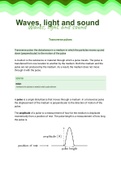
Transverse pulse: the disturbance in a medium in which the particles moves up and
down (perpendicular) to the motion of the pulse
A medium is the substance or material through which a pulse travels. The pulse is
transferred from one location to another by the medium. Both the medium and the
pulse are not produced by the medium. As a result, the medium does not move
through it with the pulse.
A pulse is a single disturbance that moves through a medium. In a transverse pulse
the displacement of the medium is perpendicular to the direction of motion of the
pulse.
The amplitude of a pulse is a measurement of how far the medium is displaced
momentarily from a position of rest. The pulse length is a measurement of how long
the pulse is.
, The position of rest is the position the medium would be in if it were undisturbed.
This is also called the equilibrium position. People will often use rest and equilibrium
interchangeably
Superposition:
Principle of superposition
The principle of superposition states that when two disturbances occupy the same
space at the same time the resulting disturbance is the sum of two disturbances.
● Constructive Interference
The original amplitudes of the pulses remain intact when they pass past each other
and continue in the same direction.
When two pulses collide to produce a bigger pulse, this is called constructive
interference. The two beginning pulses' amplitudes are added to create the size of
the final pulse. This could be the junction of two crests or troughs.
Transverse pulse: the disturbance in a medium in which the particles moves up and
down (perpendicular) to the motion of the pulse
A medium is the substance or material through which a pulse travels. The pulse is
transferred from one location to another by the medium. Both the medium and the
pulse are not produced by the medium. As a result, the medium does not move
through it with the pulse.
A pulse is a single disturbance that moves through a medium. In a transverse pulse
the displacement of the medium is perpendicular to the direction of motion of the
pulse.
The amplitude of a pulse is a measurement of how far the medium is displaced
momentarily from a position of rest. The pulse length is a measurement of how long
the pulse is.
, The position of rest is the position the medium would be in if it were undisturbed.
This is also called the equilibrium position. People will often use rest and equilibrium
interchangeably
Superposition:
Principle of superposition
The principle of superposition states that when two disturbances occupy the same
space at the same time the resulting disturbance is the sum of two disturbances.
● Constructive Interference
The original amplitudes of the pulses remain intact when they pass past each other
and continue in the same direction.
When two pulses collide to produce a bigger pulse, this is called constructive
interference. The two beginning pulses' amplitudes are added to create the size of
the final pulse. This could be the junction of two crests or troughs.