Elementary Education K-6 FTCE
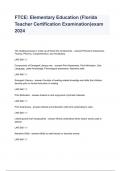
Elementary Education K-6 FTCE Alliteration the occurrence of the same letter or sound at the beginning of adjacent or closely connected words. Analogy a comparison between things that are alike in some ways Antonyms words that have opposite meanings Argument A statement put forth and supported by evidence Automaticity accurate, speedy word recognition; is necessary, but not sufficient, for fluency development. Blending Mixing sounds in words smoothly while reading. Buddy Reading Students of different grade levels reading the same text together. Chunking Breaking words into smaller units Clerihew a witty satiric verse containing two rhymed couplets and mentioning a person. Climax Most exciting moment of the story; turning point. Comprehension The ability to understand what you have read, seen, or heard. Concepts of Print Examples of letters, words, directionality, punctuation. Consonant Blend Two or more consecutive consonants which retain their individual sounds. Creative Writing Writing that uses the writer's imagination. Decode To sound out words; segmenting and blending phonemes. Descriptive Writing Writing that paints a picture of a person, place, thing, or idea. Digraph Two consonant letters used together to create a sound unlike their individual sounds. Diamante A poem with seven lines in a diamond shape. Emergent Literacy Earliest phase of literacy development. Encode The process of changing oral language into writing. Evaluation A judgment of the significance, worth, or value of a student's work. Expository Writing Writing that explains, informs, or presents information. Fable A brief story that leads to a moral, often using animals as characters. Figurative Language Language that uses figures of speech, especially metaphors. Fluency In reading, the ability read quickly, accurately, and with proper expression. Genre A set of principles or conditions and styles within a particular media. Haiku A japanese form of poetry, consisting of three unrhymed lines of five, seven, and five syllables. High-Frequency Words Words that appear most frequently in the printed text children read. Hyperbole An obvious exaggeration. Idiom An expression that can't be understood by the literal meaning. Ex. "My heart is beating out of my chest." Informative Writing Writing that informs the reader in an attempt to create a new found knowledge. Interactive Writing Children and teachers create a written work together. Irony Using words to convey the opposite of their literal meaning. Legend A story passed down through many generations that is believed to be based on real people and events. Limerick a humorous, rhyming, five-line poem with a specific meter and rhyme scheme. Literal Language language that means exactly what it says. Literary Element Essential parts of narratives; setting, character, plot, theme, and style. Literary Language A dialect of language used in literary writing. Literature Circles Small, temporary, and heterogeneous groups of students that gather together to discuss a common book that each of them is reading with the goal of enhancing comprehension. Metonym A word that is used to stand for something else that it has attributes of or is associated with. Ex. "the wagon" being used instead of "sobriety." Metaphor A figure of speech where something is described as though it were something else. Myth
Written for
- Institution
- Elementary Education K-6 FTCE
- Course
- Elementary Education K-6 FTCE
Document information
- Uploaded on
- March 26, 2023
- Number of pages
- 15
- Written in
- 2022/2023
- Type
- Exam (elaborations)
- Contains
- Questions & answers
Subjects
-
elementary education k 6 ftce alliteration the occurrence of the same letter or sound at the beginning of adjacent or closely connected words analogy a comparison between things that are alike in so