Environmental enrichment
04/11/2022 12:57
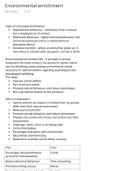
Types of stereotypical behaviour
• Displacement behaviour - a behaviour that is natural
but is displayed out of context.
• Redirected behaviour - highly motivated behaviour that
cannot be expressed and so is redirected to an
alternative stimuli.
• Excessive inactivity - where an animal has ‘given up’ it
may refuse to interact with care givers, not eat or drink.
Environmental enrichment (EE) - A principle in animal
husbandry that helps enhance the quality of captive animal
care by identifying and providing environmental stimuli
necessary for optimal welfare regarding psychological and
physiological wellbeing.
This helps:
• Improve animal welfare
• Part of animal routine
• Promote natural behaviour and reduce stereotypes
• Not a permanent feature to the enclosure
Why is it important?
• Captive animals are subject to habitats that can greatly
differ from their natural environment
• Behavioural restriction
• Promote normal behaviour and reduce stereotypes
• Provides the animal with choice and control over their
environment
• Challenges them, stress is not always bad
• Contra-freeloading
• Encourages interaction with environment
• Educational and interesting
• Required to maintain and to obtain a license
Pros Cons
Encourages natural behaviour Costly
(crucial for reintroduction)
Reduce abnormal behaviour Time consuming
Promotes mating success Messy
04/11/2022 12:57
Types of stereotypical behaviour
• Displacement behaviour - a behaviour that is natural
but is displayed out of context.
• Redirected behaviour - highly motivated behaviour that
cannot be expressed and so is redirected to an
alternative stimuli.
• Excessive inactivity - where an animal has ‘given up’ it
may refuse to interact with care givers, not eat or drink.
Environmental enrichment (EE) - A principle in animal
husbandry that helps enhance the quality of captive animal
care by identifying and providing environmental stimuli
necessary for optimal welfare regarding psychological and
physiological wellbeing.
This helps:
• Improve animal welfare
• Part of animal routine
• Promote natural behaviour and reduce stereotypes
• Not a permanent feature to the enclosure
Why is it important?
• Captive animals are subject to habitats that can greatly
differ from their natural environment
• Behavioural restriction
• Promote normal behaviour and reduce stereotypes
• Provides the animal with choice and control over their
environment
• Challenges them, stress is not always bad
• Contra-freeloading
• Encourages interaction with environment
• Educational and interesting
• Required to maintain and to obtain a license
Pros Cons
Encourages natural behaviour Costly
(crucial for reintroduction)
Reduce abnormal behaviour Time consuming
Promotes mating success Messy