

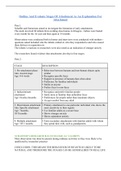
Outline And Evaluate Stages Of Attachment As An Explanation For
Attachment
Para 1:
Schaffer and Emmerson aimed to investigate the formation of early attachments
The study involved 60 infants from working class homes in Glasgow - babies were busted
every month for the 1st year and then again at 18 months
Observations were conducted both in homes and interviews were conducted with mothers -
questions asked included who the infants smiled at, who they responded to and who caused
them distress on separation etc
The infants’s reactions to researchers were also noted as an indication of stranger anxiety
The researchers found evidence that attachments develop in four stages:
Para 2:
STAGE DESCRIPTION
1: Pre-attachment phase • Behaviour between humans and non-human objects quite
Aka: Asocial stage similar
Age: 0-6 weeks • Recognise specific faces
• Happier in presence of humans than when alone
• Preference for familiar individuals
• Smiles at anyone
• Prefers faces to non-faces
2: Indiscriminate • Recognise and prefer familiar people
attachment • Smile more at familiar than unfamiliar faces
Age: 6weeks-6months • Preferences for people rather than inanimate objects
• Accept comfort from any adult
3: Discriminate attachment • Primary attachment to one particular individual who shows the
Aka: Specific attachment most sensitivity to their signals
Age: 7months- • Use familiar adults as a secure base
10/11months • Shows stranger anxiety
• Shows separation anxiety
4: Multiple attachment • Form secondary attachments with familiar adults with whom
Age: 10/11 months they spend time with, such as grandparents
SCHAFFER’S RESEARCH HAS ECOLOGICAL VALIDITY
Most observation was done by parents during ordinary activities so they were likely to be
unaffected by researcher presence
CONCLUSION: THIS MEANS THE BEHAVIOUR OF INFANTS IS LIKELY TO BE
NATURAL AND THEREFORE THE STAGES CAN BE GENERALISED TO REAL LIFE
Attachment
Para 1:
Schaffer and Emmerson aimed to investigate the formation of early attachments
The study involved 60 infants from working class homes in Glasgow - babies were busted
every month for the 1st year and then again at 18 months
Observations were conducted both in homes and interviews were conducted with mothers -
questions asked included who the infants smiled at, who they responded to and who caused
them distress on separation etc
The infants’s reactions to researchers were also noted as an indication of stranger anxiety
The researchers found evidence that attachments develop in four stages:
Para 2:
STAGE DESCRIPTION
1: Pre-attachment phase • Behaviour between humans and non-human objects quite
Aka: Asocial stage similar
Age: 0-6 weeks • Recognise specific faces
• Happier in presence of humans than when alone
• Preference for familiar individuals
• Smiles at anyone
• Prefers faces to non-faces
2: Indiscriminate • Recognise and prefer familiar people
attachment • Smile more at familiar than unfamiliar faces
Age: 6weeks-6months • Preferences for people rather than inanimate objects
• Accept comfort from any adult
3: Discriminate attachment • Primary attachment to one particular individual who shows the
Aka: Specific attachment most sensitivity to their signals
Age: 7months- • Use familiar adults as a secure base
10/11months • Shows stranger anxiety
• Shows separation anxiety
4: Multiple attachment • Form secondary attachments with familiar adults with whom
Age: 10/11 months they spend time with, such as grandparents
SCHAFFER’S RESEARCH HAS ECOLOGICAL VALIDITY
Most observation was done by parents during ordinary activities so they were likely to be
unaffected by researcher presence
CONCLUSION: THIS MEANS THE BEHAVIOUR OF INFANTS IS LIKELY TO BE
NATURAL AND THEREFORE THE STAGES CAN BE GENERALISED TO REAL LIFE


