

History
John Burnside
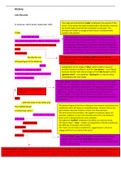
The single word declarative ‘today’ emphasises the gravitas of this
St Andrews: West Sands; September 2001 event. It also places the poem emphatically in the present, whereas
we would expect from the title rumination on the past. This
prompts the reader to recognise that history is fundamentally
Today rooted in the present.
as we flew the kites This is a positive image of youthful freedom and exuberance
which jars with the unsettling epigraph. The sibilance could be
- the sand spinning off in ribbons along the beach
the natural energy of the scene and the wind sweeping across
and that gasoline smell from Leuchars gusting the coastline. Alternatively, it could be a transferred epithet for
humanity being separated by this news; everyone is in disparate
across states. The innocence and serenity of the kite flying is tainted by
image of planes in 9/11. Subordinate clause creates suspense.
the golf links;
the tide far out The olfactory image of the ‘gasoline smell’ taints the natural
landscape, emphasising the ease with which the natural is destroyed
and quail-grey in the distance; by the manmade.
people
Juxtaposition of the image of ‘kites’, which creates a sense of
jogging, or stopping to watch youthful freedom and liberty, with the ‘war planes’ – act of flying
becomes tainted. Both liminal images of the ‘tide far out’ and the
as the war planes cambered and turned ‘gasoline smell’ – inescapability. ‘Quail-grey’ is a natural colour,
in the morning light – contrasting to the man-made.
The ‘war planes’ symbolise human destruction intruding on the natural
setting. The morning light is fleeting and transient and cannot be enjoyed
in the presence of the human destruction. The caesura with the dash
Single-word declarative reflects suggests the speaker recognises his thoughts have drifted off to images of
difficulty. destruction – reflects his endeavours to wrench himself back to the
present: ‘today’. The image of the planes echoes planes of 9/11 – gives
sense that no matter where we are in personal history, political history is
today inescapable.
- with the news in my mind, and
The dashes fragment the focus of being in the moment and subverts the
the muffled dread
traditional notion of history as something linear. Instead, links to the
of what may come – post-modern idea that history is a fluid, non-linear process.
The form enacts the semantics: the speaker is trying to repress his
I knelt down in the sand anxieties; however, in turn this ironically severs the unity between
them as he is distracted by his inner anxieties.
with Lucas
The adjective ‘muffled’ emphasises his efforts to mask the dread.
gathering shells The future tense – ‘may’ – creates a juxtaposition of tenses emphasises
the difficulty of staying in the moment.
and pebbles The ‘news’ can be read as euphemistic, suggesting he is afraid to
finding evidence of life in all this engage with the true reality of the event.
driftwork:
The verb ‘knelt’ suggests the speaker is overwhelmed by intense
anguish. The verb phrase ‘knelt down’ suggests submission to
greater forces – either the greater political forces or the desperation
to find spiritual solace.
‘Gathering shells / and pebbles’ alludes to the idea of sifting through the wreckage and rubble of 9/11, further emphasising the difficulty of
rooting oneself in the present. Irony as ‘shells and pebbles’ are a natural image. The noun ‘evidence’, with its scientific connotations,
suggests he is trying to compensate for the life lost and to mitigate his own feelings of anguish. Connection between personal and political.
, The noun ‘driftwork’ suggests there are greater natural forces that
govern us – links to him kneeling down in the sand. The noun
‘driftwork’ is a transferred epithet for the arbitrary, disorderly nature
snail shells; shreds of razorfish; of the world. We are all looking for meaning in a world devoid of
meaning.
smudges of weed and flesh on tideworn stone. A sense of irony pervades these lines as these objects are far from
‘evidence of life’: they are all images of emptiness and
meaninglessness.
At times I think what makes us who we are Alternatively, these lines could be read positively as they are symbols
that life exists. The speaker is trying to find hope from nature by
is neither kinship nor our given states focusing on the specific details in order to forget the destruction of
but something lost between the world we own 9/11. ‘Tideworn’ suggests slow erosion in contrast to the shock of
9/11 – hope for the slow time passing as opposed to instant
and what we dream about behind the names destruction.
on days like this
Absence of punctuation shifts the style to stream-of-consciousness
our lines raised in the wind and creates a sense of philosophical, existential rumination on the
human condition. Longer lines – trying to draw some clear
our bodies fixed and anchored to the shore conclusion. Contrasts to the containment of feelings in the dashes.
The dual negation creates a sense of nihilism – the things that seem
to de9fine us actually offer no true meaning. ‘Dream’ suggests
and though we are confined by property reaching for something greater but something intangible and
abstract. ‘On days like this’ – physical gap gives sense of being
what tethers us to gravity and light broken up.
has most to do with distance and the shapes
This suggests the speaker is in a liminal state between the physical
we find in water and the psychological; there is a disconnect between them. ‘Lost’,
‘between’, ‘behind’ – humanity not at the forefront of the world –
reading from the book prepositions suggest that there is constantly something that eludes
of silt and tides: us and is ephemeral.
the rose or petrol blue Verbs ‘fixed’ and ‘anchored’ suggest we struggle to find freedom –
we are confined and limited to the physical world by mundane daily
of jellyfish and sea anemone things. ‘Raised in the wind’ suggests there is the potential to do so.
combining with a child's
The verb ‘confined’ suggests that our materialistic values are limiting
first nakedness. and restricting; instead, we need to form meaningful bonds and
relationships or nature. The verb ‘tethers’ implies the speaker is
concerned with staying connected. ‘Gravity’ and ‘light’ are both literal
and symbolic: ‘gravity’ suggests being rooted in the world and ‘light’
The metaphor followed by the listing of natural nouns
could symbolise hope. There is a strange juxtaposition between the
emphasises that what we learn stems from our direct
verb ‘tethers’, with its physical and tangible connotations, and the
experience with the natural world. The enjambment
suggests all these things are interconnected and elusive ‘distance and shapes’ which are images of ephemerality. There
harmonious. There is a precision: ‘rose’ and ‘petrol’ – is an ironic contrast: we want to stay grounded but what tethers us is
celebration of the small details of nature. From a negative ephemeral and constantly moving. From a Marxist perspective, gravity
perspective, however, all of these things are fleeting and and light are equalising forces.
transient. The child’s ‘first nakedness’ is a Romantic image
of purity and innocence before we are corrupted by political
regimes.
John Burnside
The single word declarative ‘today’ emphasises the gravitas of this
St Andrews: West Sands; September 2001 event. It also places the poem emphatically in the present, whereas
we would expect from the title rumination on the past. This
prompts the reader to recognise that history is fundamentally
Today rooted in the present.
as we flew the kites This is a positive image of youthful freedom and exuberance
which jars with the unsettling epigraph. The sibilance could be
- the sand spinning off in ribbons along the beach
the natural energy of the scene and the wind sweeping across
and that gasoline smell from Leuchars gusting the coastline. Alternatively, it could be a transferred epithet for
humanity being separated by this news; everyone is in disparate
across states. The innocence and serenity of the kite flying is tainted by
image of planes in 9/11. Subordinate clause creates suspense.
the golf links;
the tide far out The olfactory image of the ‘gasoline smell’ taints the natural
landscape, emphasising the ease with which the natural is destroyed
and quail-grey in the distance; by the manmade.
people
Juxtaposition of the image of ‘kites’, which creates a sense of
jogging, or stopping to watch youthful freedom and liberty, with the ‘war planes’ – act of flying
becomes tainted. Both liminal images of the ‘tide far out’ and the
as the war planes cambered and turned ‘gasoline smell’ – inescapability. ‘Quail-grey’ is a natural colour,
in the morning light – contrasting to the man-made.
The ‘war planes’ symbolise human destruction intruding on the natural
setting. The morning light is fleeting and transient and cannot be enjoyed
in the presence of the human destruction. The caesura with the dash
Single-word declarative reflects suggests the speaker recognises his thoughts have drifted off to images of
difficulty. destruction – reflects his endeavours to wrench himself back to the
present: ‘today’. The image of the planes echoes planes of 9/11 – gives
sense that no matter where we are in personal history, political history is
today inescapable.
- with the news in my mind, and
The dashes fragment the focus of being in the moment and subverts the
the muffled dread
traditional notion of history as something linear. Instead, links to the
of what may come – post-modern idea that history is a fluid, non-linear process.
The form enacts the semantics: the speaker is trying to repress his
I knelt down in the sand anxieties; however, in turn this ironically severs the unity between
them as he is distracted by his inner anxieties.
with Lucas
The adjective ‘muffled’ emphasises his efforts to mask the dread.
gathering shells The future tense – ‘may’ – creates a juxtaposition of tenses emphasises
the difficulty of staying in the moment.
and pebbles The ‘news’ can be read as euphemistic, suggesting he is afraid to
finding evidence of life in all this engage with the true reality of the event.
driftwork:
The verb ‘knelt’ suggests the speaker is overwhelmed by intense
anguish. The verb phrase ‘knelt down’ suggests submission to
greater forces – either the greater political forces or the desperation
to find spiritual solace.
‘Gathering shells / and pebbles’ alludes to the idea of sifting through the wreckage and rubble of 9/11, further emphasising the difficulty of
rooting oneself in the present. Irony as ‘shells and pebbles’ are a natural image. The noun ‘evidence’, with its scientific connotations,
suggests he is trying to compensate for the life lost and to mitigate his own feelings of anguish. Connection between personal and political.
, The noun ‘driftwork’ suggests there are greater natural forces that
govern us – links to him kneeling down in the sand. The noun
‘driftwork’ is a transferred epithet for the arbitrary, disorderly nature
snail shells; shreds of razorfish; of the world. We are all looking for meaning in a world devoid of
meaning.
smudges of weed and flesh on tideworn stone. A sense of irony pervades these lines as these objects are far from
‘evidence of life’: they are all images of emptiness and
meaninglessness.
At times I think what makes us who we are Alternatively, these lines could be read positively as they are symbols
that life exists. The speaker is trying to find hope from nature by
is neither kinship nor our given states focusing on the specific details in order to forget the destruction of
but something lost between the world we own 9/11. ‘Tideworn’ suggests slow erosion in contrast to the shock of
9/11 – hope for the slow time passing as opposed to instant
and what we dream about behind the names destruction.
on days like this
Absence of punctuation shifts the style to stream-of-consciousness
our lines raised in the wind and creates a sense of philosophical, existential rumination on the
human condition. Longer lines – trying to draw some clear
our bodies fixed and anchored to the shore conclusion. Contrasts to the containment of feelings in the dashes.
The dual negation creates a sense of nihilism – the things that seem
to de9fine us actually offer no true meaning. ‘Dream’ suggests
and though we are confined by property reaching for something greater but something intangible and
abstract. ‘On days like this’ – physical gap gives sense of being
what tethers us to gravity and light broken up.
has most to do with distance and the shapes
This suggests the speaker is in a liminal state between the physical
we find in water and the psychological; there is a disconnect between them. ‘Lost’,
‘between’, ‘behind’ – humanity not at the forefront of the world –
reading from the book prepositions suggest that there is constantly something that eludes
of silt and tides: us and is ephemeral.
the rose or petrol blue Verbs ‘fixed’ and ‘anchored’ suggest we struggle to find freedom –
we are confined and limited to the physical world by mundane daily
of jellyfish and sea anemone things. ‘Raised in the wind’ suggests there is the potential to do so.
combining with a child's
The verb ‘confined’ suggests that our materialistic values are limiting
first nakedness. and restricting; instead, we need to form meaningful bonds and
relationships or nature. The verb ‘tethers’ implies the speaker is
concerned with staying connected. ‘Gravity’ and ‘light’ are both literal
and symbolic: ‘gravity’ suggests being rooted in the world and ‘light’
The metaphor followed by the listing of natural nouns
could symbolise hope. There is a strange juxtaposition between the
emphasises that what we learn stems from our direct
verb ‘tethers’, with its physical and tangible connotations, and the
experience with the natural world. The enjambment
suggests all these things are interconnected and elusive ‘distance and shapes’ which are images of ephemerality. There
harmonious. There is a precision: ‘rose’ and ‘petrol’ – is an ironic contrast: we want to stay grounded but what tethers us is
celebration of the small details of nature. From a negative ephemeral and constantly moving. From a Marxist perspective, gravity
perspective, however, all of these things are fleeting and and light are equalising forces.
transient. The child’s ‘first nakedness’ is a Romantic image
of purity and innocence before we are corrupted by political
regimes.



