DNA Structure and Replication
How is genetic information stored and copied?
Why?
Deoxyribonucleic acid or DNA is the molecule of heredity. It contains the genetic blueprint for life. For
organisms to grow and repair damaged cells, each cell must be capable of accurately copying itself. So how
does the structure of DNA allow it to copy itself so accurately?
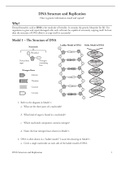
Model 1 – The Structure of DNA
Ladder Model of DNA Helix Model of DNA
Nucleotide
Phosphate
Deoxyribose Nitrogen-
sugar containing
base
Nitrogen Bases
Adenine
Thymine
Guanine
Cytosine
1. Refer to the diagram in Model 1.
a. What are the three parts of a nucleotide?
b. What kind of sugar is found in a nucleotide?
c. Which nucleotide component contains nitrogen?
d. Name the four nitrogen bases shown in Model 1.
2. DNA is often drawn in a “ladder model.” Locate this drawing in Model 1.
a. Circle a single nucleotide on each side of the ladder model of DNA.
DNA Structure and Replication 1
, b. What part(s) of the nucleotides make up the rungs of the “ladder”?
c. What parts of the nucleotides make up the sides (backbone) of the “ladder”?
d. Look at the bottom and top of the “ladder” in Model 1. Are the rungs parallel (the ends of
the strands match) or antiparallel (the ends of the strands are opposites)?
3. On the ladder model of DNA label each of the bases with the letter A, T, C or G.
4. Refer to Model 1. When one nucleotide contains adenine, what type of base is the adenine
attached to on the opposite nucleotide strand?
5. The two strands of DNA are held together with hydrogen bonds between the nitrogen bases.
These are weak bonds between polar molecules. How many hydrogen bonds connect the two
bases from Question 4?
6. Refer to Model 1. When one nucleotide contains cytosine, what type of base is the cytosine
attached to on the opposite nucleotide strand?
7. How many hydrogen bonds connect the two bases from Question 6?
8. With your group, use a complete sentence to write a rule for how the bases are arranged in the
ladder model of DNA.
Read This!
Erwin Chargaff (1905–2002), an Austrian-American biochemist, investigated the ratio of nucleotide bases
found in the DNA from a variety of organisms. From his research, as well as research by Rosalind Frank-
lin and Maurice Wilkins, Watson and Crick developed the complementary base-pair rule during their
race to discover the structure of DNA. The complementary base-pair rule states that adenine and thymine
form pairs across two strands, and guanine and cytosine form pairs across two strands.
9. Fill in the complementary bases on the strand below according to the base-pair rule.
A T C C A G
10. The ladder model of DNA is a simplified representation of the actual structure and shape of a
DNA molecule. In reality, the strands of DNA form a double helix. Refer to the double helix
diagram in Model 1 and describe its shape using a complete sentence.
2 POGIL™ Activities for High School Biology
How is genetic information stored and copied?
Why?
Deoxyribonucleic acid or DNA is the molecule of heredity. It contains the genetic blueprint for life. For
organisms to grow and repair damaged cells, each cell must be capable of accurately copying itself. So how
does the structure of DNA allow it to copy itself so accurately?
Model 1 – The Structure of DNA
Ladder Model of DNA Helix Model of DNA
Nucleotide
Phosphate
Deoxyribose Nitrogen-
sugar containing
base
Nitrogen Bases
Adenine
Thymine
Guanine
Cytosine
1. Refer to the diagram in Model 1.
a. What are the three parts of a nucleotide?
b. What kind of sugar is found in a nucleotide?
c. Which nucleotide component contains nitrogen?
d. Name the four nitrogen bases shown in Model 1.
2. DNA is often drawn in a “ladder model.” Locate this drawing in Model 1.
a. Circle a single nucleotide on each side of the ladder model of DNA.
DNA Structure and Replication 1
, b. What part(s) of the nucleotides make up the rungs of the “ladder”?
c. What parts of the nucleotides make up the sides (backbone) of the “ladder”?
d. Look at the bottom and top of the “ladder” in Model 1. Are the rungs parallel (the ends of
the strands match) or antiparallel (the ends of the strands are opposites)?
3. On the ladder model of DNA label each of the bases with the letter A, T, C or G.
4. Refer to Model 1. When one nucleotide contains adenine, what type of base is the adenine
attached to on the opposite nucleotide strand?
5. The two strands of DNA are held together with hydrogen bonds between the nitrogen bases.
These are weak bonds between polar molecules. How many hydrogen bonds connect the two
bases from Question 4?
6. Refer to Model 1. When one nucleotide contains cytosine, what type of base is the cytosine
attached to on the opposite nucleotide strand?
7. How many hydrogen bonds connect the two bases from Question 6?
8. With your group, use a complete sentence to write a rule for how the bases are arranged in the
ladder model of DNA.
Read This!
Erwin Chargaff (1905–2002), an Austrian-American biochemist, investigated the ratio of nucleotide bases
found in the DNA from a variety of organisms. From his research, as well as research by Rosalind Frank-
lin and Maurice Wilkins, Watson and Crick developed the complementary base-pair rule during their
race to discover the structure of DNA. The complementary base-pair rule states that adenine and thymine
form pairs across two strands, and guanine and cytosine form pairs across two strands.
9. Fill in the complementary bases on the strand below according to the base-pair rule.
A T C C A G
10. The ladder model of DNA is a simplified representation of the actual structure and shape of a
DNA molecule. In reality, the strands of DNA form a double helix. Refer to the double helix
diagram in Model 1 and describe its shape using a complete sentence.
2 POGIL™ Activities for High School Biology