FCCS Exam Review 2023 Solved 100%
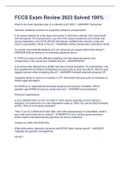
What is the most important sign in a critically ill pt? Why? - ANSWER-Tachypnea Indicates metabolic acidosis w/ respiratory alkalosis compensation A pt misses dialysis for a few days and comes in with fluid overload. He's tachycardic and tachypneic. On physical exam, you find JVD, pulsus paradoxus (20 mmHg drop during inspiration), and HoTN (80/40) with distant, muffled heart sounds. Lungs are clear to auscultation. What is the dx? - ANSWER-Cardiac tamponade; obstructive shock If a pt has a thyromental distance of 2 cm, what can you expect about their airway? - ANSWER-Difficult airway w/ an anteriorly displaced larynx A COPD pt comes in with difficulty breathing. He then becomes apneic and unresponsive. How would you ventilate this pt? - ANSWER-BVM A pt arrives after falling from a ladder and has a frontal laceration. On examination, you find papilledema and labored breathing w/o being able to clear secretions. What is your biggest concern when intubating this pt? - ANSWER-Cerebral edema/increasing ICP Intubation tends to cause an increase in ICP. Administer lidocaine prior to intubation to inhibit vagal stimulation. An ESRD pt w/ hyperkalemia develops dyspnea and requires intubation. Which paralytic agent/NMB should you avoid and why? - ANSWER-Succinylcholine Worsens hyperkalemia A pt is admitted after an OD. He starts to have apneic episodes and his SpO2 is dropping. You place him on a non-rebreather mask w/ 100% O2, yet his SpO2 remains at 80%. Why is it not being corrected? Then, if you try a BVM and it also fails, and video laryngoscopy is unavailable, what is your next best choice for an airway? - ANSWER-The pt is having apneic episodes, which means that administering high-flow O2 will be ineffective. Choose an LMA if the BVM fails. What intervention improves outcomes with ROSC after cardiac arrest? - ANSWER-Targeted temperature management. 32-36 C A shunt means there is perfusion without ventilation. What disease process is an example of a shunt? - ANSWER-Pneumonia Which type of respiratory failure occurs with CNS depression after an OD? - ANSWER-Acute hypercapnic respiratory failure --> mixed A 50 y/o pt is having a COPD exacerbation. You have tried steroids, bronchodilators, etc. with no improvement. PCO2 is in the 90s, pH is 7.20. You decide to intubate. Vent settings are: VT 375, RR 20, FiO2 .35, PEEP 5. CXR is normal. A few minutes later, his BP drops to 70/40. Lungs are clear/equal. Vent shows peak airway pressure of 55 (high) and plateau pressure of 15. End expiratory hold gives auto-peep of 15. What is the cause of this pt's HoTN and why? - ANSWER-Auto-peep is the cause. COPD pts have difficulty exhaling --> pressure buildup in alveoli. We use PEEP for the pressure and to improve oxygenation. Auto-peep comes from breath-stacking --> intrinsic peep. Alveoli enlarge --> high peak airway pressure. All leads to low venous return --> low CO --> HoTN A COPD pt is admitted to the ICU for exacerbation. Pt is on a vent. Pt is tx w/ bronchodilators, steroids, and Abx. ABG was normal 1 hr ago, but now the peak airway pressure is up to 55 and plateau pressure is also high at 50. Pt becomes hypotensive at 70/40. You observe tracheal deviation to the R. Normal breath sounds on the right, diminished on the left. No wheezing. WBC is normal. What is the dx and treatment? - ANSWER-Tension pneumothorax Needle decompression/chest tube A pt in ARDS s/p pneumonia is on 100% FiO2 with PEEP of 22. PO2 is 88%. Peak airway pressure and plateau are both high. VT is 5 ml/kg. How can you decrease the airway pressures? - ANSWER-Decrease the PEEP, even though it will decrease PaO2. (Note: you can't decrease the VT because it is already on the low end). A young asthmatic pt is on the vent. His lungs are very tight. He is on the AC setting and there is a lot of auto-PEEP. You correct it by reducing the rate, giving him more time to exhale and making sure he has enough flow. FiO2 is at .50. He is sedated and seems comfortable. On ABG the pH is 7.24, CO2 is 65, O2 is 80, and bicarb is 29. What would you do with the vent settings in this case? - ANSWER-Keep the settings where they are. You can't hyperventilate the pt to blow off CO2 b/c the asthma will worsen. As long as the pH is > 7.2, the settings are okay as they are. CO2 will correct over time. Which two conditions are the most indicated for BiPAP? - ANSWER-COPD exacerbation Cardiogenic pulmonary edema A 70 y/o pt with CHF presents with SOB, accessory muscle use, RR 34, SpO2 90% on 8L O2. CXR reveals infiltrates in a bat wing pattern. She also has LE edema. She is dx with a CHF exacerbation w/ respiratory failure. Her ABG shows pH 7.3, PO2 64, CO2 50. What is the best tx for this pt? - ANSWER-Non-invasive BiPAP. A pt comes in w/ a femur fx and a rod is placed. Post-op he develops dyspnea and fever. HR 140, RR 30, SpO2 92% on non-rebreather. He is transferred to the ICU where you intubate, place a central line, and start resuscitating him. Hb 8.2, lactate 3.2, SVO2 is 52%. Why is his SVO2 low? How can we improve it? - ANSWER-Decreased O2 delivery and increased consumption. (normal is 65-70) Administer packed RBCs - 1U of blood will change his Hb from 8.2 to 9.2. O2, fluid, and VT would not work. A young pt after an MVA comes to the ER hypotensive and tachycardic. CXR is clear. He has a contusion on his chest wall and torso. He is unconscious. What will give you the best insight on what is causing his shock? Hb SCV Urine Output FAST exam - ANSWER-FAST exam 41 y/o pt in the SICU following debridement of b/l lower extremities for necrotizing fasciitis is intubated on AC. Temp 102, HR 116, RR 16, BP 92/46. ABG shows pH 7.23, PO2 133, PCO2 38, Na 139, K 3.7, Cl 102, Bicarb 16, lactate 4. Dx is metabolic acidosis w/ anion gap d/t infection. What is the most appropriate intervention? Increase VT Continue resuscitation
Written for
- Institution
- FCCS
- Module
- FCCS
Document information
- Uploaded on
- March 20, 2023
- Number of pages
- 7
- Written in
- 2022/2023
- Type
- Exam (elaborations)
- Contains
- Questions & answers
Subjects
- fccs
- fccs review
-
fccs exam review 2023 solved 100
-
what is the most important sign in a critically ill pt why
-
a pt misses dialysis for a few days and comes in with fluid overload hes tachycardi

Also available in package deal