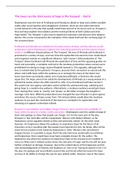
‘The lovers are the chief source of hope in The Tempest’ – Part B
Shakespeare uses the love of Ferdinand and Miranda to allude to hope and a better possible
reality after social injustice and unhappiness. However, there are also other extremely
crucial elements in the play that equally install hope and act as its source such as; Prospero’s
final and long-awaited reconciliation and the eventual liberty of both Caliban and Ariel.
Hope within ‘The Tempest’ is also used to exploit the characters and discover their deepest
desires, this can be connected to the metaphor of the island itself and the confusing logic of
the unnamed place.
Ferdinand and Miranda are catalysts for the plays source of hope, yet they also act as plot
accelerators where Shakespeare explores the controlling patriarchy and the women placed
within it. In different interpretations of ‘The Tempest’ the love of Miranda and Ferdinand is
presented in a variety of ways, and over time this exploration has become more modernised
and recognises women as a significant influence. Julie Taymor’s 2010 production of ‘The
Tempest’ allows Ferdinand and Miranda the exploration of love and the opposing gender via
touch and sensuality, a complete contrast to the Jacobean productions where women were
prohibited from being on stage, Queen Elizabeth banned it. This arguably, although their
love is orchestrated by the patriarch, Prospero, presents their connection as natural and this
allows and instills hope within the audience as in amongst the chaos of the island, two
lovers have been successfully united, even if planned artificially. A feminist critic would
argue that, the hope comes from solely the development of Miranda as a young woman in a
patriarchal society where she offers herself as ‘wife, if you [Ferdinand] will take me [her]’.
She asserts her own agency and takes control within the androcentric play, satisfying and
giving hope to a modern-day audience. Alternatively, a Jacobean audience would gain hope
from viewing their union as ‘courtly’ and ‘proper’ as the father arranges the daughter’s
marriage. Over time, different productions have changed the way Miranda’s is given agency
and where the source of hope comes from. This interpretation would allow the Jacobean
audience to see past the constraints of the island as a metaphor for exploration and
cleansing as it appears somewhat civilised.
Prospero’s reconciliation and sudden change of heart is also crucial for the possibility of
hope within the play for a better reality and justice. Shakespeare uses this sudden change of
heart and apology, to show that people can change. Yet, for the most part of the play,
Prospero is ‘the controller and the manipulator’ (literary critic Robert Wilson), so his
forgiveness can be arguably viewed as false and extremely rushed. On the other hand,
however, his forgiveness allows the audience to experience hope for the future of all
characters as he is reuniting with the people most important to him, his family. After all the
chaos he has created on the island his forgiveness is ‘ethic’ (literary critic and director
Gregory Doran). it is possible to argue that if the play had never ended with reconciliation
and forgiveness, there would have never been complete closure for the author. The
forgiveness also allows the audience to experience hope as the characters are enabled to
return to Milan and a civilised society where the obscurity of magic and the isle will not pose
further confusion or damage. However, due to the rushed nature of his forgiveness and his
rash acknowledgement of Antonio and Stephano as ‘men of sin’ during his speech in Act 5 of
the play, his apology and reconciliation seems false and forced which decreases the hope
we have in his ability to change the way he sees optical reality. However, due to the nature
Shakespeare uses the love of Ferdinand and Miranda to allude to hope and a better possible
reality after social injustice and unhappiness. However, there are also other extremely
crucial elements in the play that equally install hope and act as its source such as; Prospero’s
final and long-awaited reconciliation and the eventual liberty of both Caliban and Ariel.
Hope within ‘The Tempest’ is also used to exploit the characters and discover their deepest
desires, this can be connected to the metaphor of the island itself and the confusing logic of
the unnamed place.
Ferdinand and Miranda are catalysts for the plays source of hope, yet they also act as plot
accelerators where Shakespeare explores the controlling patriarchy and the women placed
within it. In different interpretations of ‘The Tempest’ the love of Miranda and Ferdinand is
presented in a variety of ways, and over time this exploration has become more modernised
and recognises women as a significant influence. Julie Taymor’s 2010 production of ‘The
Tempest’ allows Ferdinand and Miranda the exploration of love and the opposing gender via
touch and sensuality, a complete contrast to the Jacobean productions where women were
prohibited from being on stage, Queen Elizabeth banned it. This arguably, although their
love is orchestrated by the patriarch, Prospero, presents their connection as natural and this
allows and instills hope within the audience as in amongst the chaos of the island, two
lovers have been successfully united, even if planned artificially. A feminist critic would
argue that, the hope comes from solely the development of Miranda as a young woman in a
patriarchal society where she offers herself as ‘wife, if you [Ferdinand] will take me [her]’.
She asserts her own agency and takes control within the androcentric play, satisfying and
giving hope to a modern-day audience. Alternatively, a Jacobean audience would gain hope
from viewing their union as ‘courtly’ and ‘proper’ as the father arranges the daughter’s
marriage. Over time, different productions have changed the way Miranda’s is given agency
and where the source of hope comes from. This interpretation would allow the Jacobean
audience to see past the constraints of the island as a metaphor for exploration and
cleansing as it appears somewhat civilised.
Prospero’s reconciliation and sudden change of heart is also crucial for the possibility of
hope within the play for a better reality and justice. Shakespeare uses this sudden change of
heart and apology, to show that people can change. Yet, for the most part of the play,
Prospero is ‘the controller and the manipulator’ (literary critic Robert Wilson), so his
forgiveness can be arguably viewed as false and extremely rushed. On the other hand,
however, his forgiveness allows the audience to experience hope for the future of all
characters as he is reuniting with the people most important to him, his family. After all the
chaos he has created on the island his forgiveness is ‘ethic’ (literary critic and director
Gregory Doran). it is possible to argue that if the play had never ended with reconciliation
and forgiveness, there would have never been complete closure for the author. The
forgiveness also allows the audience to experience hope as the characters are enabled to
return to Milan and a civilised society where the obscurity of magic and the isle will not pose
further confusion or damage. However, due to the rushed nature of his forgiveness and his
rash acknowledgement of Antonio and Stephano as ‘men of sin’ during his speech in Act 5 of
the play, his apology and reconciliation seems false and forced which decreases the hope
we have in his ability to change the way he sees optical reality. However, due to the nature