RPA Level 3 (Sales, Cost and Income Approaches) 2023 update
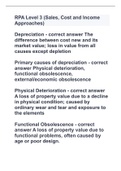
Depreciation The difference between cost new and its market value; loss in value from all causes except depletion Primary causes of depreciation Physical deterioration, functional obsolescence, external/economic obsolescence Physical Deterioration A loss of property value due to a decline in physical condition; caused by ordinary wear and tear and exposure to the elements Functional Obsolescence A loss of property value due to functional problems, often caused by age or poor design. Economic Obsolescence A loss of property value due to factors outside the subject property, such as changes in competition or surrounding land use; usually considered incurable. Also referred to as external obsolescence. Curable depreciation can be fixed at reasonable cost; gain in value from repair will be equal to or greater than cost of repair Incurable depreciation cannot be repaired in a cost-effective manner Sales comparison method to measure depreciation compares depreciated value of improvements from comparable sales of similar properties Income capitalization method to measure depreciation capitalizes income of a comparable property to estimate value of improvements and then compare to the replacement costs Total economic life estimated period that a property may be used profitably; sum of effective age and remaining economic life Effective age The age the improvements appear, based on, chronological age, condition, and degree of modernization; not actual age. Remaining Economic Life The period of usefulness that a building has remaining as of the day of the appraisal. Economic Age-Life Method A method to determine depreciation using the improvements expected economic life and a systematic annual rate from new condition to zero usefulness; straight-line depreciation; also known as lump sum method Modified Economic Age-Life Method A method to determine depreciation in which curable and incurable depreciation is accounted for separately using straight line depreciation Lump sum method Most often used method of estimating physical deterioration; also know as Economic Age-Life Method Loss due to market decline not included in depreciation Short-lived comp depreciate more rapidly than long-lived components Steps in Cost Approach 1) Estimate land value was if vacant and available for development to its HBU 2) Estimate replacement cost new 3) Estimate depreciation 4) Subtract depreciation 5) Estimate cost of accessory improvements 6) Add land Types of depreciation physical deterioration, functional obsolescence and external obsolescence. Elements of Cost Direct costs, indirect costs and entrepreneurial profit Concepts of Cost Reproduction cost, replacement cost, historical cost, trended historical cost Reproduction cost The cost to construct a new building that is exactly like an existing building in every physical detail, even if outdated Replacement cost The cost to construct a building of equal utility, using modern construction designs and materials
Written for
- Institution
- RPA - Retirement Plans Associate
- Course
- RPA - Retirement Plans Associate
Document information
- Uploaded on
- March 19, 2023
- Number of pages
- 35
- Written in
- 2022/2023
- Type
- Exam (elaborations)
- Contains
- Questions & answers
Subjects
-
rpa level 3 sales
-
cost and income approaches 2023 update

Also available in package deal