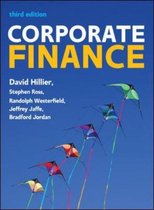
Corporate finance
Week 1: H12
Lecture 1
Balance sheet:
Asset: all the stuff that belongs to the company, that they keep with the idea to generate
somehow to create revenue
Current assets < 1 year cash, cash equivalent, account receivable (someone owes me
money and has to repay in 1 year, customers) & inventory (stuff that is sold in de normal
operating activity)
Fixed assets > 1 year PPE
Operating activity: how we generate revenue
Liabilities: current (< 1 year) & non-current (money we owe to someone else that we repay
in a period longer then 1 year) debt (finance language)
Mortgage on a house: both liabilities because you start to repay immediately, and you’ll see
it directly on current liabilities.
Owners equity: capital that has been provided by shareholder. Initial Public Offering
Money that’s stay in/belongs to the company.
Common stock/shares or paid in capital
Retained earnings (accumulated losses): profits the company generated in the past that has
not been paid out by shareholders as a dividend
Hybrids: convertible bond (helps with risks)
Income statements (P&L) used during the year
Rev
- Cogs
Gross profits
- Operating expenses
Operating profit (EBIT)
- Interest expenses (+interest income (when a company has a lot of cash and few debt))
Earning Before Taxes
- Corporate Tax
Net Income (at the end of the year is moved to retained earnings)
Depreciation (loss of value of a fixed asset because you use it) operating expenses or
when related to production process in COGS (overhead costs)
Dep expenses = Purchase price / utility life
,Amortization depreciation of intangible assets
Cash flow statement cash inflow and cash outflow, has things changed in my cash
pocket
Operating: expensed directly related to operating activity
Investing: transactions within fixed assets, negative is not bad (a company is growing)
Financing: right side of the balance sheet, inflow: take out new loan, give more share to
shareholders to buy
Sum = change in cash
Finance: generate highest possible return on assets
1. In which assets should I invest?
2. How should I finance assets?
Lecture 2
NPV (time value of money):
Rf risk free rate
Always take future value and take it back to present value
Compounding: PV FV
FV = PV x (1+r)t
Discounting: FV PV
PV = FV/ (1+r)t
Interest bij compounding
Discount bij discounting
NPV = (-CF0) + CF1/(1+r)1 + CF2/(1+r)2 + …. + CFn/(1+r)n
If NPV > 0 -> investeren
If NPV < 0 -> niet starten met project
Forecast profit/lost first forecast revenue (Qty x sales price) and expenses (COGS
production costs, direct material, direct labor, )
WACC (discount rate in NPV):
WACC = E/(D+E) x re + D/(D+E) x rd x (1-tc)
, CAPM (cost of equity):
The more risk = the more return
R = rf + B x (rm - rf)
rf = risk free rate, compensates us for time
rm = return on the market
R = required return for us to invest in company X given the level of risk
B= beta, beta of the market = 1, risk of the firm
Correlation:
1. Positive correlation (if one variable goes up, the other variable goes up)
2. Negative correlation (if one variable goes up, the other variable goes down, and the
other way around)
Independent and dependent variables
R will compensate us for risk and time
(rm - rf): compensation of risk over the whole market, excludes the time.
Realized return: return in the past, should be higher then required return
Take position of investor (calculate required return) or firm itself (calculate cost of equity)
1. Calculate cost of equity CAPM
2. Calculate discount rate WACC
3. Project yes/no NPV
Week 1: H12
Lecture 1
Balance sheet:
Asset: all the stuff that belongs to the company, that they keep with the idea to generate
somehow to create revenue
Current assets < 1 year cash, cash equivalent, account receivable (someone owes me
money and has to repay in 1 year, customers) & inventory (stuff that is sold in de normal
operating activity)
Fixed assets > 1 year PPE
Operating activity: how we generate revenue
Liabilities: current (< 1 year) & non-current (money we owe to someone else that we repay
in a period longer then 1 year) debt (finance language)
Mortgage on a house: both liabilities because you start to repay immediately, and you’ll see
it directly on current liabilities.
Owners equity: capital that has been provided by shareholder. Initial Public Offering
Money that’s stay in/belongs to the company.
Common stock/shares or paid in capital
Retained earnings (accumulated losses): profits the company generated in the past that has
not been paid out by shareholders as a dividend
Hybrids: convertible bond (helps with risks)
Income statements (P&L) used during the year
Rev
- Cogs
Gross profits
- Operating expenses
Operating profit (EBIT)
- Interest expenses (+interest income (when a company has a lot of cash and few debt))
Earning Before Taxes
- Corporate Tax
Net Income (at the end of the year is moved to retained earnings)
Depreciation (loss of value of a fixed asset because you use it) operating expenses or
when related to production process in COGS (overhead costs)
Dep expenses = Purchase price / utility life
,Amortization depreciation of intangible assets
Cash flow statement cash inflow and cash outflow, has things changed in my cash
Operating: expensed directly related to operating activity
Investing: transactions within fixed assets, negative is not bad (a company is growing)
Financing: right side of the balance sheet, inflow: take out new loan, give more share to
shareholders to buy
Sum = change in cash
Finance: generate highest possible return on assets
1. In which assets should I invest?
2. How should I finance assets?
Lecture 2
NPV (time value of money):
Rf risk free rate
Always take future value and take it back to present value
Compounding: PV FV
FV = PV x (1+r)t
Discounting: FV PV
PV = FV/ (1+r)t
Interest bij compounding
Discount bij discounting
NPV = (-CF0) + CF1/(1+r)1 + CF2/(1+r)2 + …. + CFn/(1+r)n
If NPV > 0 -> investeren
If NPV < 0 -> niet starten met project
Forecast profit/lost first forecast revenue (Qty x sales price) and expenses (COGS
production costs, direct material, direct labor, )
WACC (discount rate in NPV):
WACC = E/(D+E) x re + D/(D+E) x rd x (1-tc)
, CAPM (cost of equity):
The more risk = the more return
R = rf + B x (rm - rf)
rf = risk free rate, compensates us for time
rm = return on the market
R = required return for us to invest in company X given the level of risk
B= beta, beta of the market = 1, risk of the firm
Correlation:
1. Positive correlation (if one variable goes up, the other variable goes up)
2. Negative correlation (if one variable goes up, the other variable goes down, and the
other way around)
Independent and dependent variables
R will compensate us for risk and time
(rm - rf): compensation of risk over the whole market, excludes the time.
Realized return: return in the past, should be higher then required return
Take position of investor (calculate required return) or firm itself (calculate cost of equity)
1. Calculate cost of equity CAPM
2. Calculate discount rate WACC
3. Project yes/no NPV