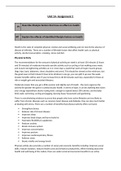
CCNA 1 Final Exam Study Guide 100% Pass
CCNA 1 Final Exam Study Guide 100% Pass characteristics of fault tolerant network Redundancy Qos mechanisms for priorities With a QoS policy in place, the router can manage the flow of data and voice traffic, giving priority to voice communications if the network experiences congestion. Benefits of using cloud computing can be accessed from anywhere, less space, cheaper, lower overhead function of the shell in an OS to act as an intermediary between user and OS through GUI or CLI SSH Secure Shell (SSH) - SSH is a method for remotely establishing a secure CLI connection through a virtual interface, over a network. Unlike a console connection, SSH connections require active networking services on the device including an active interface configured with an address. SSH is the recommended method for remote management because it provides a secure connection. SSH provides encrypted password authentication and transport of session data. This keeps the user ID, password, and the details of the management session private. Most versions of Cisco IOS include an SSH server and an SSH client that can be used to establish SSH sessions with other devices. modes of operation User EXEC Mode ">" This mode has limited capabilities but is useful for basic operations. It allows only a limited number of basic monitoring commands but does not allow the execution of any commands that might change the configuration of the device. The user EXEC mode is identified by the CLI prompt that ends with the > symbol. Privileged EXEC Mode "#" To execute configuration commands, a network administrator must access privileged EXEC mode. Higher configuration modes, like global configuration mode, can only be reached from privileged EXEC mode. The privileged EXEC mode can be identified by the prompt ending with the # symbol. Ctrl-Shft-6 key command All purpose break sequence. used to abort DNS lookups, traceroutes and pings. interface VLAN1 Cisco IOS Layer 2 switches have physical ports for devices to connect. These ports do not support Layer 3 IP addresses. Therefore, switches have one or more switch virtual interfaces (SVIs). These are virtual interfaces because there is no physical hardware on the device associated with it. An SVI is created in software. The virtual interface provides a means to remotely manage a switch over a network using IPv4. Each switch comes with one SVI appearing in the default configuration "out-of-the-box." The default SVI is interface VLAN1. TCP - Layer 4 protocol, responsibilities in the network communication process advantages of open protocol encourages competition and promotes choices benefits of layered model assists in protocol design prevents technology in one layer from affecting other layers OSI model Vs TCP/IP Model layers name of the transport layer PDU segment NIC has responsibilities in both layer 1 and 2 - purpose of the physical layer factors that cause throughput mismatch the specified bandwidth of physical links characteristic of UTP cabling cancellation characteristic of of LLC sublayer characteristic of fiber-optic cable not affected by EMI or RFI more expensive than UTP WAN topologies - partial mesh topologies provides high availability and connects some, but not all, remote sites LAN topologies - carrier sense multiple access with collision avoidance (CSMA/CA) three primary functions provided by Layer 2 data encapsulation data link layer addressing detection of errors through CRC calc delimiting groups of bits into frames ethernet MAC address store and forward switching receives entire frame and performs CRC check to detect errors before forwarding frame layer 2 frame header content addresses mapped by ARP services provided by the OSI network layer table analysis two functions of NVRAM retain contents when power is removed store the startup configuration file configure initial settings dotted decimal representation of the IPv4 address three characteristics of multicast transmission *a single packet can be sent to a group of hosts *multicast transmissions can be used by routers to exchange routing information *routers will not forward multicast addresses in the range of 224.0.0.0 to 224.0.0.255 three ranges of IP address that are reserved for internal private use 10.0.0.0 127. 192.168.0.0 NAT64 purpose on IPv6 converts ipv6 to ipv4 most compressed format IPv6 range of link-local addresses FE80::1/10 number of valid host addresses on an IPv4 subnet that is configured with a /26 mask subnet mask for the site must accommodate 126 hosts 255.255.255.128 is 192.168.1.61/26 the subnet to include 192.168.1.96 VLSM The use of the source and destination port numbers TCP and UDP overview - port number is used as the destination port number two ways that the TCP uses the sequence numbers in a segment functions of the presentation layer key characteristics of the peer-to-peer networking model Nslookup, traceroute, ipconfig, and netstat utilities top-level domains * .com DHCP address features DHCP protocol, CSMA/CD, ICMP, SNMP, and FTP A trojan horse, viruses and worm features login block-for, exec-timeout, service password-encryption and banner motd commands
Written for
- Institution
- CCNA - Cisco Certified Network Associate
- Course
- CCNA - Cisco Certified Network Associate
Document information
- Uploaded on
- March 14, 2023
- Number of pages
- 8
- Written in
- 2022/2023
- Type
- Exam (elaborations)
- Contains
- Questions & answers
Subjects
-
ccna 1 final exam study guide 100 pass

Also available in package deal