Guyton and Hall, Medical Physiology, Ch 1 Notes study guide
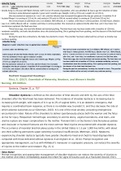
Chp. 1 Physiology – science that seeks to explain physical and chemical mechanisms responsible for the origin, development, and progression of life Cells are the Living Units of the Body Organ – aggregate of many different cells All cells have certain basic characteristics that are alike o I.e. general chemical mechanisms for delivering energy are the same Extracellular Fluid – the Internal Environment 60% of the human body is fluid Extracellular fluid – ions and nutrients needed by cells to maintain life The ECF contains large amounts of Na, Chloride, and Bicarbonate ions o Also oxygen, glucose, fatty acids, amino acids, and carbon dioxide The ICF contains large amounts of K, Mg, and phosphate ions Homeostasis – Maintenance of a Nearly Constant Internal Environment Homeostasis – maintenance of nearly constant condition in the internal environments Powerful control systems exist for maintaining the concentration of Na and H ions, as well as other important substances Disease – often considered a state of disrupted homeostasis o Even in the presence of disease, homeostatic mechanisms remain in place Pathophysiology – explains how various physiological process are altered in disease/injury Extracellular Fluid Transport and Mixing System – the Blood Circulatory System ECF is transported through the body in two stages o 1. Movement of blood through the body in blood vessels o 2. Movement of fluid between blood capillaries and intercellular spaces Circulatory System: Left lung left heart pump gut (nutrition and excretion) kidneys (regulation of electrolytes) arterial end capillaries venous end right heart pump right lung Fluids diffuse and constituents dissolve through the capillary walls and interstitial spaces This study source was downloaded by from CourseH on :33:40 GMT -05:00 Origins of Nutrients – Respiratory System Blood picks up oxygen in the alveoli Alveolar membrane – membrane between alveoli and lumen of pulmonary capillaries o 0.4 – 2.0 micrometers thick o Oxygen can diffuse rapidly via molecular motion Origins of Nutrients – GI Tract Site where dissolved nutrients (carbohydrates, fatty acids, amino acids) are absorbed from ingested food into the ECF of blood Origins of Nutrients – Liver/ Other Primarily Metabolic Organs Not all GI absorbed substances can be used in absorbed form by cells Liver – changes chemical compositions of substances to more usable o Along with fat cells, GI mucosa, kidneys, and endocrine glands o Also eliminates certain waste products produced in the body and ingested toxins Origins of Nutrients – Musculoskeletal System Without muscles, the body could not move to obtain foods required for nutrition Provides motility for protections against adverse surroundings Removal of Carbon Di
Written for
- Institution
-
Tulane University
- Module
-
CELL 3891
Document information
- Uploaded on
- March 14, 2023
- Number of pages
- 6
- Written in
- 2022/2023
- Type
- Exam (elaborations)
- Contains
- Unknown