Creative Writing
Story Arc
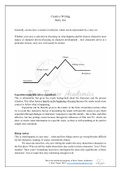
Generally, stories have a similar overall plot, which can be represented by a story arc.
Whether your story is plot driven (focusing on what happens and the choices characters must
make), or character driven (focusing on character development – how characters arrive at a
particular choice), story arcs will usually be similar.
Climax
Falling Action
Rising Action
Resolution
Exposition
Exposition (hopefully clever exposition)
This is information that gives the reader background about the characters and the present
situation. This often features heavily at the beginning of a story because the reader needs some
context to follow what is happening.
Exposition can be literally given to the reader, in the form of narration (writers often
try to avoid this, instead in favour of presenting the reader with specific scenes to give them
exposition through dialogue or characters’ responses to specific stimuli – this is fine, and often
effective, but has perhaps arisen because through the influences of film and TV, which can
show so much visual information in a specific scene, so there is still something to be said for
simple story narration).
Rising Action
This is what happens in your story – when and how things start to go wrong/become difficult
for the characters, leading, of course, towards the climax.
We must ask ourselves, why am I telling the reader this story about these characters in
the first place? Why not tell the reader about three days earlier in these characters’ lives? Three
months? Three years? Something must have interrupted the stasis (the equilibrium) of these
characters’ lives to make this story interesting enough to tell.
This is the intellectual property of Ross Turner Academics
© Ross Turner 2023 | www.rossturneracademics.com