OVERVIEW
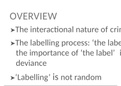
➤The interactional nature of crim
➤The labelling process: ‘the labe
the importance of ‘the label’ i
deviance
➤‘Labelling’ is not random
,CONCLUDING REMARKS
➤From “criminology” to “sociology
➤Relevance as a theory today? – ba
➤Contemporary examples
➤What about the victims of crime?
the labelling process?
,CONTEXT =
DURKHEIM
Social functionalist perspective
➤ Crime outrages society
➤ Society labels acts that outrage them (inc
➤ Labelling of deviants satisfies the outrage
need to control deviant behaviour
,CONTEXT = 1960’S
CRIMINOLOGY
➤ Questioning of the status quo, turning aw
explained crime in terms of characteristi
structure orthe characteristics of neighbo
➤ Focus on who makes the criminal law in t
and why?
➤ The definitional power of the criminal law
➤ Is law breaking the most important criter
,ROOTS = ‘SYMBOLIC
INTERACTIONISM
➤ Emerged in Chicago - ’ of George Herbe
work
➤ The ‘self’ = a process – an interplay between tw
➤ ‘I’ and the ‘Me’
➤ Understand how meanings are assigned to tho
product of people’s interactions
➤ A person’s self-image = constructed by interacti
awareness of how others see them
, THEORY =
LABELLING
➤ Look at the processes through which certain
categorise the behaviour of others
➤ Argue that people given a certain label are st
are responded to by others accordingly
➤ Such social stereotyping is seen to reinforce
the behaviour it is designed to prevent
➤ Labelling theories focus on the ways in which
deviant, and the implications of such definiti
➤The interactional nature of crim
➤The labelling process: ‘the labe
the importance of ‘the label’ i
deviance
➤‘Labelling’ is not random
,CONCLUDING REMARKS
➤From “criminology” to “sociology
➤Relevance as a theory today? – ba
➤Contemporary examples
➤What about the victims of crime?
the labelling process?
,CONTEXT =
DURKHEIM
Social functionalist perspective
➤ Crime outrages society
➤ Society labels acts that outrage them (inc
➤ Labelling of deviants satisfies the outrage
need to control deviant behaviour
,CONTEXT = 1960’S
CRIMINOLOGY
➤ Questioning of the status quo, turning aw
explained crime in terms of characteristi
structure orthe characteristics of neighbo
➤ Focus on who makes the criminal law in t
and why?
➤ The definitional power of the criminal law
➤ Is law breaking the most important criter
,ROOTS = ‘SYMBOLIC
INTERACTIONISM
➤ Emerged in Chicago - ’ of George Herbe
work
➤ The ‘self’ = a process – an interplay between tw
➤ ‘I’ and the ‘Me’
➤ Understand how meanings are assigned to tho
product of people’s interactions
➤ A person’s self-image = constructed by interacti
awareness of how others see them
, THEORY =
LABELLING
➤ Look at the processes through which certain
categorise the behaviour of others
➤ Argue that people given a certain label are st
are responded to by others accordingly
➤ Such social stereotyping is seen to reinforce
the behaviour it is designed to prevent
➤ Labelling theories focus on the ways in which
deviant, and the implications of such definiti